


All posts by Robert Estrin

What is a Concert Grand Piano?

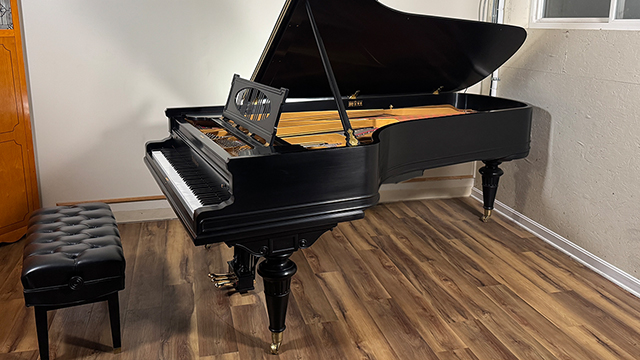
You’ve probably heard the term “Concert Grand Piano” many times in the past and you might have wondered if there is something fundamentally different about a piano that would classify it as a “concert grand” instead of just a regular grand. So what does this term mean?

In some cases the term concert grand is used loosely by people to describe concert level grand pianos they might own. It sounds right, doesn’t it? They have a grand piano and it’s a concert level instrument, so it’s should be safe to call it a concert grand piano, right? Technically, no.

While there are concert level instruments that are smaller than typical concert grand pianos, they are not actually concert grand pianos! Standard concert grand pianos are around 9 feet long. The reason this term is designated to pianos of this size is because in a concert setting, particularly where a piano is used with a symphony orchestra, it will need to be this size in order to produce the volume needed to balance with the orchestra. Concert grand pianos are the standard for Classical performances and recording.

In certain cases where a concert grand piano simply won’t fit in a location or is impractical for a performance (such as with a chamber group where the volume could be overwhelming), a semi-concert grand piano might be an appropriate fit. These pianos are typically around 7 feet long and are fairly close to the sound and feel of concert grands.

So what makes concert grand pianos different from their counterparts? Is it just the size and the sound? There is actually a great deal that differentiates them from smaller pianos.

When I was a student in music conservatory and I was going to practice, I would always peek into the recital hall to see if either of the two concert grand pianos were available because even a few minutes of practice on one of the concert grands would benefit my practice tremendously because of primarily two things: the touch and the sound.

The touch of a concert grand piano is different from a standard grand piano. This is because the keys are longer on a concert grand. It’s not the part of the keys you see, but what’s behind the fallboard. In fact, when you go from a baby grand, to a parlor grand, to a grand and so on up to a concert grand, the keys get longer and longer as you progress to larger instruments. This makes a difference in the feel because on smaller pianos it is more difficult to press the keys down the closer you get to the fallboard. This is because the keys of pianos function like a seesaw. When you are closer to the middle, it’s harder to push down. Since concert grand pianos have longer keys, they have a more even feel from the front to the back of the keys. However, you will also be moving more mass which produces a more formidable feel.

The sound of a concert grand can be an ideal scale design. Smaller pianos offer compromises in sound and touch. Only on concert grand pianos do the strings get longer and longer as you go down the bass on the instrument. On grand and baby grand pianos, the strings are roughly the same length on the bottom half of the keyboard. Therefore, lower notes lack the purity of the fundamental pitch of a concert grand and and produce strong overtones which color the sound.

The tone also develops slower on concert grands than on smaller pianos. I’ve found through my personal experiences that I tend to play slower on concert grand pianos because the tone lasts so much longer, particularly in the bass and tenor registers. If you have the opportunity to play a concert grand piano you should certainly try one out and see how it differs from pianos you are used to.

Thanks again for joining me here at Living Pianos. If you have any questions about this topic or any topic at all please contact us directly: Info@LivingPianos.com (949) 244-3729

5 Essentials of Piano Practice

Over the years I’ve made a lot of videos about pianos and practicing piano. Today I’m going to provide a concise list of some areas to focus on during your development as a pianist and give some examples of past lessons you can refer to.

1. Memorize, Memorize, Memorize!

One of the most important aspects to practicing the piano and developing as a musician is to spend time on a regular basis memorizing music. I can’t stress enough how important this is and how it is often neglected. Any pianist specializing in solo classical music must spend a vast amounts of time memorizing music.

The amount of music in the world is endless and nobody can memorize all of it. But if you spend time on a daily basis memorizing music, you will develop security and mastery of performance. Not only will you expand your repertoire, you’ll be giving your brain a workout and you will spend more time focusing on how to play your music rather than what you have to play.

My video on how to memorize music is a great resource for you:

2. Sight Reading

Sight Reading is another crucial element to your development as a pianist and is another topic that is often overlooked. Wouldn’t it be great to explore new repertoire and try it out before you commit a significant amount of time learning it? That’s where sight reading becomes incredibly beneficial.

Developing your sight reading is very important and if you work on it regularly, you will continually improve. The following video has tips to improve your sight reading:

3. Playing With Other Musicians

Playing music with other musicians is not only fun, it’s a necessary experience in developing your own skills. Even if your primary interest is playing solo piano, you should seek out opportunities to play with other musicians and do it as often as possible.

There is no need to be intimidated by playing with musicians who are better than you are. In fact, this is one of the best ways to advance your scope as a musician. Even if they play other instruments, examining their sense of style, phrasing, timing and other aspects of their playing can help you develop a new depth of understanding to music.

Sight reading might be incredibly difficult on your own as you will find yourself starting and stopping when you make mistakes. When you sight read with other musicians, you will be forced to recover and you won’t be able to stop playing. It forces you to become a better at sight reading!

If you need help in learning how to accompany other musicians I highly recommend this video that I produced with my wife Florence Estrin (a concert flutist).

4. Improvise Often and Don’t be Afraid to Explore New Styles of Music

Improvising is so important to understanding your music and gaining a new depth of understanding about how it’s constructed. Many styles of music such as rock and jazz rely on improvisation as a key element to the music and encourages musicians to create something new and interesting every time they perform. Developing your improvisation skills (even with classical music) is a crucial element to becoming a better and more well-rounded musician.

Exploring new styles of music enables you to experience and understand styles you might not have been aware of; it can also be a great deal of fun! I’m a classical pianist but when I’ve been at parties with other musicians and played blues music, it’s been a great deal of fun and an incredible learning experience to improvise with them and learn how they approach music.

Improvising is also a universal language. If you learn how to read a lead sheet for jazz standards, you can take that anywhere in the world, to play with any musicians. Spoken language is not a barrier for musical performance!

Never improvised on the piano before? No problem, check out this video to get some great tips on where to begin:

5. Practice Mentally

This is something that people might not ever think of. Practicing mentally away from your instrument can offer benefits not possible while playing your instrument. Playing music requires a thought process and there are tremendous benefits to thinking through your music.

Let’s say you’re waiting in line at the grocery store. You can practice your music mentally by thinking through a piece with every nuance of performance without any physical restrictions. Going through your music when you are away from your instrument allows you to think about it in a different light. Naturally, practicing with your instrument is essential, but you may rely on motor memory rather than the music. Practicing mentally allows you to think through your music playing it exactly as you want.

This can have tremendous benefits strengthening your memory. Just play through your music in your mind and see how far you get. You can always refer to the score to clarify the comprehension of the score.

I hope this is helpful and if you have any questions about this topic or any other, please email me Robert@LivingPianos.com for more information.

Piano Lessons: Approaching Beethoven’s Sonata Op. 49 No. 2

This is a great piece of music for students to learn. It is not a simple piece of music by any means, but it’s one of the easiest Beethoven Sonatas to learn and it is a substantial work. It’s interesting to know that the Op. 49 sonatas were composed much earlier than the opus number would indicate. However, they were published later.

There are many aspects to approaching Beethoven’s works that can be applied to this piece. It’s very important to play with a regular beat. So, practicing with the metronome is invaluable with Beethoven. It can make life much easier to memorize the piece first. Classical period music is not particularly hard to memorize and I have a video on the subject you can watch.

What techniques can you use in your practice of this work and other pieces of Beethoven?

You should practice in chords whenever possible. Learning to play your music in chords can be very beneficial. This aids in a number of ways. First, by reducing the music to chords, you will understand the harmonies. More than that, you will discover fingerings that accommodate the notes well. It also makes it easier to learn.

It’s important to bring out the melody which is typically in the right hand. One technique for achieving this is to play the accompanying parts staccato with a light wrist when the texture allows for it.

Another important aspect of practicing effectively is to work out your trills. It isn’t important to play a large number of notes. It is essential that you work out exactly the number of notes you can play with confidence. This will result in a musical execution.

Beethoven didn’t write out many of the dynamics in this piece. However, many editions offer suggestions for expression. For example, you can start this piece forte. In different editions of the piece, people will suggest certain dynamics and while no version is necessarily better than others, you should find something to create contrasts with the music to keep the performance compelling.

Obviously, these are not the only aspects to learning this piece or any work of Beethoven. But they will provide a good foundation for progressing through the music to bring it to a higher level.

Thanks again for joining us here at Living Pianos. If you have any questions about this topic or any others, please contact us at: Info@LivingPianos.com (949) 244-3729
What are Double Stemmed Notes?

I just recently received this question from a viewer and I thought it would be a good thing to address. If you play piano – or other polyphonic instruments – you probably have seen these before:

If you’re a singer or you play the flute, clarinet, trumpet, or perform another monophonic instrument you may have never seen these before in your notation.

These notes typically only occur in polyphonic writing. For example, on the piano you have multiple parts and sometimes you will have two different parts that play the same note. Imagine for example if there was a choir and there was the same note being sung between both the altos and the sopranos. Instead of writing the note twice, it would be easier to write the note on the same line and just add a line going up for the soprano and down for the alto.

Sometimes you might even see double stem notes for different rhythms. You might have a half note and a quarter note on the same note. This might sound confusing and it can be but it’s best to break down the music and understand how it is supposed to sound.

Hopefully this clears up the mystery for some of you out there! Thanks again for joining me Robert Estrin Robert@LivingPianos.com

The Half-Pedal Technique for Piano

Welcome to another video in our series on the Art of Pedaling. In the first video we covered the Right Pedal (Damper Pedal). Next we covered How to Use the Pedal to Add Color to Your Music and last time we addressed Special Uses for the Pedals. Today we are going to cover half-pedaling. So what is half-pedaling and how can you use it in your playing?

Pedaling really is an art form and half-pedaling is an advanced technique that can add a lot of depth to your music if employed creatively. In the video I use the Chopin Ballade in G minor to demonstrate this technique. There is a gorgeous theme in the middle section of this piece that perfectly captures what half-pedaling can bring to your music.

As I have mentioned in past videos, it is essential that you Practice Your Music Without Using the Pedal. Playing this piece by Chopin without the pedal is going to be a huge challenge but it’s very beneficial for you to understand where and how to employ the pedal by practicing without it first learning how to connect as much as possible with your hands.

As I mentioned in the past videos in this series, you’ll want to change the pedal when harmonies change. This technique involves releasing the pedal as soon as harmonies change and then pushing it right back down. This produces a clean sound. With half-pedaling you can create richness in key melody notes while minimizing lower notes avoiding a muddy sound.

The pedal does not have to be completely on or off. Experimenting with the amount of pedal is a great way to enhance your music. Using the half-pedal technique (by not pushing the pedal all the way down) you can capture the amount of sustain applicable to the sound you are after. You will hear that you can enhance the sound of particular notes by using different amounts of pedal. Experiment and see what you can come up with.

Keep in mind that every piano you play will have different characteristics. The pedal is never the same on any two pianos. Room acoustics also affect the sound. So, getting to know and experiment with your piano is essential to improving the sound of your music.

Thanks again for joining me Robert Estrin Robert@LivingPianos.com (949) 244-3729

What is a Concerto?

The Concerto goes back centuries and is a very important musical form. You might have seen my video on What is a Sonata?; This is a good follow up.

When we talked about Sonatas, I referred to the famous C Major Sonata K545 of Mozart. We discussed the structure of a Sonata extensively in the last video and we talked about how Sonatas can be written for any instrument and usually feature piano accompaniment.

A concerto, by contrast, is a piece of music written for a solo instrument or a small group of instruments along with a symphony orchestra. Symphony concerts often feature soloists at the start of the second half of the program. You will usually see a pianist or a violinist playing solo in front of the orchestra as they back them up. In the Baroque era, Bach wrote the Brandenburg Concertos for small groups of instruments accompanied by a small orchestra. There are countless Classical and Romantic period concertos which feature more than one soloist with an orchestra as well.

Many of you are probably familiar with the famous Tchaikovsky B flat minor Piano Concerto which starts with the thunderous chords on the piano. (You can hear them in the video example provided above.) While the piano is playing these huge chords, the orchestra is playing a beautiful melody which accompanies it.

There is a structural similarity between Sonatas and Concertos that is significant. Concertos are often written in the Sonata-Allegro form! If you want a detailed explanation of this please check out the link for the Sonata video provided above.

Thanks again for joining me, Robert Estrin: Robert@LivingPianos.com (949) 244-3729