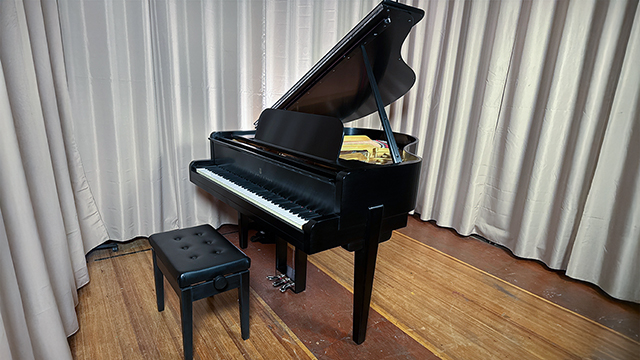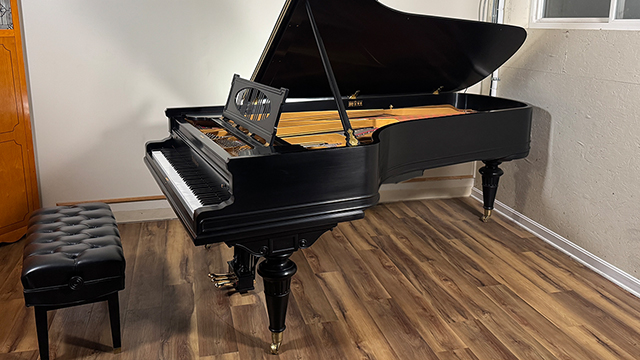


Welcome to LivingPianos.com. I’m Robert Estrin. Today we’re going to explore a fascinating question about piano tone and design. Did we lose something when piano builders moved from straight-strung pianos to overstrung, or cross-strung, designs? You’re going to hear the difference for yourself by listening to the same Chopin excerpt played on two very different instruments: a meticulously restored 1870 Chickering concert grand and a 20th-century Baldwin with a modern scale design. By comparing these instruments directly, using the same music and the same recording setup, you can decide what you hear and what you prefer.
What Is Cross-Stringing?
First of all, what is cross-stringing anyway? Cross-stringing was an attempt by piano builders to fit longer strings into smaller instruments. The idea actually dates back to the 1820s, when a piano builder named Jean-Henri Pape experimented with crossing strings over one another inside a very small cabinet. By using two bridges, with strings running in different directions, he was able to achieve greater string length in a compact piano.
The Rise of Cross-Stringed Pianos
It wasn’t until the 1850s that cross-stringing really took hold. Steinway introduced a square grand piano with cross-stringing, and that innovation marked the beginning of the end for straight-strung pianos. By the end of the 1800s, nearly all pianos were being built with cross-stringing. This allowed not only for longer strings, but also for bridges to be placed more centrally on the soundboard, improving sound transmission.
The Hidden Trade-Off
In straight-strung pianos, many of the strings sit around the perimeter of the soundboard. Cross-stringing solves that issue, but it introduces a new challenge. There can be noticeable tonal differences where the strings transition from one bridge to another. This is one reason why some pianists, including Daniel Barenboim, have renewed interest in straight-strung instruments and are working with modern builders, such as Chris Maene in Belgium, to recreate historically accurate designs.
Hearing the Difference on a Modern Piano
To demonstrate this, let’s look at a Steinway Model S, which, like nearly all modern pianos, is cross-strung. On this piano, the strings switch from one bridge to another between B and B-flat. If you listen carefully, you can hear a change in tone between those two notes. The tonal continuity is interrupted right at the bridge transition.
How Manufacturers Try to Minimize the Problem
Piano makers have worked hard to reduce this inherent issue in cross-stringed designs. On the Steinway Model S, for example, the scale transitions from three plain steel strings to two copper-wound strings between E-flat and D. There is a subtle tonal change there as well, but it’s far less dramatic than the change that occurs when the strings move from one bridge to another.
Why This Matters for Romantic-Era Music
This is exactly why some pianists prefer historically accurate instruments for music written in the 1800s. The tonal continuity of straight-strung pianos can be especially well suited to composers like Chopin. To illustrate this, you’ll hear a short Chopin excerpt recorded at the same point in the music on both pianos, using the same microphones and identical recording conditions. Check out the video to hear the differences for yourself!
What Do You Hear?
I’m very interested in your opinion of what you’ve just heard. There’s no right or wrong answer here. What matters is what you prefer and what sonic differences stand out to you. Do you hear greater smoothness and continuity, or do you prefer the power and projection of the modern design?
The Pros and Cons of Cross-Stringing
To be clear, cross-stringing has real benefits. You get longer strings, more centrally located bridges, and greater efficiency in soundboard vibration. But you also lose some continuity and smoothness from the top of the keyboard to the bottom, and there is undeniably a change in tone.
I’d love to hear your thoughts, so please leave your comments here at LivingPianos.com. Let’s get the conversation going!