


Piano and Music Videos

Can't find what you're looking for?

You may have heard the term “Asian Production Pianos.” What does that mean? Here is some historical context. The piano industry started in Europe centuries ago offering hand-built pianos from many manufacturers. Eventually manufacturing migrated to the United States which had well over 1,000 companies making pianos a century ago. The Japanese followed with the giants, Yamaha and Kawai. This is when the scale of production increased to a point where technologies were employed to produce massive numbers of pianos which would be classified as “Asian Production Pianos”. Later the Koreans produced pianos including Samick and Young Chang. Today, hundreds of companies in China are manufacturing pianos. The vast majority of these pianos are production pianos meaning that they produce vast numbers of instruments.

Just because pianos are made in Asia does not necessarily mean that they are Asian production pianos. Here is an example: Yamaha is a very large piano manufacturer and they make many pianos and many of them would be classified as Asian production pianos. Even their CX series would be in my opinion classified as an Asian production piano. This simply means that they make a lot of them! When you take a company like Mason Hamlin which only make around 100 to 150 pianos a year and European companies like Sauter which make a only a few hundred pianos a year, these are hand-crafted pianos. Steinway is the most notable example of hand-built pianos of the highest order.

When it comes to production pianos, Pearl River would be a classic example. Last year they made around 130,000 pianos! Obviously, there have to be technologies employed to this massive scale of production from seasoning woods to crafting actions with thousands of parts. Just one of their factories is over 1 million square feet ! So, that is a great example of an Asian production piano. However, Pearl River does have other name brands they sell in more limited quantities with more hand work.

When it comes to Yamaha, just because it’s a Yamaha doesn’t mean that it’s an Asian production piano. They have their CF and SX series which are hand built pianos. I would not classify these as Asian production pianos even though they are produced by Yamaha. They are handmade in limited production in separate factories from where they make their other pianos such as the CX series.

They also have pianos they make on the other end of the spectrum that they build in factories in Indonesia which are certainly Asian production pianos. These are price point pianos which service the entry level market for baby grand and upright pianos. They may not be heirloom pianos, but they serve a very important function in the market. I hope this has been helpful for you! This is Robert Estrin at LivingPianos.com – your online piano store. 949-244-3729 info@LivingPianos.com

What are Asian Production Pianos?

You may have heard the term “Asian Production Pianos.” What does that mean? Here is some historical context. The piano industry started in Europe centuries ago offering hand-built pianos from many manufacturers. Eventually manufacturing migrated

How Many Pianos are Sold in the USA?

This is a really good question. There is a simple answer and I’m going to tell you right up front. Last year there were around 30,000 pianos sold in this country. That might sound like a lot or maybe not particularly. If you consider that over one

What’s the Biggest Piano Maker in the World?

China has more companies producing pianos than there are piano stores in the United States! The largest piano manufacturer in China is Pearl River. They have several factories and they just put a new factory online over a year ago that has 1.2 millio

Has anyone ever made a backwards piano? Shouldn’t left handed people have a go of it with a piano where the high keys are on the bottom and the low keys are on the top? It seems like a crazy idea but indeed, the Dutch team Poletti and Tuinman built such a piano. I think about the fact that we’ve learned how to play piano as it is, what an arduous task it would be to relearn the piano!

Famously, there are some guitar players such as Jimi Hendrix who played guitar flipped over. Some players even reversed the strings – and that’s interesting enough! But here’s an interesting fact: You can actually try out a backwards piano! How can this be? There is music software available which I first utilized back in the 1990s from Mark of the Unicorn called, Performer. It had a function where you could set the MIDI keyboard controller to play the notes in reverse order from top to bottom. I found it so fascinating to hear pieces played upside down! One of the facts of inverting music is that everything major becomes minor and everything minor becomes major. As a result, you get really interesting music. It’s like hearing an entirely fresh piece with a totally different emotional content that can still work heard upside down!

If you ever get a chance to play an upside down keyboard, which is probably going to be through MIDI because it’s hard to find any actual pianos built that way, you’re going to find that you can play pieces you know and have refreshing new compositions you can play instantly almost like whole new pieces!

The bottom line is this, you need some conventions in the world. For example, in your country, you know what side of the street to drive on. Imagine how haphazard it would be otherwise. It’s the same thing with the piano. To relearn everything would be an arduous task. Indeed, with the piano you have to be ambidextrous anyway because both hands have an equal role to play. But it is certainly fascinating playing such a piano.

Thanks for joining me, Robert Estrin here at LivingPianos.com. info@livingpianos.com

The Backwards Piano – A Left-Handed Piano?

Has anyone ever made a backwards piano? Shouldn’t left handed people have a go of it with a piano where the high keys are on the bottom and the low keys are on the top? It seems like a crazy idea but indeed, the Dutch team Poletti and Tuinman built

Do pianists hit the fallboard when they play the piano? Whenever I bring this up, almost anyone I know who plays the piano says they don’t hit the fallboard when playing. Yet, if you go to a music conservatory or look at a serious pianist’s piano, the fallboard will be compromised and have scratch marks. My father’s pianos were both gouged out to the wood across almost the entire fallboard! You might wonder how this happens.

My father had large hands. So, it’s somewhat expected that his hands would hit the fallboard from time to time. I have rather small hands. Yet, every piano I practice on shows signs of wear on the fallboard and we have to constantly refresh the finish on our fallboards to remove scratch marks.

What happens when you’re playing is that although you are not thinking about hitting the fallboard, it’s right there and even though you may not realize it, you’re actually hitting it all the time! If you were to put a slow-motion camera right by the fallboard, you would indeed see that you are hitting the fallboard!

If you have a piano with a satin finish, in particular, take a close look and you’ll see lines where your fingers are indeed coming in contact with the fallboard surface. If you practice a great deal over many years, you eventually will get down to the raw wood which I’ve seen many times from concert pianist’s pianos.

So the answer to this question is a resounding, “Yes”, you do hit the fallboard when you play. Hope you have enjoyed this – Robert@LivingPianos.com.

Do You Hit the Fallboard on Your Piano?

Do pianists hit the fallboard when they play the piano? Whenever I bring this up, almost anyone I know who plays the piano says they don’t hit the fallboard when playing. Yet, if you go to a music conservatory or look at a serious pianist’s p

Today we are going to delve into a topic that you may be fascinated to learn about. We are all familiar with the traditional piano keyboard and the traditional method of reading and writing musical notation. But believe it or not, there are alternative systems to both of these that have existed for quite some time.

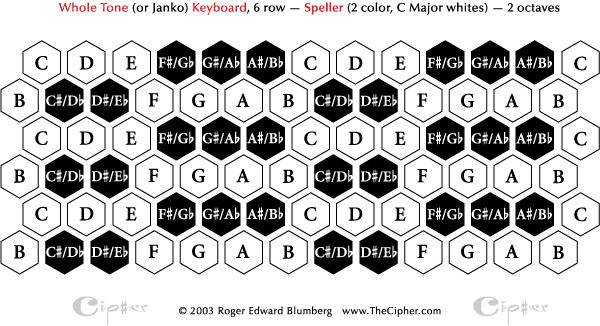
Everyone knows what a traditional piano keyboard looks like since we’ve all grown up with them and are familiar with how the keys are arranged. In 1882, a new type of keyboard known as the Janko Keyboard was invented.

It was supposed to be superior to the traditional piano keyboard since it was oriented both horizontally and vertically – somewhat like a typewriter or computer keyboard. So, when you want to reach higher octaves you just have to go up and down the keyboard instead of making large leaps left and right. The other interesting thing is that all scales have similar fingering!

So why didn’t this keyboard take off and replace the original one we all know? Some people claim that the act of watching someone perform on the piano and performing large leaps added an exciting visual element that would be lost on a keyboard like this; and those actions (despite being challenging to the performer) bring life to a performance and excite the audience.

I believe that this alternative keyboard may not offer the same level of power as a traditional piano keyboard particularly when handling large leaps.

As for alternative system of notation, there are a number of different notation types that exist such as leadsheet notation and the Nashville number system that are less new forms of notation as they are shortcuts to simplifying musical notation for improvised types of music.

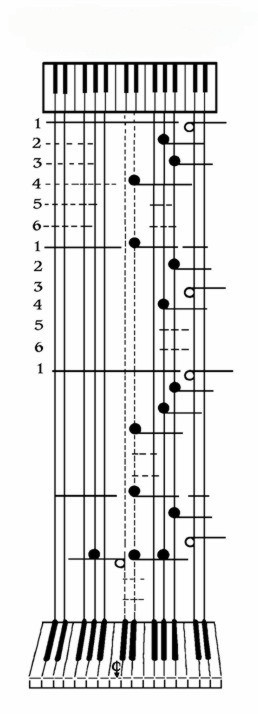
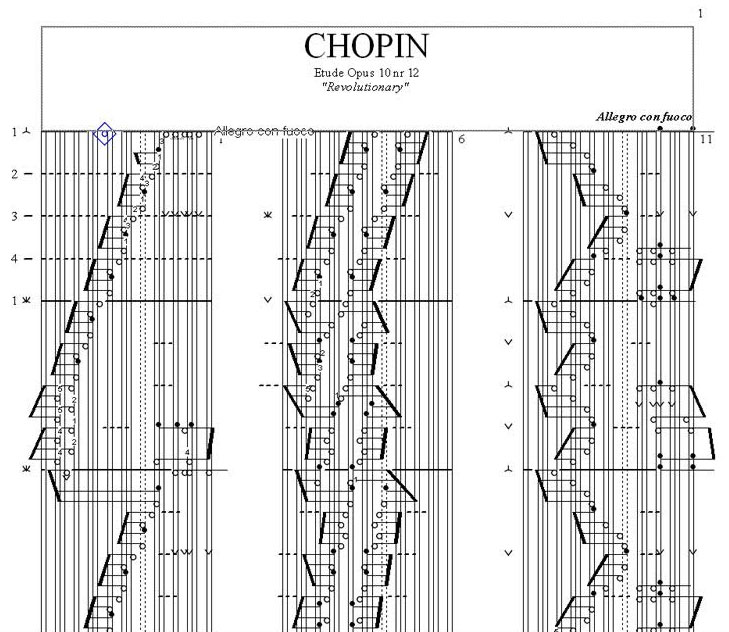
There actually is an alternative form of musical notation developed that has notes oriented differently on the page. It is called The Klavarskribo System.

A lot of people new to reading music find it confusing that the piano keys are oriented left to right, yet the lines in the music are horizontal. The Klavarskribo system attempts to eliminate this confusion by having the lines of the staff line up with the notes on the keyboard.

As you can see, the lines go vertically and match up with the keys on the piano. So if this is easier to read, why isn’t more music created with the Klavarskribo system?

It’s not until you start breaking it down into more complex sheet music that you see where this system runs into problems. For example, with the lines going vertically, how do you account for ledger lines? How do you cover all the notes? There is a limit to how many lines you can read! You also would have instances of note clusters that can be difficult to read.

While there might be systems out there that simplify or improve upon the systems we have in place, there are issues with these alternative keyboards and systems of notation. When it comes to musical notation, you would have to change the world of music in order to adopt a new form of notation for everyone to agree upon. The traditional one we’ve had has worked for centuries and the idea of simply switching to a new one is a daunting task. Even if it were better and more streamlined, the process of changing everyone over to a new form of musical notation is next to impossible. Just think about how in America we still don’t use the metric system even though it’s adopted by nearly every country in the world; we have tried and failed to convert our system of measurement – the same would probably happen in music.

The simple saying If it ain’t broke, don’t fix it! applies here! These alternative keyboards and forms of notation are interesting, but the systems we have in place work incredibly well – so we’re in good shape!

I hope this is helpful and if you have any questions about this topic or any other, please email me Robert@LivingPianos.com for more information.

Alternative Keyboards and Other Types of Notation

Today we are going to delve into a topic that you may be fascinated to learn about. We are all familiar with the traditional piano keyboard and the traditional method of reading and writing musical notation. But believe it or not, there are alternati