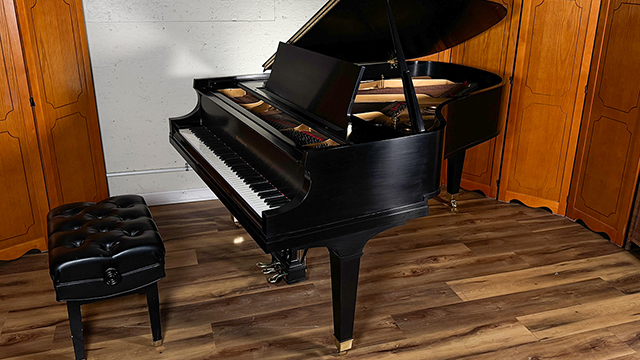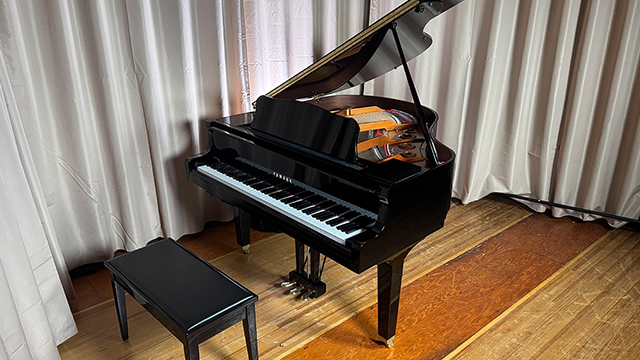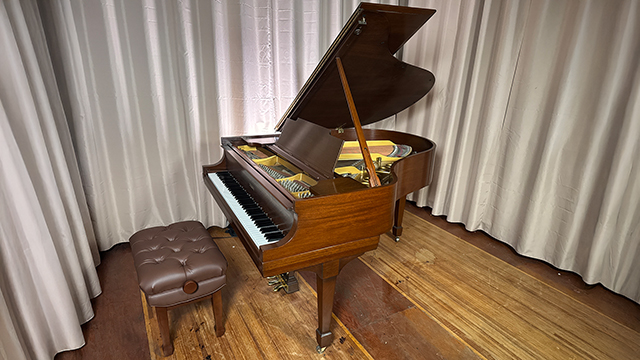


If you play the piano even casually, you probably know that the sustain pedal on the right makes all the notes you play hold until you release the pedal. The other 2 piano pedals are not as clear cut. In fact, only the sustain pedal operates on upright pianos. The other pedals do various things, but seldom what they are designed to do. Even some grand pianos pedals don’t operate the way they are intended.
The left pedal, sometimes referred to as the soft pedal is actually called the une corde pedal for “one string”. Indeed, early pianos had 2 strings for each note and the une corde pedal shifted the action so that the hammers only struck one string. Modern pianos have 3 strings for each note throughout most of the piano. So the une corde pedal shifts the action so that the hammers strike only 2 of the strings squarely. This is significant because it not only makes the notes quieter, but if offers a change of timbre. Upright pianos usually offer a soft pedal that changes the feel, not the sound. It does this by shifting the hammers closer to the strings making it harder to play loud.
The middle pedal is seldom used and even more seldom understood. Most pianos didn’t have functioning sostenuto pedals as they are called until the end of the 19th century. Many European piano manufacturers didn’t include middle piano pedals until well into the 20th century. Like the sustain pedal, the sostenuto pedal holds notes after you release the keys. The difference is that subsequent notes that are depressed will not hold, only the notes that were depressed when the middle pedal is engaged. This is useful in a few scores of Debussy and other 20th century composers. It’s like having a 3rd hand to hold notes in another register without blurring the harmonies with the sustain pedal. However, the sostenuto pedal is only called upon in 20th century music and very few compositions. It is by no means essential but could be important for someone specializing in 20th century piano music.


 Use the metronome: Even in music that has fluidity with the tempo will benefit from metronome practice. You need a reference of time to know how much you are bending the phrase with rubato. Also, when learning difficult passages, it is usual to slow down. Over time you may even overcompensate for difficult passages rushing them. Difficult passages can be mastered by increasing the metronome a notch or 2 at a time to speed up particularly difficult passages.
 Practice in chords when possible: Not only does reducing the music to chords help to clarify the structure, it also helps to figure out the best fingering.
 Use the 80/20 rule: If you focus the majority of your time on the few places that are weak, you will get much better results than practicing equally on all sections of your music.
 While there are many digital pianos on the market for well under $1000, plan on spending $800 in order to get a good weighted action and sound. Yamaha in particular has many models at that price point that are quite good. In fact, spending more offers more features but not necessarily a superior instrument. The exception is the quality of the built in sound system which makes a huge difference in the more expensive models. If you invest in a good stand for stability and utilize a decent quality home stereo system or good computer sound system with sub woofer, you can get very good results without investing thousands of dollars for a high end Clavinova or other digital piano.
 The acoustic piano has the benefit of an almost infinite range of expression. While digitals keep getting better, the complex action, interaction of harmonics, pedal subtleties and expression can be invaluable to an aspiring pianist. If you are taking lessons or are considering taking lessons, it is important to invest enough to achieve a minimum level of performance. Otherwise, I suggest you are better off with a decent piano and no lessons rather than an inferior instrument and lessons. Practicing on a bad piano or inadequate digital piano can make lessons unproductive and become a frustrating experience. We are fortunate at this time in history to have a choice of acoustic or digital pianos.