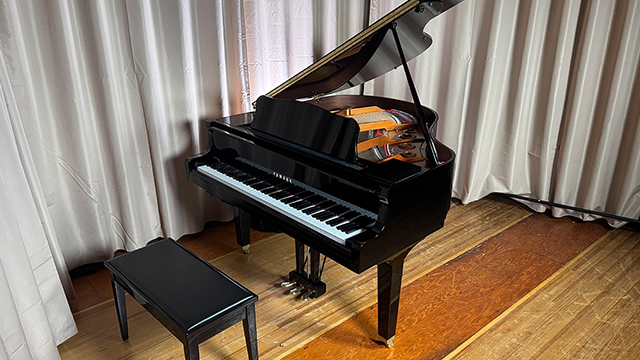
Welcome to LivingPianos.com, I’m Robert Estrin. Today I have a really interesting presentation for you. What happens in a studio after dark? This week we’ve been putting together two whole new studios here. Late last night I walked over to the piano and it sounded so beautiful in my studio I just started recording.
I didn’t even turn the lights on!
I think you’re going to appreciate what I played. Interestingly, this idea of doing things after hours in a recording studio is nothing new. Studio time used to be very expensive, and even today to get a good room with good acoustics and a good piano is tough. A lot of times bands or musicians come in after hours when everything is quiet and dark, and it can be a very inspiring time to make music which you can hear for yourself.
That’s a little bit of what can happen after the studio is closed. You can’t choose when you will be inspired. So, a lot of these things can just go by the wayside and nobody ever gets to experience them because no one’s there. But the beautiful thing about a studio is that you can record! So that’s what I’m going to do for you with my new studios and loyal audience of subscribers, for which I am so grateful! You can join the Living Pianos Patreon to get even more! I figure this is the time to share my music with all of you. I hope you enjoy it!
I’m Robert Estrin here at LivingPianos.com, Your Online Piano Resource.
Please feel free to contact me with any piano related questions for future videos!
Welcome to LivingPianos.com, I’m Robert Estrin. Today’s subject is about the importance of setting goals in your piano practice. There are 3 distinct ways of practicing the piano depending upon what you’re trying to achieve. I have an extended video about this on my Patreon channel, which you’re all welcome to join. But I’m going to give you a little taste of it because it’s so important!
Knowing what you’re trying to achieve is a prerequisite for getting anything accomplished when you sit down to practice.
Whether you’re learning a piece of music to memorize it, or you’re trying to develop your sight reading, or perhaps you are working on improvisation skills, these are all important skill sets. So, here are some tips from my Patreon channel for you.
Piano music is extremely complex compared to almost any other instrument.
You have to have a unique way to approach learning music on the piano. For example, if I were to recite a series of twenty random numerical digits, it would be difficult for you to remember all of them. Even if those numbers were repeated several times, you would still struggle to commit all twenty digits to memory. But if I gave you only three digits, it would be very easy to remember them. Then, I could give you three more digits, and three more after that connecting as you go, you could learn those twenty digits in just a few minutes! Because, there is only a certain amount of information your brain can assimilate at one time. That is the secret to memorizing piano music, or anything else!
Look with your eyes, not your head.
When sight reading music, if you need to glance at your hands, do not move your head. It takes too long. Just look down with your eyes instead. Your eyes are quick! Trust your feel and and your ears when sight reading rather than trying to look at your hands.
Keep Your Eyes on the Score
When I was much younger, my father was performing the Tchaikovsky B-flat minor Piano Concerto at Carnegie Hall. One day he asked me to accompany him in his studio, since he had two pianos. He put the music in front of me and I felt overwhelmed – all those flats and so many notes, a whole orchestral score reduced for the piano! At that time I could barely sight-read anything. But, I just kept my eyes on the score. I missed more notes than I got, but I got through it! I never lost my place in the score. From that moment on, I knew I could read anything, and I’ve been getting more and more of the notes ever since! So, that’s the secret, keeping your eyes on the music. The best way I’ve discovered to have the discipline to do that is playing with other musicians.
This is just a taste of what’s available on Patreon.
I hope this has been enlightening for you! It’s so important to utilize different methods of practice depending upon what you want to accomplish. That’s a really important subject that I wish all teachers would show their students. If you enjoy exploring pianos and piano playing, you may want to join my Patreon family which offers you even more videos and the opportunity to be part of the creative process. These videos are for you!
I’m Robert Estrin here at LivingPianos.com, Your Online Piano Resource.
Please feel free to contact me with any piano related questions for future videos!
Welcome to LivingPianos.com, I’m Robert Estrin. Today’s subject is about how important it is to double check your work when practicing the piano. If you’ve ever seen any of my videos on how I practice, you know I break things down to the smallest parts. I take small sections and study the notes carefully, just in the right hand. I figure out the rhythm. Then I count to make sure everything is secure and figure out the best fingering. Then I study all the other details, the expression, the slurs, the staccatos. I look back and forth dozens of times until I have it securely memorized. Then I do the same long process just with this tiny phrase on the left-hand part until that is secure, going back and forth, double and triple checking. Finally I play both hands together. That’s the hardest part! Naturally, there’s a lot of back and forth in that process making sure it’s right. Then I go on phrase by phrase until I have the whole piece memorized connecting phrase by phrase as I go. After all of that, I go back and study the score agan! I take my foot off the pedal and play through really slowly to double-check my work. And yet, with all of this, I still discover things I didn’t catch in the score!
I recommend going back and forth a great deal, particularly in the formative phase of learning a piece.
As I’ve said so many times before, unlearning is much harder than learning. So you must constantly reference the score at every stage of your practice. Even when you think you have a piece beautifully memorized on performance level, go back to the music and play excruciatingly slowly. I bet you will find things you didn’t know were there. After all, there are tens of thousands of details in even a short piece of music. When you consider notes, rhythm, fingering, phrasing, and expression, it’s mind boggling that we can learn music at all! That’s why I recommend the method that I just described.
Try it for yourself!
So, any of you who have pieces really solid, go through your score as I just mentioned. Go slowly, using no pedal, reading every detail, and see what you discover in the process. I think it will be richly rewarding. Better than that, be sure to double, triple, quadruple check your work as you learn so you don’t have to unlearn things later. It will save you vast amounts of time in the long run.
I hope this is helpful for you! If you enjoy exploring pianos and piano playing, joining my Patreon family www.patreon.com/robertestrin. It will offer you even more videos and the opportunity to be part of the creative process.
I’m Robert Estrin here at LivingPianos.com, Your Online Piano Resource.
Please feel free to contact me with any piano related questions for future videos!
Welcome to LivingPianos.com, I’m Robert Estrin. Today’s subject is, “The Importance of Fingers on The Piano.” It seems obvious. But there are actually three parts of the body that come into play when playing the piano: The fingers, the wrists, and the arms. I have an extended video series on my Patreon channel on this subject. I’m going to give you a free taste today. I hope you enjoy it!
The first thing we have to talk about is how to approach the keyboard.
Sometimes, you see people sitting really close to the piano, and it strangles them. So you want to make sure you’re far enough away. And you don’t want to sit with the bench right behind your knees. You want to be able to have flexibility because sometimes you need to reach from one end of the keyboard to the other. You want to be comfortable!
When you look at the keyboard, you see white keys, and you see black keys. The white keys extend all the way forward. The black keys are set back. But, the white keys also extend all the way back. Why am I bringing this up? This is really important. Often I will see beginning students placing their hands on the keyboard where they can only reach the white keys. Then they have to move their hands in and out for every black key. What you want is to keep your hands at the point at which black and white keys meet. This is the appropriate place to keep your hands, generally.
It’s important to curl your fingers.
If your fingers are stretched out, some are far longer than others. So that’s one of the main reasons for curving your fingers. This way you keep them all in alignment with the keys and you don’t have to go in and out with the thumb every time the thumb has to play. This is very important. It might be obvious to some of you, but this is worthy of mentioning.
You can see there’s so much to piano playing, and identifying what parts of the body come into play is critical for being able to solve technical and musical challenges. I hope this is enjoyable for you. If you enjoy exploring pianos and piano playing, joining my Patreon family will offer you even more videos and the opportunity to be part of the creative process. These videos are for you!
I’m Robert Estrin here at LivingPianos.com, Your Online Piano Resource.
Please feel free to contact me with any piano related questions for future videos!
Welcome to LivingPianos.com, I’m Robert Estrin. Today’s subject is, “Why You Must Find Your Place in the Score When You Make a Mistake.” Say you’re playing a piece and everything’s going fine. Suddenly, you make a mistake you never normally make. So, you just want to go back to the beginning and go through it again. You probably will get through it okay the second time around. But you’re missing an incredible opportunity.
Whatever you missed has some level of insecurity
I know how hard it is to find your place in the score. You just want to go back and pass that point. But if you take some extra time with the music, you can find where the confusion was that caused the problem. This will prevent future problems. You might get it right nine out of ten times, and every time you miss it you go back and think, “I know I can get this.” But when you do go back, you’re missing the opportunity to find out what the problem was and secure the memory so that it never happens again.
My recommendation to you is to take the extra time, even though it is more difficult
I understand how hard it is. It’s even hard for me! Sometimes I’m practicing a piece of music and I lose my place. It’s frustrating. I get it. But I take the time because I know it will help me in the long run. No matter how long it takes, find where you are in the score. That way you’ll be able to forever eradicate the uncertainty you have in that section of the piece. It will never plague you again! I hope this is helpful for you.
I’m Robert Estrin here at LivingPianos.com,Your Online Piano Resource.
Please feel free to contact me with any piano related questions for future videos!
Welcome to LivingPianos.com, I’m Robert Estrin. Today’s subject is, “Tempo Must be the Lowest Common Denominator.” What does this mean? You may hear a performance that starts at a nice fast tempo and everything’s going great. Then the performer gets to a section they don’t know quite as well as the rest of the piece, so they slow down in order to make accommodations. Maybe they’ll speed up again when they get to a part they know better. This is a a terrible way to perform, but I understand the temptation. If you know a piece and you can play most of it at a nice tempo that sounds great, but there are one or more parts that you can’t quite play up to tempo, you might want to play everything up to that point at a good tempo and slow down for the sections you are struggling with. But, in a performance, you never want to do that. So, what can you do in order to correct this?
If there are just a few key sections of a piece that you can’t quite play up to tempo, work on those sections!
Zero in on the parts of the piece you can’t play up to tempo and work with a metronome. Set the metronome at a tempo you can keep up with, then slowly increase the tempo to get those sections up to the speed of the rest of the piece. Better yet, work until you can play them even faster than the rest of the piece! Then the weakest parts of your performance become the strongest parts. But if you ever find yourself in a situation where you don’t have parts of your performance up to speed, you must take a tempo at which you can play the whole piece, including those parts. This is very important if you are performing. At a piano lesson, or something of that nature, it’s not really necessary to do this. A teacher will understand if you haven’t quite gotten everything up to speed yet. But in a performance, be sure to lock in the right tempo!
How do you find the right tempo for your performance?
Think of a piece you’re playing where you have a couple of sections that you have really put work into, but your performance is still not secure. Listen to yourself play it. Then find the speed at which you can play those sections comfortably and make that the tempo of your piece. You will give a much more convincing and satisfying performance that maintains tempo throughout, rather than changing tempo to accommodate parts you can’t play as fast. You might think that it makes you sound less impressive because you can play some other parts so fast. But believe me, it will be much more enjoyable for the listener and they will be more impressed with you for giving a more cohesive performance.
I’m Robert Estrin here at LivingPianos.com, Your Online Piano Resource.
Please feel free to contact me with any piano related questions for future videos!