

Tag Archives: online piano store

Five Signs You Have the Wrong Piano Teacher

Hi, this is Robert Estrin at LivingPianos.com. Today’s subject is, “Five Signs You Have the Wrong Piano Teacher.” Choosing the right piano teacher for yourself or your children can be difficult. Today I will tell you five things to avoid when choosing a teacher.

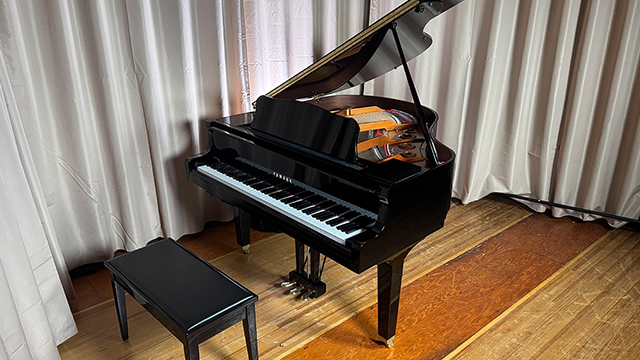
1. They teach on a spinet piano.

Spinets, those very small upright pianos, don’t have the greatest sound because the strings are so short and the soundboards are small. But there’s more to it than that. Spinet pianos have an easier action than other pianos. Therefore, somebody who practices on a spinet is not really prepared to play a grand piano because a grand piano is so much harder to play. One of the nice things about going to a lesson with a teacher who has a nice grand piano, is that even if at home you only have an upright or even a spinet or digital piano, at least once a week, you see what it’s like to play a more formidable instrument. This prepares you for contests and concerts. That’s one tip. It’s not a deal breaker, but a clue that maybe they aren’t a high level teacher.

2. They babysit their kids during lessons.

You might think that would never happen but it absolutely does! Maybe the kids are in the next room watching TV or maybe they’re fighting with each other and the teacher is really not 100% focused on the lesson. Or worse yet, they babysit neighbors’ kids during lessons! This sounds like a joke, but you would not believe the kind of things that go on.

3. They call themselves piano teachers without any significant piano training.

This isn’t to say that there aren’t some great dedicated piano teachers out there. We appreciate them so much! But there are some who just put ads out and start taking students. Maybe they don’t really have the background or the inclination to really care enough. They’re trying to make money teaching piano without considering the best interests of their students.

4. They hit your hands with a ruler when you miss notes!

This one is a deal breaker. It’s hard to believe that this happens at all, but I have heard of this from many people. I believe it’s sick to inflict pain on students, especially children. You want a teacher to be nurturing and supportive in order to connect with you on a personal level and get you to practice and understand what it’s all about. Certainly inflicting pain is the furthest thing from anything that would be helpful, in my opinion. If any of you have had that kind of experience, I’d love for you to share it in the comments below.

5. They don’t teach you how to practice.

This last one is the most important thing. If a teacher doesn’t show you how to practice, even if they’re spectacular pianists, your progress is going to be hindered tremendously. You only go to a lesson once a week. But imagine a teacher who shows you what to do the other six days of the week. You are going to improve exponentially with a teacher who shows you step-by-step exactly what you should be doing at home. This is the most critical thing and maybe not the most obvious thing to look for in a teacher. If any of you have teachers and you get home and you have no idea where to even start, the teacher really isn’t giving you the tools you need. You want a teacher who will show you step-by-step how to practice. This way you can be productive without them, so eventually you won’t even need a teacher! You can practice on your own and accomplish great things.

I hope this has been helpful for you. I welcome your viewpoints in the comments below!
Thanks so much for joining me. I’m Robert Estrin here at LivingPianos.com, Your Online Piano Store. See you next time!

info@LivingPianos.com
949-244-3729
Why is it So Hard to Sight-Read Ragtime Music?

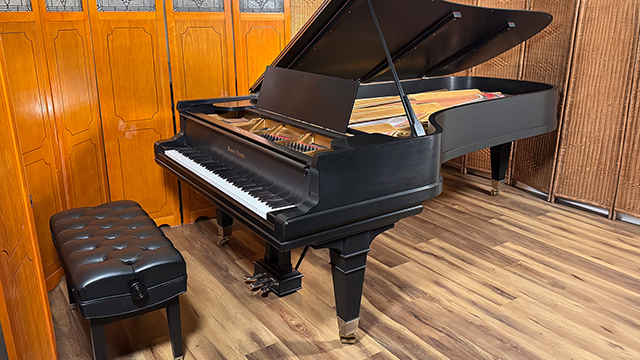
Welcome to LivingPianos.com. Today’s question is “Why is it So Hard to Sight-Read Ragtime Music?” Ragtime music is so much fun to listen to and it’s fun to play as well. But it’s extraordinarily difficult to sight-read! And you might wonder why. To give you an example as to why it is so difficult to sight-read ragtime music, I’m going to compare it to something that is as far removed from ragtime as you can get, which is Bach.

Baroque era music can be played without your hands jumping around the keyboard.

Even though the music is complex, you don’t need to look at your hands because it’s all right there under your fingers. The hands don’t leap around like they do in ragtime. Music which has octaves alternating with chords in the left hand, which is very typical of ragtime music, is all but impossible to play without looking at your hands. So if you’re reading the score, how do you look at your hands and the score? It can be maddening! There’s a lot of music that falls into that category where you just need to look at your hands to handle the leaps. But here’s the good news: if you go to the trouble of memorizing ragtime, it’s not particularly difficult to play! There’s a certain technique that’s required. It’s the same technique utilized in pieces of Liszt, such as the end of his 6th Hungarian Rhapsody. The left hand goes all over the place!

Leaping back and forth from octaves to chords makes sight-reading nearly impossible.

That’s why ragtime or any music that has fast leaps is extraordinarily difficult to read. Even some relatively simple accompaniments, like some works by Fritz Kreisler. They’re absolutely glorious works and they have very simple piano parts. But the left hand has leaps in several sections making it very hard to read. There are two ways you can approach this. One way is to have the score memorized. The other way is to work on practicing those leaps without looking. I love to be well prepared when I have an accompaniment like that so I can either choose to look down at the hands or follow the score. I like to practice keeping my eyes on the score and get it to the point where I can do it just by feel. Now think about this. There are some sensational blind pianists out there. So, it is possible to be able to sight-read music that has leaps, but it’s extraordinarily difficult.

Thanks so much for joining me. I’m Robert Estrin here at LivingPianos.com, Your Online Piano Store. See you next time!

info@LivingPianos.com
949-244-3729
How Richard Wagner Led To Atonality In Music

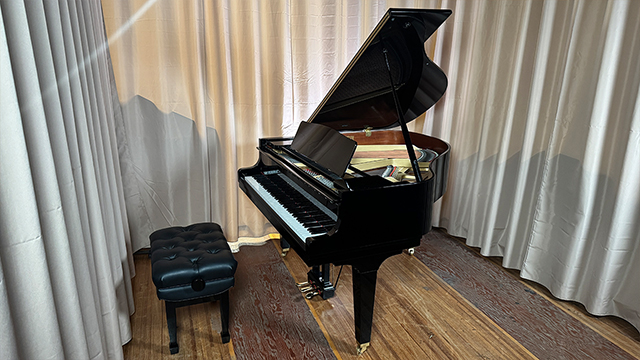
Hi, I’m Robert Estrin. This is LivingPianos.com. Today the subject is “How Richard Wagner Led To Atonality In Music.” If you’re familiar with Wagner’s music, you might be thinking of Ride of the Valkyrie, the Meistersingers, and so much more. It’s as tonal as you can get! So what am I talking about? How could Wagner be associated with atonality?

As counterintuitive as it may seem, it’s a fact that the whole trajectory of music in the late 19th century with Wagner and then Richard Strauss into the 20th century, tonality had constantly shifting key centers. It modulated so often that there was total ambiguity as to what the final notes should be. Usually, you hear a piece and you know where it should end! Not so with Wagner. Certainly in later Wagner, like in Tristan and Isolde. Listen to the main theme. You’ll hear how there’s no key center, even though it’s tonal. Listen to this and you’ll see what I’m talking about. The implications that this brings to music are profound. But what do gorgeous, rich harmonies like those have to do with atonality? Well, If you have more and more shifting key centers, eventually you don’t even have a center of pitch anymore. And that’s exactly what happened.

The 12-tone system

Arnold Schoenberg, another great German composer, is credited with inventing the 12-tone system. That’s where instead of basing a composition on major or minor scales and chords, a tone row was created, putting all of the 12 possible notes in a specific order referred to as a, “tone row”. The whole idea of a tone row is to methodically avoid any kind of preference for any one note over any other note. They are all equal. Whereas in tonal music, there is a pull to certain active tones which must resolve to resting tones. The whole idea of tonality is, some tones are resolved and others must be resolved, not so with atonality.

Wagner pushed the boundaries so far that there was nowhere else to go other than the complete disintegration of tonality.

Listen to early Arnold Schoenberg, for example, his First Chamber Symphony, and you’re going to hear rich, lush, late romantic tonal music that is evocative of Wagner or post-Wagner. And so, Schoenberg himself finally broke through and just eliminated tonality from his music and then Berg and Webern followed suit. That led to a whole other style of atonal music, which truth be known, can be extremely difficult to listen to because the harmonies clash instead of blending. It takes a sophisticated listener to be able to decipher what you’re even hearing because the intervals are not very closely related. You know when you play a fifth, those are related in the overtone series. That’s a subject a little bit too deep for me to get into in this video, but the fact of the matter is, when you have a random arrangement of the 12 tones, you’re going to have music that is generally much more harsh. Which is great for certain styles of music. And I particularly like it when composers utilize elements of atonality in their music. It doesn’t necessarily mean that the entire piece has to be atonal. It’s a tool like anything else, and it can be used to craft wonderful music.

I hope this has been interesting for you. I’d love to hear your comments about this! And any of you who have different perspectives on this, I welcome them in the comments and you’re always welcome to contact us at info@livingpianos.com, We really appreciate bringing these to you and there’s lots more to come.

Thanks so much for joining me. I’m Robert Estrin here at LivingPianos.com, Your Online Piano Store. See you next time!

Should You Lock Your Piano?

Hi, I’m Robert Estrin and this is LivingPianos.com. Today’s question is, “Should You Lock Your Piano?” You might notice that some pianos have little keyholes on them. Oftentimes, when we sell restored vintage pianos, people ask if we have the key. I’m not talking about the 88 keys you play, but they want the key for the lock! So the question is, should you lock your piano?

Will locking your piano protect it against vandals?

You might think that there are some times when it would be really important to lock your piano. For example, let’s say you have a piano in a school or a church and you’re worried that people will abuse the instrument, so you want to lock it to prevent any damage. Well, the fact of the matter is, the locks that are built into pianos are not very robust and they’re easily jimmied open. So it doesn’t adequately protect your piano in a situation like that. What about at home?

Will children damage a piano left unlocked?

Maybe you have kids banging on your piano and you think they’re going to damage the instrument. But kids, even if they use their fists, are not going to damage a piano! When a concert pianist is playing, the energy they exert is much greater than a child is capable of even with their fists. Children are not going to damage your piano by doing that. (Just make sure they don’t approach your piano with any metal objects.) So locking your piano for that reason is pointless. Now there might be one good reason to lock your piano.

Locking your piano keeps people from playing it.

If the sound of your kids banging on your piano is driving you nuts and you can’t get them to use their fingers on the piano appropriately, then maybe there’s a good reason to lock it. Otherwise, I think pianos should be open for people to play. I can’t tell you how frustrating it is for me if I find a piano somewhere and it’s locked. I am always heartbroken. I think pianos are meant to be played!

How do all of you feel about this. Do you lock your piano? You can leave your comments and we can discuss further about this.

Thanks so much for joining me. I’m Robert Estrin here at LivingPianos.com, Your Online Piano Store. See you next time!

info@LivingPianos.com
949-244-3729

Robert Estrin Dresses Up: Scarlatti on the Harpsichord

One of the greatest composers for the harpsichord was an Italian composer by the name of Domenico Scarlatti. He wrote over a thousand sonatas! I cherry-picked three of the most glorious sonatas to perform on the accompanying video. These are not sonatas like Mozart or Beethoven sonatas which are multi-movement works. They’re far shorter works which are all in a two-part form. There is an A section which repeats, and then a B section which also repeats. But they’re all dramatically unique compositions written specifically for the harpsichord, unlike Bach who designated his works merely for, Clavier which means simply, “keyboard”. What you’re about to hear is music written specifically for the harpsichord, three sonatas of Scarlatti, one in D minor, one in C major, and another one in D minor that has very fast repeated notes that I think you will enjoy.

Living Pianos: Journey Through Time: Historic Concert Experience

This performance video was at Riverside Community College. I have performed the Living Piano show across the state at colleges, universities, art centers, conventions, with symphony orchestra, and even a Living Piano cruise! You can explore more about this here: https://www.youtube.com/playlist?list=PLC9F55F8E11E5FBDE

The Man Who Could Sight-Read Anything On the Piano

I’m Robert Estrin. This is LivingPianos.com. Today I’m going to tell you about the man who could sight-read anything on the piano. Now that seems like a bold claim, so let me back up a bit and give you some perspective on this.

My father, Morton Estrin, would sight read anything, anytime, with anyone. For example, I remember once we were visiting my uncle Harvey Estrin. Harvey was a top-line studio musician in New York City, a woodwind man who played on many film scores, commercials, the ABC orchestra, and much more. His wife, Trudy Kane, was the principal flutist in the Metropolitan Opera Orchestra. We had a social visit, and Trudy handed my father the score of a piece he’d never even heard before. I believe it was the Reinecke Flute Sonata for flute and piano. Indeed, my father and Trudy played this together, and it was a beautiful performance – right at sight! I was amazed at the cohesiveness of the performance, and that he could sight read with that level of musicianship.

However, there are always limits, aren’t there?

I actually majored in both piano and French horn at the Manhattan School of Music. I played French horn from the time I was in fourth grade. My father was kind enough to accompany me whenever I’d ask him. As a matter of fact, I probably pushed that a little harder than I should have in retrospect, because he was very busy between his performing and teaching, but he was so gracious about it.

If any of you pianists out there have ever accompanied concertos, you probably know that many of them are incredibly awkward. For example, the Strauss Second Horn Concerto has so much going on in the orchestral writing, that if you look at the score, the piano reduction is filled with little notes in the orchestra part that you can’t possibly play on the piano. There aren’t enough fingers in the hands!

Sometimes there are other problems. A good example of this is, the Telemann Horn Concerto. Telemann is credited with composing more music than any other composer who ever lived, so this is a rather obscure work, except maybe to French hornists! My father was kind enough to accompany me on this. In fact, I still have the music to that piece, and in looking at the score, I can see that he wrote in fingering. So, he practiced this piece. The orchestra part has repeated 16th notes in the right hand. Repeated notes on the strings is easy. The bow goes back and forth. On the piano, it’s not so easy. You can see why my father wrote in fingerings for this.

The man who could sight-read anything is the great pianist John Ogdon.

John Ogden won the Tchaikovsky International Piano Competition the same year Vladimir Ashkenazy won it. They tied for first place. John Ogdon had an illustrious career. His recordings of the Brahms Concertos, his Liszt recordings (and more) reveal spectacular playing! I was fortunate enough to study with him during my time at Indiana University

It came to our attention, all of us who studied with him at Indiana University, that he could sight-read anything. So, we would come into lessons and put scores in front of him. It seemed like there was nothing he couldn’t read! But, I wondered if maybe he knew the pieces.

One day he invited me to his home and he told me to bring my horn; he’d accompany me.

I couldn’t believe it! I brought a stack of music. And just for fun, I brought that Telemann Concerto with that impossible piano part. What I haven’t told you yet is that as hard as the repeated 16th notes in the right hand are, underneath those were eighth notes in the right hand. So every other note, you’ve got a note underneath it in the tenor line, and that’s just the right hand! My father didn’t even bother trying to play those other notes. And he had practiced to the point of writing in fingerings just to be able to negotiate the repeated notes!

I put the score in front of John Ogdon. He said, “I’ve never seen this.” And I said, “Well, it goes kind of fast.” He sailed into it even faster than I played it and nailed it perfectly. He didn’t leave out any notes! If I hadn’t seen this with my own eyes and heard it with my own ears, I would tell anyone that this is absolutely impossible. But yet, John Ogdon could read anything.

That is my story about John Ogden’s incredible sight-reading ability. I hope that you’ve enjoyed this story – and there’s lots more videos coming your way. Thanks for joining me, Robert Estrin, here at LivingPianos.com, Your Online Piano Store.

info@LivingPianos.com
949-244-3729