

Tag Archives: living pianos

Where to Place a Piano in Your Home

This is Robert Estrin. Welcome to livingpianos.com. Today’s topic is: “Where to Place a Piano in Your Home“. Pianos come in all different lengths from around five feet all the way to over nine feet. Most people don’t have a nine foot concert grand in their home! A piano that size requires a large room that can handle not just the size of the piano, but the sound as well. The bigger the piano, the more volume they create.

How to place upright pianos.

I have a video about WHERE TO PUT AN UPRIGHT PIANO IN A ROOM. Upright pianos are all about five feet wide, because of the 88 keys, and they come a couple feet out from the wall. You also want to allow extra space for when the bench is pulled out. Here’s the key though: if you leave some space between the back of the piano and the wall, you’ll get a much richer sound because most of the sound of an upright comes from the back. If the piano is right against the wall, it soaks up the sound. Now on the flip side, if an upright piano is too loud, put it up against the wall or better yet against some curtains and it will be much quieter.

Placing baby grand and grand pianos.

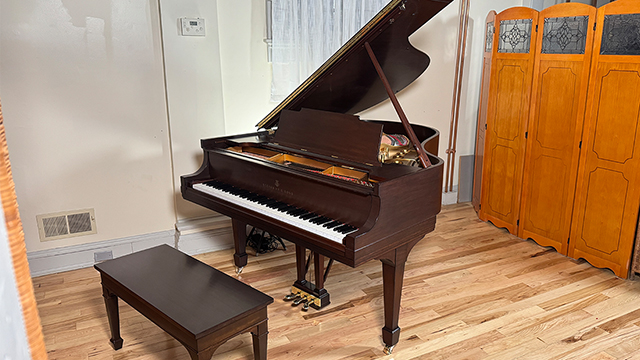
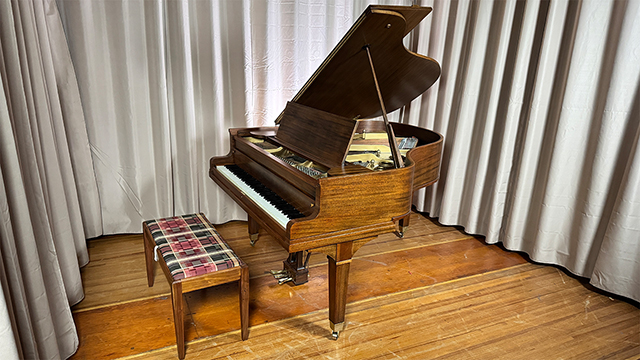
A lot of people think upright pianos are easier to place in a home, but it’s actually easier to place a grand piano than an upright! Ideally, you want to place your grand piano so it opens into the room. It’s nice to have the piano situated in this respect so you can see the keys and the inside of the piano. However, even though this is the typical way that pianos are placed on stage for concerts, in your home it isn’t necessary. It doesn’t matter how you position your piano, you’re going to hear it fine throughout your home. They can tuck into a corner and look quite lovely and sound fine. Or maybe you prefer to sit looking into the room when you’re playing the piano. All of these ways work fine.

Place your piano where you can enjoy it!

If you have an open floor plan, the volume of the piano could be an issue for people in other parts of the house. You want to think about that. You never want to have your piano in a place where you don’t want people to play it because it’s disturbing to you or your neighbors! If a grand piano is too loud, you can put a rug underneath to soak up the sound. With a grand piano, just like the back of an upright, half the sound comes from underneath, or almost all the sound when the lid is closed.

Do what works best for you.

There are many different ways you can place your piano. Baby grands and grands are actually easier to place than upright pianos. They look good any way, and you are going to hear it in your home whether the lid is facing one way or the other. Ultimately where you place a piano in your home comes down to personal preference. So give some thought to where the piano will look and sound best, and will fit in with your lifestyle.

Any of you who have questions about placing a piano in your home, you’re welcome to take pictures and send them to us at info@LivingPianos.com, and we’ll be happy to give you advice about how to place your piano. Thanks for joining us here at livingpianos.com, Your Online Piano Store

Reinventing Yourself as a Musician

I’m Robert Estrin from Livingpianos.com. Today’s topic is, “Reinventing Yourself as a Musician”. You may wonder what I am talking about. In life, not just in music, there’s an illusion that you can have total stability. Of course this is impossible. Everything around you is constantly changing. Even things that appear consistent are in a constant state of flux.

Each performance is unique.

Let’s say for example you perform a piece and it goes exactly the way you want it to. The next time you perform that piece, can you recreate the performance? Even though you’ve done it once before, it’s never going to be the same. You’ll never be able to perfectly recreate that performance, any more than you could recreate a conversation you had with someone. After you have a great performance, you are in a different mental state about that piece. You’ve experienced something new that adds to your repertoire of performances. If you start chasing things you’ve done in the past, you’ll never move forward. You will never reach the same heights as before by trying to imitate something you have done in the past.

How can you reinvent yourself musically?

Studying music that you’ve never played before is a tremendous way to enrich yourself. It can add to your musicianship and help you to see things in a different light. Learning a new piece of music not only offers you the possibility of playing new repertoire, but it can also change your outlook on pieces you’ve previously studied. For example, if you’ve studied several early pieces of Beethoven, and you venture into a later piece of Beethoven, you might have a better understanding of Beethoven and how his mind worked.

You might even delve into a completely new style of music.

Maybe you’ve never played jazz before, and you start learning some jazz! If you go back to your classical pieces, you will find similarities. For example, a cadenza in the G-minor Ballad of Chopin is not dissimilar from a jazz riff of something improvised. We can think of these little cadenza passages as what Chopin might have done while improvising. It’s more spontaneous and can give us a glimpse as to how Chopin played the piano.

Each instrument can show you something new

If you’ve been practicing on the same piano all the time, and then you have an opportunity to play a nicer instrument, it can change your whole outlook on music. The sounds are different, the touch is different. Your connection is different! Having different instruments to play on is unbelievably valuable. For pianists this is especially true because you generally can’t bring your personal piano with you to performances. With Living Pianos, I’ve had the opportunity to play so many great pianos, which has helped me to grow as a musician.

You must reinvent yourself as a musician all the time.

I remember my father, Morton Estrin, would always learn new pieces his entire life. Into his eighties, he was learning mammoth new works, and when he would see colleagues from years ago performing “the same program they played when they were at Julliard 25 years ago” he had no patience for that. Musicians who keep recycling the same music over and over again oftentimes stop growing. It’s important to expand your repertoire and your playing experiences. If you’ve always played recitals, maybe do chamber music. If you’ve rarely performed solo recitals, maybe you’ve done concertos a great deal, then you should try solo performing or something completely different. Always expand your outlook. It’ll keep you fresh. It keeps your music compelling, and it’s the secret to growth, not only as a musician, but in every aspect of life. You must give yourself new experiences all the time in order to keep life fresh and vibrant.

I hope this has been a good lesson for you! I’d love to hear from you, and how you feel about your music and reinventing yourself. Is this something you have done, and how has it worked for you? I’m Robert Estrin at Livingpianos.com, Your Online Piano Store.

info@LivingPianos.com
949-244-3729

Can Playing the Piano Ease Depression?

I’m Robert Estrin from LivingPianos.com. Today’s question is, “Can playing the piano ease depression?” Disclaimer: I am not a doctor and the information in this article is anecdotal. I would not suggest playing the piano as your only treatment if you have a serious mental or emotional condition. However, I will say this; I can’t even imagine living in this world if I didn’t have the piano to play!

How can playing the piano affect your emotional health?

What’s great about the piano in regards to emotional health is that you get a chance to completely occupy yourself. Playing music requires intense focus thereby quieting the mind. It’s almost like a form of meditation. Studies have shown meditation can reduce depression and anxiety, and even help people manage chronic pain. But there are other benefits to playing the piano in regard to how it makes you feel.

The beauty of music can connect you to the beauty of life.

Imagine playing a transcendentally beautiful melody like the F-Sharp Major Nocturne by Chopin, and how that makes you feel. If you were depressed and you played that piece, it might make you feel some joy! When I play that melody it fills me with very warm feelings. So you have the benefit of taking your mind away from everything in the outer world, as with meditation, while also experiencing the soul and emotions of people who lived hundreds of years ago who had something special to say. So it fills you with the emotions that they were feeling during their lives.

It can be cathartic to play music that explores deeper emotions

The beginning of the B-minor Scherzo of Chopin has such anger and hostility, it might actually help you release some of your pent up feelings. So, there can be a cathartic quality to playing the piano since there is a soothing calmness you can experience with music of great beauty. All the while, you can become detached from the day-to-day issues and frustrations that we all face in life.

I want to know how any of you feel about playing music. Does it help to keep you emotionally stable? Does it help you to overcome sadness and even depression? I’d love to hear from any of you out there who knows more about this subject. Put it in the comments. Let us know here at LivingPianos.com, Your Online Piano Store.

info@LivingPianos.com
949-244-3729

Augmented Reality in Concert Halls

This is Robert Estrin from LivingPianos.com. Today’s subject is augmented reality in concert halls. It sounds futuristic and a little bit scary! What are we talking about here?

Designing a concert hall is very difficult.

If you build a concert hall that has beautiful acoustics for an orchestra, will it have the right acoustics for solo piano? If you bring in a jazz ensemble, will it have the right acoustics for that? What about rock bands with amplifiers and digital reverb? It is impossible to have one concert hall that will serve all of those purposes. With depleting budgets for classical music, having a hall dedicated to just classical music is rare. But the fact is, the acoustics in a hall designed for an orchestra might not be right for other performances.

There are new technologies that can customize acoustics in concert halls.

For example, the symphony hall in Indianapolis, Hilbert Circle Theater, has technology where the hall itself is acoustically somewhat dead. But they have built into the hall a microphone and speaker system that creates the ambiance artificially. You might think this sounds like a terrible idea until you actually hear it. They do an absolutely splendid job of creating beautiful acoustics electronically!

You can have a hall where the ideal acoustics can be dialed in for whatever ensemble is performing there.

For example, if you have a group that is playing amplified music, there is nothing worse than having a hall with rich reverberation that creates a wash of sound, making everything muddy. Worse yet, if there is a speaking engagement in the acoustically live hall, it can be impossible to understand speech. Just imagine being able to dial in the reverb at your will. For example, you could have a dry sound for speaking, and a reverberant hall for classical music ensembles.

There are new types of reverbs that use impulses of samples from actual halls.

These convolution reverbs allow you to take the acoustics of Carnegie Hall, for example, and create that space acoustically on recordings or possibly even live. You can make a small hall sound like a medium or large hall. You can dial in whatever hall you want! This isn’t the future, it is happening right now.

Many halls now utilize digital technologies in order to create ideal sound in spaces with acoustic compromises.

Even with the best intentions and all of the best scientific data available, some concert halls are built, but once completed, it becomes apparent that they didn’t get the acoustics quite right. To remedy this they would have to rip everything out and put in new panels with different reflecting patterns and baffles to get the hall’s acoustics dialed in. Some halls actually have mechanical panels that can be moved to alter the acoustics of the hall. Segerstrom Hall in Orange County has this sort of technology. That’s a great situation! It is also very expensive. Once a hall has digital acoustics installed, it is just the beginning. You can experiment with an unlimited number of acoustic possibilities all at the push of a button!

Augmented reality in concert halls, what a fascinating subject! I hope you’ve enjoyed this. Once again, this is Robert Estrin of LivingPianos.com, Your Online Piano Store
info@LivingPianos.com

949-244-3729

Tips for Dealing With a Concert Hall

This is Robert Estrin here at LivingPianos.com. Today we are going to talk about the importance of walking around a concert hall. What am I talking about? If you ever get the opportunity to play a concert and you have the chance to go to the hall beforehand, there is no better experience than to get someone else playing the piano in that space while you walk around the hall. You will learn so much.

No matter how fine of a hall you are playing in, the sound you will get in the front row compared to the last row, the left to the right, and the balconies can be dramatically different.

Unless you have the opportunity to hear music in the hall on the instrument you play, there is no way that you can really be sure of what you are projecting.

I had the opportunity with my father Morton Estrin who played in so many different halls, including Carnegie Hall and Lincoln Center, to walk around and listen. You get to understand that in some halls you might want to alter your touch or tempo of what you are playing because things can become muddied in certain areas of the hall. Other halls might be overwhelmingly loud in some sections and soft in others and you might want to be able to moderate your expression to be able to suit the hall.

This isn’t just for concert halls. Anywhere you play you’ll want to listen in different parts of the room. Imagine you are having an in-home concert and the piano is opened up, and you go in the room and people’s ears are getting blown away because you don’t realize how loud it is! You’re probably just playing at your regular volume that you always practice at. You want to make sure that you are playing appropriately for the space.

There is no better way than to get another person to play so you can walk around and listen.
That way you’ll know exactly how to create the sound you are after. If you don’t have the luxury of a second person to play:

If you have a good quality portable recorder you can try recording from different sections of the hall.

You can listen back and get some idea of what you are getting. But, there is really no substitute for being there live. One of the coolest things is if you have a recording system on your piano. You actually play in the hall on the piano, play it back, and walk around the hall. That’s an ideal situation! Short of that, get a friend to play for you, listen to what you are getting, and pepper your performance to make sure it is ideal for the space you are playing in.

Thanks again for joining me, I’m Robert Estrin from LivingPianos.com, Your Online Piano Store.

info@LivingPianos.com
949-244-3729

Can You Learn to Tune a Piano Online?

This is Robert Estrin here at LivingPianos.com with the question, “Can you learn to tune a piano online?” The whole world has moved online and people seem to be able to learn just about anything on the internet. Does this mean you can learn to tune a piano online too?

Actually, there are online resources for learning how to tune a piano!

First, let’s go back in time a bit. In the olden days (not so long ago!), most piano technicians learned their craft through apprenticeships. An established tuner would take somebody under their wing who had a desire and passion for tuning and piano repair. They would get to practice with some side work, and little by little be trained so that they could start to service some of their clients. Indeed, one of the best ways to learn the craft of piano tuning is through an apprenticeship if you are lucky enough to be able to hook up with someone. You might think that piano technicians would love to have the help from somebody who is eager to learn the craft. But, the amount of time it takes to train somebody can far outweigh the benefit a technician is going to get from the work of someone who is a relative newbie to piano tuning. Piano technicians’ schools are available online. You might consider looking at Piano Technician Academy:

Piano Technology Academy
https://www.pianotechnicianacademy.com/

They are a wonderful resource online where you can actually be certified as a Registered Piano Technician (RPT) through the Piano Technicians Guild (PTG). This enables you to prove to people that you have passed a certain level of proficiency in servicing pianos. There are other schools online, but I happen to know this one personally, and it’s a great place to learn. The North Bennet School https://www.nbss.edu/ allows you to physically attend to study the craft of piano tuning. But if you want to learn right in your own home, the Piano Technician Academy is a great resource. Having said that:

You obviously still have to work on actual pianos.

You can’t do it all online and be ready to go. You’ll need to have some pianos to work on, and in a perfect world, you’ll also have some kind of experienced piano technician who you can mentor with to some extent. An ideal situation would be the ability to take the best of the old world and the best of technologies and marry them together to learn the craft of piano tuning right at your own home with the help of somebody to guide you through to make sure you are on the right track. Thanks for the great questions I know there are a lot of people out there wanting to learn piano technician skills. If you are willing to travel:

There are areas of the country that have a dearth of piano technicians and the work opportunities are plentiful.

I happen to know this because Living Pianos sells pianos all over the country and we engage piano technicians from the Piano Technicians’ Guild. There are some areas with weeks of waiting lists of clients! I encourage any of you who want to get into this. It is a great skill to learn. You get to be around pianos, and you set your own hours which is why it is something that appeals to a great number of people. Once again, I’m Robert Estrin here at LivingPianos.com, Your Online Piano Store.

info@LivingPianos.com
949-244-3729