


Top 5 Piano Myths
1. Steinway is the best piano in the world.

There are a handful of piano companies which make pianos equal in quality to Steinway. (For example: Bösendorfer, Bechstein, Fazioli, Blüthner and Mason & Hamlin are all top notch pianos with rich histories.) In fact, if you look in the latest supplement to “The Piano Book”, by Larry Fine, New York made Steinway pianos are rated in the 3rd rank of pianos according to manufacturing quality. So why is Steinway recognized as the undisputed leader? In a word: marketing. Just as Microsoft dominates computer software because of aggressive licensing arrangements, John Steinway helped propel Steinway & Sons to its market dominance through exclusive artist contracts and favorable institutional arrangements.
2. When you move a piano it has to be tuned.

This is a half truth. The fact is, a piano that is moved will show up pretty much as it left most of the time. However, after the piano gets acclimated to its new environment, it will require tuning. The piano may not sound bad, but the pitch of the entire instrument may adjust slightly up or down. It is important to keep a piano stable. It is best to wait at least a couple of weeks or even longer after a move before tuning to make sure the piano has settled.
3. Kids banging on a piano may damage the instrument.

While it can grate on your nerves, the force with which kids hit the keys of a piano even with their fists can’t match the power professional pianists inflict upon a piano in concert. Just be sure that the children don’t take sharp or heavy objects to the keyboard since this can damage the instrument.
4. The fall board of a piano must have a slow close feature to avoid injury.

The slow close fall-board feature of a piano is a great marketing tool. The truth is, unless you have some really wild kids, the incidence of being hurt by a falling fall board is quite rare. Most of the best pianos including Steinway do not offer a slow close fall board.
5. You shouldn’t place a piano on an outside wall.
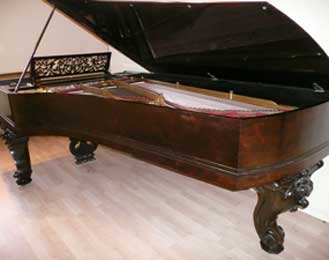
Even in a temperate climate, the insulation of modern homes will keep the temperature fairly stable even on an outside wall. However, it is important to avoid direct sunlight on your piano. This will not only effect tuning stability, but it will fade the finish in a matter of weeks. Also, you should keep your piano closed particularly at night. If you leave your windows open at night, the moist night air will rust the strings. Also, even with the piano closed, the cooler air can make the sound board contract destabilizing the tuning. Use your judgment in balancing the enjoyment of your piano versus its longevity.
I’m interested to hear your opinions and thoughts on these piano myths. Please leave some comments below. Thanks for reading.
13 thoughts on “TOP 5 PIANO MYTHS”
I would make the comparison of Steinway to Rolex than to Bose.
Rolex is assuredly an outstanding and premier watchmaker but within the watch community and fans there are a number of other prestigious brands that are generally unheard of to the rest of the consumer world.
Bose just has great marketing as their only trump card.
So in other words, Steinway is the Bose of the Piano worlds. Although, I do think Steinway is still a much better piano than what Bose speakers are…
I loved this blog. I myself own a piano store, and for 6 years worked in a store were i was co/manager of the piano dept were we sold Steinway/Boston/Essex… The #1 myth is so TRUE! It is so frustrating to hear over and over about what i think is the most overrated piano in the world, the American Steinway.
IMO, Kawai, who many do not :like” has far surpassed all other piano makes when it comes to warranty and “MATERIALS USED”…. the Carbon fiber action is a game changer, and has lead to Mason&Hamlin trying there own type of composite, along with the new Baldwins; which i also am a dealer for.
But the Steinway is by far, NOT, the best piano in the world. They just are the best marketing company in the world.
Can I keep things (books, tape player, other musical instruments) on top of my upright? I would like to have easy access to them while I am playing, but have head you should put things on a piano.
Putting things on your upright won’t hurt the function of the piano. Just be careful to avoid scratching of the furniture. Keep in mind that everything has to come off the piano whenever you get it tuned. Also, always avoid liquids on the piano since this can be potentially harmful.
How you find ideas for articles, I am always lack of new ideas for articles. Some tips would be great
I teach and there’s a piano in my classroom. I was always told that letting untrained kids gliss up and down the keys could potentially cause expensive key damage. I was just wondering how true this is.
Thanks!
Excellent blog, Great content but images are little bit old, no matter but content is king.
I highly enjoyed reading this blogpost, keep up creating such exciting stuff!
Nice images to go along with this article… where did you find them?
Many of the images are of past pianos
Piano industry has become much more developed than in the past. Even learning to play piano is now a lot easier.