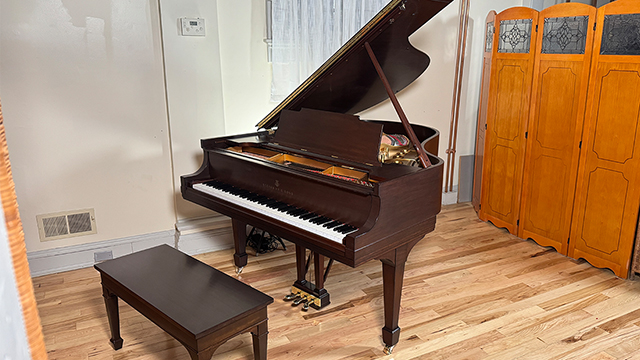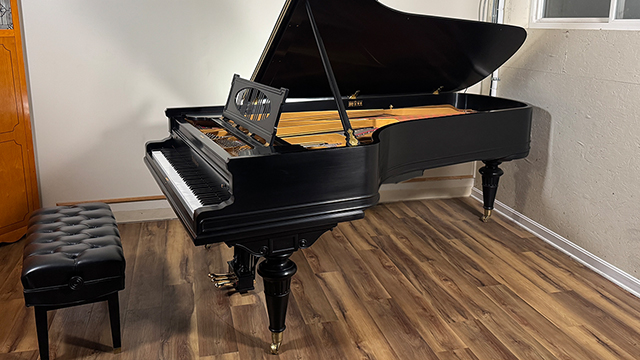


Below are 10 of the most common FACTS and FICTION about Steinway and Sons pianos.

Steinway started as a German company.
FALSE: Steinway began in New York by German immigrants. Later they opened a factory in Hamburg, Germany. Today Steinway pianos are manufactured in both New York and Hamburg.

Steinway was owned by CBS in the 1960’s and 1970’s.
TRUE: Steinway was owned by CBS in the 1960’s and 1970’s. Many people agree that the quality of manufacturing was generally lower during this period of time.

Boston is a lower line piano made by Steinway.
FALSE: Boston is a stencil piano. The name was invented by Steinway to sell pianos through the Steinway dealer network with pianos manufactured by Kawai.

In the early part of the 20th century, Steinway and Sons treated action parts in a way that made them seize up years later.
TRUE: Steinways from the early part of the 20th century often suffer from a condition known as verdigris. The treatment which was thought to avoid corrosion on action parts caused action parts to seize up and require extensive restoration.

Steinway used Teflon in their actions so they wouldn’t wear out.
TRUE: During the CBS period of ownership in the 1960’s and 1970’s and even into the early 1980’s, Steinway experimented with utilizing Teflon instead of the usual felt bushings in their actions. Most technicians found it difficult to deal with clicking noises that resulted over time.

A Steinway 7-foot piano is actually 6 feet 10 1/2 inches.
TRUE: Steinway 7 foot pianos are an inch and a half short of 7 feet. The 9 foot concert grand is also an inch under 9 feet.

All currently produced Steinways have the Accelerated action.
FALSE: New York made Steinways have Accelerated actions. However, Hamburg produced Steinway pianos utilize actions made by Renner and do not employ the Accelerated actions.

A new Steinway direct from the factory is more refined than a Yamaha from the factory.
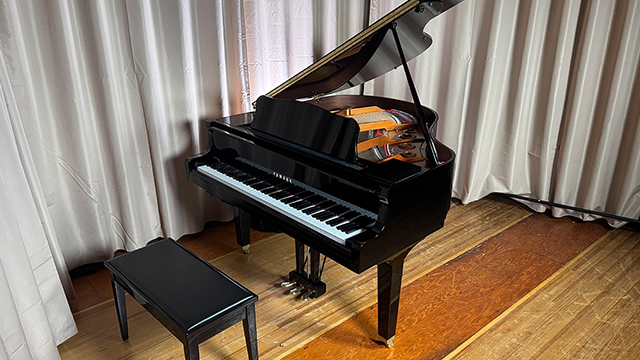
FALSE: New out of the box, a Yamaha is far more refined than a Steinway. Steinway pianos come to dealers in an unrefined state. It is up to the dealer to have extensive regulation, voicing, tuning and other adjustments to get the pianos playing on a high level.

Used Steinways represent an excellent value in a high quality used piano.
FALSE: While a good used Steinway piano may be a better investment than a new Steinway, there is a premium you must pay on a Steinway piano compared to comparable pianos from other top tier manufacturers because of the recognition of the name.

Steinway is the number 1 selling American made piano.
TRUE: There were only 1600 pianos produced in the United States last year and Steinway produced over 1000 of them.

 Use the metronome: Even in music that has fluidity with the tempo will benefit from metronome practice. You need a reference of time to know how much you are bending the phrase with rubato. Also, when learning difficult passages, it is usual to slow down. Over time you may even overcompensate for difficult passages rushing them. Difficult passages can be mastered by increasing the metronome a notch or 2 at a time to speed up particularly difficult passages.
 Practice in chords when possible: Not only does reducing the music to chords help to clarify the structure, it also helps to figure out the best fingering.
 Use the 80/20 rule: If you focus the majority of your time on the few places that are weak, you will get much better results than practicing equally on all sections of your music.
 While there are many digital pianos on the market for well under $1000, plan on spending $800 in order to get a good weighted action and sound. Yamaha in particular has many models at that price point that are quite good. In fact, spending more offers more features but not necessarily a superior instrument. The exception is the quality of the built in sound system which makes a huge difference in the more expensive models. If you invest in a good stand for stability and utilize a decent quality home stereo system or good computer sound system with sub woofer, you can get very good results without investing thousands of dollars for a high end Clavinova or other digital piano.
 The acoustic piano has the benefit of an almost infinite range of expression. While digitals keep getting better, the complex action, interaction of harmonics, pedal subtleties and expression can be invaluable to an aspiring pianist. If you are taking lessons or are considering taking lessons, it is important to invest enough to achieve a minimum level of performance. Otherwise, I suggest you are better off with a decent piano and no lessons rather than an inferior instrument and lessons. Practicing on a bad piano or inadequate digital piano can make lessons unproductive and become a frustrating experience. We are fortunate at this time in history to have a choice of acoustic or digital pianos.