



Piano and Music Videos

Can't find what you're looking for?

I highly encourage everyone to watch the accompanying video with this article. It provides excellent visual representations of the Neapolitan 6th chord as well as a demonstration of how it can be utilized in your music.

Neapolitan 6th might sound like a strange name, but it’s a beautiful chord that can enhance your music. Even if you haven’t heard the name, you’ve probably heard the chord. But what is it exactly and how can you utilize it in your music?

The Neapolitan 6th can function like a IV chord. Sometimes composers will substitute a II 6 chord for the IV chord. So in the key of C major, instead of the IV chord, F – A – C, you have the first inversion of the II chord which has the F on the bottom: F – A – D.

The Neapolitan 6 chord offers another substitution taking things one step further. The Neapolitan chord is a major triad built on the flatted second degree of the scale. That might sound complicated, so let’s break it down. In the key of C major, the second degree of the scale is D. So, lower that note a half-step and you have D-flat. Build a major chord on D-flat: D-flat – F – A-flat. That is the Neapolitan chord in root position. You might wonder how a D-flat major chord will fit in a the key of C major, but in the first inversion (6) it functions the same as the IV or the II 6 chord but has a unique sound.

Again, build a Neapolitan 6th chord by lowering the second note of a major scale. So, in C major you start with D and lower it a half-step to D-flat and build a major triad on D-flat: D-flat – F – A-flat. Then invert it so F is on the bottom (6 inversion) F – A-flat – D-flat. You now have a Neapolitan 6th chord!
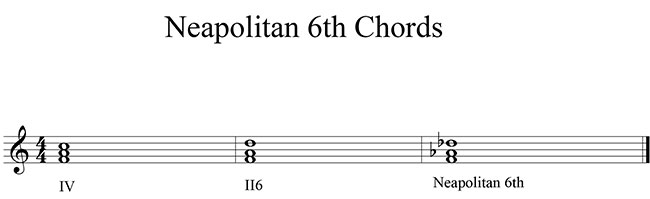
So if you’re improvising or composing, and are using a IV or II 6 chord, think about using a Neapolitan 6th instead to give your music a distinct flavor. It’s a fun and creative tool to have at your disposal and something that can make your music more interesting. Furthermore, as you study your scores, you will discover the use of this chord in countless compositions.

Thanks again for joining us here at Living Pianos. If you have any questions about this topic or any topic at all please contact us directly: Info@LivingPianos.com or (949) 244-3729.

What is the Neapolitan 6th Chord?

I highly encourage everyone to watch the accompanying video with this article. It provides excellent visual representations of the Neapolitan 6th chord as well as a demonstration of how it can be utilized in your music. Neapolitan 6th might sound lik

If you’ve played music for any length of time you may be familiar with etudes. What they are exactly is a two part answer, because there are fundamentally two different types of etudes. Even though they are both called etudes, these two different types are radically different from one-another. So let’s explore this topic and explain the differences in etudes and how they relate to your music.

Etude comes from the French word meaning, “study”. Etudes generally focus on overcoming specific technical challenges. One type of etude is strictly an exercise. There are famous Czerny and Hanon etudes that are famous exercises, but they aren’t pieces people generally perform. Their main purpose is to develop technique on an instrument.

Most Hanon etudes are simply a series of repeated note patterns. They are valuable for younger students to develop strength. Hanon Virtuoso Pianist in 60 Exercises also contains the standard fingering for all major and minor scales and arpeggios, a staple for serious pianists. Brahms and Czerny also have etudes that are used for developing technique as opposed to necessarily providing great musical compositions. However, some Czerny etudes are quite enjoyable to listen to.

The other type of etudes are musical etudes. Chopin, Liszt, and others have created masterful pieces of music called etudes. These etudes explore different technical issues such as double thirds, sixths, octaves and other unique challenges. Yet, they are masterful works of music.

Musical etudes from Chopin, Liszt, Moszkowski, Scriabin, Rachmaninoff and others are sometimes extremely complex and can be daunting for intermediate students to attempt to play. But the good news is there are some musical etudes from composers such as Burgmüller that are very nice pieces of music which help develop technique, yet provide intermediate level students with richly rewarding music to play! There are musical etudes that range from student level to virtuoso. Mastering a musical etude can greatly benefit your development as a pianist and give you music to perform as well.

I hope this is helpful and if you have any questions about this topic or any other, please email me Robert@LivingPianos.com for more information.

What are Etudes? Music Theory Lessons – Musical Etudes

If you’ve played music for any length of time you may be familiar with etudes. What they are exactly is a two part answer, because there are fundamentally two different types of etudes. Even though they are both called etudes, these two different t

The question today is, “Is Silence Music?” Naturally you may think, “How can silence be music?” Interestingly, there’s a pivotal piece of music that was composed in 1952 by John Cage called “Four Minutes, Thirty-three Seconds“. You may have heard of it.

“4’33” was written for piano in three movements and all three movements are nothing but rests. The artist comes on stage, opens the fallboard of the piano, and looks at his or her watch and waits the appropriate time for each of the three movements and that is the whole piece! What was he trying to prove? It’s actually a very interesting point that is made.

When you think about the whole universe, you cannot have matter without having space. Indeed, the space between things is as much of a reality as the objects in it. One cannot exist without the other. When I was attending the Manhattan School of Music, we studied the literary works of Carlos Castaneda in one of my classes. Castaneda conducted many different experiments to come to the realization of the meaning of life.

One of the teachings of Don Juan was when you look at a tree most people just look at the leaves of the tree, identify it and stop thinking about it because that is what we are programmed to do as human beings. He was trying to get the young man to understand that you can look at the tree and try not to classify it and indeed you can look at the space between the leaves and appreciate the beauty of that reality as well.

How does this relate to music? Music is all about timing and the rests in music are just as important as the notes. Sometimes, they are even more important. The time you take between notes is what sets the notes apart from one another. So yes, silence is music and almost all great pieces of music have silence in them. Perhaps not to the extent of Cage’s “4’33” which was really more of a statement and philosophical treatment on what music is. Silence must be taken seriously as a pivotal point in music. Thanks for joining me at Living Pianos. Robert@LivingPianos.com

Is Silence Music?

The question today is, “Is Silence Music?” Naturally you may think, “How can silence be music?” Interestingly, there’s a pivotal piece of music that was composed in 1952 by John Cage called “Four Minutes, Thirty-three Seconds&

If you’ve followed my videos you might be familiar with some of my more advanced videos on this subject: How to Play Chords on the Piano Part 1 and Part 2; Diminished 7th Chords Part 1, Part 2, and Part 3, and What are Parallel Chords? as well as some videos that cover the basics of scales: Relative Minor Scales, Major Scales, Whole Tone Scales, and Chromatic Scales. A lot of these videos go very well with this topic and they all relate to one-another.

So what is a chord? It might seem simple when you think about it but trying to put it into words can be challenging.

A chord is 3 or more notes arranged in thirds.

A scale is built upon whole-steps and half-steps (seconds) and a chord is built on the interval of a third. What is a third? It is essentially every other note of a scale. So if you were to play a C major scale (or any other major scale) and leave out every other note you would have a chord! It really is that simple; you can make a chord by simply playing every other note of a scale.

There are two types of thirds that are used in chords: major thirds with a total of four half-steps and minor thirds which contain three half-steps. Different combinations of major thirds and minor thirds are the fundamentals of Western harmony. There are expanded chords we can get into in another video but this is the basic information on what exactly a chords is.

And when it comes to chords, you don’t have to start on the first note of a scale, you can start on the second, the third and so on as long as you skip every other note of the scale.

Thanks so much for joining me here. We will be bringing you more videos on this topic very soon. If you have any questions please contact me directly Robert Estrin Robert@LivingPianos.com (949) 244-3729.

What is a Chord?

If you’ve followed my videos you might be familiar with some of my more advanced videos on this subject: How to Play Chords on the Piano Part 1 and Part 2; Diminished 7th Chords Part 1, Part 2, and Part 3, and What are Parallel Chords? as well as s

What is Polyphony in Music?

You may have heard the term polyphony before and might have wondered what it meant. Polyphony is intrinsic to almost all the music we listen to today but it wasn’t always that way. So, what does this term mean and why is it important? There was a t

The tritone was considered to be a forbidden interval hundreds of years ago. Churches actually banned this interval from being played! Luckily there are no such restrictions today so we will be experimenting with it and understanding what its function is.

To put it very simply, the tritone is half an octave. There are twelve possible tones in Western music and if you go six half steps you will create a tritone. When you invert a tritone, it remains a tritone because it divides the octave exactly in half. When you play a triton you will understand why it was feared; the sound is eerie and almost demonic. In fact, it is used extensively in heavy metal music!

How does a tritone resolve? This is a very interesting aspect to tritones because you can go outward or inward by half steps and the tritone will resolve either way. So, if you have a tritone C – F-sharp, it could resolve outward to B – G. Or, it could resolve inward by half steps to C-sharp – E-sharp. Interestingly, each of these resolutions (outward or inward) end up being a tritone apart from one another. When resolving outward we ended up in G and when resolving inward it resolved to C-sharp. (G and C-sharp a tritone apart!)

The tritone is actually the basis for all Western music. This is because it is very important in determining the key of your music. In the classic cadence, I – IV – I 6/4 – V7 I, it is the tritone of the V7 chord that establishes the key.

A diminished 7th chord is actually two tritones creating great tension and a myriad of possibly resolutions which you can explore in the following videos:

Thanks again for joining me Robert Estrin Robert@LivingPianos.com

What is a Tritone?

The tritone was considered to be a forbidden interval hundreds of years ago. Churches actually banned this interval from being played! Luckily there are no such restrictions today so we will be experimenting with it and understanding what its functio