



Piano and Music Videos

Can't find what you're looking for?

The term perfect pitch sounds like a great thing doesn’t it? It even has the name perfect in it! However, there are a few drawbacks to having perfect pitch that some people might not be aware of, despite the name, it does have some challenging aspects.

Perfect pitch is actually a misnomer. It has nothing to do with intonation – being in tune – it is simply pitch memory. Someone with perfect pitch can hear any sound and without even thinking about it know exactly what note it is just like most people can recognize colors without effort.

The adjunct to perfect pitch is Relative Pitch. The vast majority of people – including professional musicians – are able to comprehend pitch by hearing one note relating it to all others. This is a skill that can be honed to the point where you might think that someone with a well developed sense of relative pitch has perfect pitch because they can nearly instantaneously recognize notes just from hearing them. The secret is that they must first identify one note. From there they can relate all other pitches from that reference note.

A person with perfect pitch does not need a reference note. They can simply identify notes on their own.

The benefits of this skill are great. For transcribing music – listening to music and writing it out – it is incredibly simple for someone with perfect pitch. There are some instances however where perfect pitch can actually be a detriment. How can this be?

Imagine this: you are singing in a choir and you have sheet music in front of you. The choir director decides that C major is a bit high for the choir so she wants to lower it down a whole-step to B-flat major. For the people in the choir with relative pitch this would make pretty much no difference – their relative pitch can easily adapt to the changes. For those in the choir with perfect pitch, they will have to calculate every single note to the lower pitch because their sense of pitch is absolute! If a C is written on the page they only see and hear C and not the B-flat the director wants.

What about if you have perfect pitch and you’re in an orchestra? Perhaps you are used to A- 440 which is how your piano is tuned at home. But what if the orchestra tunes higher to A-442 or A-444? This could be a challenge because the reference is so ingrained that a small change can be maddening – to have to play “out of tune”. The temptation is to play the “correct” pitch which is not going to work in this setting.

Let’s go back to the choir scenario. Imagine if during the performance the choir shifts up or down in pitch – which can definitely happen when the choir is not accompanied by any other instruments. People with relative pitch may not even sense the wandering of the pitch. But the person with perfect pitch will hear the error and have a hard time adjusting as the choir drifts up or down in pitch. This is a very real scenario.

Perfect pitch is not something that’s a deal breaker for musicians. In fact it can be extremely beneficial but it’s not without its challenges. It’s important for all musicians regardless of whether they have perfect pitch or not to understand the underlying structure of music. Perfect pitch is a tremendous thing to have in certain situations but it’s not a substitute for getting intimately involved in how music is constructed.

If you don’t have perfect pitch it’s not a big deal – most of us have to depend upon relative pitch. If you have perfect pitch you should enjoy your inherent skill but still focus on learning the fundamentals of music and the relationship of tones just as someone with relative pitch would have to do.

Thanks again for joining us, I would love to hear your comments about this subject – from both those with perfect pitch and without. Info@LivingPianos.com (949) 244-3729
What is Perfect Pitch?

The term perfect pitch sounds like a great thing doesn’t it? It even has the name perfect in it! However, there are a few drawbacks to having perfect pitch that some people might not be aware of, despite the name, it does have some challenging aspe

Welcome to my ongoing series of music theory lessons. Today we will be covering Pentatonic scales.

“Penta” means five, and as such these scales all have 5 notes in them. Major and minor scales contain 8 notes and chromatic scales contain 12; so 5 notes is quite a difference from other scales. As far as the intervals for pentatonic scales go, you can form one in any key by using the 1st, 2nd, 3rd, 5th, and 6th note of that major scale.

It’s actually great that we are using a piano keyboard as an example because the black keys on the piano actually form a pentatonic scale all on their own starting on G-flat. You might have noticed that if you play just the black keys on a piano, they tend to sound good together. That’s because it’s literally impossible to play a wrong note using just the black keys!

What’s really great about pentatonic scales is that all the notes sound really good together. I’m not kidding when I say you can play the black keys and make nearly anything sound good. Even someone who has never played the piano before can play just the black keys and create something that sounds pretty nice. If you’ve never improvised before this is a great place to start learning; just start playing the black keys and make something up. If you have a friend, try playing together just using the black keys; you will be pleasantly surprised at how good it can sound!

That’s really about all there is to know about pentatonic scales. I hope you enjoyed this exploration and look forward to next week’s video when we cover more music theory topics.

Robert Estrin Robert@LivingPianos.com (949) 244-3729

What are Pentatonic Scales? Music Theory Lessons

Welcome to my ongoing series of music theory lessons. Today we will be covering Pentatonic scales. “Penta” means five, and as such these scales all have 5 notes in them. Major and minor scales contain 8 notes and chromatic scales contain

Today we are going to discuss something that a lot of you have probably never heard of and that is quarter tone music. If you have ever heard quarter tone music before you would instantly recognize it as being different than anything typically heard in Western music. To most of us it may sound like music that is being played out of tune. So what exactly is it and how is it different from the music most of us know?

Let’s begin by talking about Western music. For most of us the music we are familiar with is founded upon the principles in Western Music. Everything from Rock to Pop to Symphonies utilizes the same twelve notes (or tones) that are the foundation of nearly all the music you know. But all music is not based on the principles of Western music and there are different cultures around the world that utilize notes beyond the twelve tones we are familiar with.

In our music we base things upon the smallest interval of a half step. For example, if you look at the keyboard of a piano, the smallest distance between any two keys (black and white) is a half step. On other instruments it is the same; the smallest distance between notes is a half step. Quarter tone music adds notes between these notes.

Now you might be wondering, if most instruments are made with half steps in mind, how do you produce notes between these notes? It is easier on some instruments than others. For example, on a violin – an instrument with no frets – you can simply produce these notes without much trouble provided you have the ear to produce them. There are some guitars which have extra frets which allow you to produce quarter tones as well. When it comes to piano there are a few compositions where quarter tone music is achieved by playing two pianos, one at standard pitch and another tuned a quarter step higher or lower. Here is an example of quarter tone music played on a piano.

So what does this mean? Not a whole lot to most of us. It is an anomaly to our ears and it’s something we rarely utilize in our music.

Western music is based upon 12 notes, A B C D E F G plus the sharps and flats between some notes. Other cultures have more than 12 notes or tones and some of them (like Indian music) have a great number of notes beyond our standard twelve. People who grow up with these different forms of music can actually hear more tones than someone who is only familiar with Western music. To our ears it just sounds out of tune but it is actually much more than that.

Western audiences are also indoctrinated with something called tempered tuning (See our video: Why a Piano is Never in Tune). This basically means that any two notes on a piano are out of tune with one another (except for octaves). But they are equally out of tune in all keys. When it comes to a piano there is really no way to get pure intervals like a singer or a string instrument can produce unless you tuned it to play perfectly in one key. Then all other keys will be out of tune to one degree or another. Our ears actually are used to this phenomenon so it doesn’t affect our enjoyment of the music and we hear these notes as correct even though the intonation is flawed.

When it comes to different world music there are many types of tunings that produce incredible results. I recommend listening and exploring music from different cultures for yourself. I would love to hear your comments on the subject.

Thanks again for joining us here at LivingPianos.com info@LivingPianos.com (949) 244-3729.

What is Quarter Tone Music?

Today we are going to discuss something that a lot of you have probably never heard of and that is quarter tone music. If you have ever heard quarter tone music before you would instantly recognize it as being different than anything typically heard

This is a question I received the other day and I was surprised about how in-depth the answer became. All musicians are familiar with time signatures at the beginning of pieces – whether it’s 3/4, 4/4, 6/8, or even something like 12/8 – but why is there no 3 at the bottom of time signatures? The answer to this question comes down to what a time signature means.

The top number in a time signature represents how many beats there are in each measure. In other words, each measure (the box around each set of notes) of music on your sheet has that many beats contained within it – for example, a piece in 3/4 would have 3 beats in each measure of music.

The bottom number in a time signature represents the kind of note getting one beat. For example, a 1 would stand for a whole note. So a time signature with a 1 at the bottom – such as 4/1 – would mean that each whole note gets 1 beat and the top number tells you that there are 4 beats in each measure of music. A 2 at the bottom of the time signature would represent a half note and that means that every half note gets one beat. A 4 on the bottom would represent a quarter note and that would mean that every quarter note would get one beat. This goes on and on with each number representing a different note. But you might have noticed we just skipped 3 and instead went from 2 to 4; why is this?

There is not really a 3 note in music. What about something like triplets? Couldn’t you have a triplet getting one beat? The answer is not a simple yes or no.

Composers are able to make triple divisions as part of a time signature but they aren’t represented by a 3 at the bottom of the time signature. When you see time signatures like 6/8 or 12/8 these are actually functioning differently than you might think. There are certainly 6 beats in a 6/8 time signature and there are 6 8th notes to a measure. The question is, how is this different from 3/4 where you have three quarter notes in a measure? After all, three quarter notes equals the same amount as six eighth notes; it is exactly the same amount of time that’s measured. So how are these different?

When you have something like 6/8 time or 9/8, or even 12/8 time it’s actually a triple division. 6/8 time is actually two groups of three – sometimes referred to as a duple meter. In these triple division time signatures, the bottom number can represents dotted quarter notes. So 6/8 time is like having 2 dotted quarter notes in each measure. 9/8 time can be thought of as a piece with 3 dotted quarter notes in each measure. (Each dotted quarter note contains 3 eighth notes.) So, this is how a triple division of the beat is achieved with time signatures.

So why can’t we just put a three at the bottom of the time signature? Because there is simply nothing we can denote as a three note – every time signature must have a note represented in the bottom number and 3 is not represented by any particular type of note.

Thanks again for joining us here at Living Pianos. If you have any questions about this topic or any others, please contact us at: Info@LivingPianos.com (949) 244-3729

Why is There No 4/3 Time in Music?

This is a question I received the other day and I was surprised about how in-depth the answer became. All musicians are familiar with time signatures at the beginning of pieces – whether it’s 3/4, 4/4, 6/8, or even something like 12/8 –

Last time we discussed the differences between Fixed Do and Movable Do Solfeggio. Today we are going to go a little bit more in-depth and discuss how to handle minor keys in movable do solfege.

There are different schools of thought about how to approach the relative minor in solfeggio. We know that “Do” is always the tonic of any major key in movable Do solfege – so with no sharps or flats, C is “Do”, if you add one flat, F would be “Do”, and so on. But what about the minor? If you have no sharps or flats you could be in the relative minor of C major, which is A minor. So what syllables do you use then?

Some people will say that “Do” is always the tonic, so in the case of A minor, A would be called “Do”. I personally don’t like this approach and will explain why using “La” as the tonic of the minor makes perfect sense.

The great thing about using “La” as the tonic of the minor is that you don’t have to use accidental syllables where there are no accidentals found in the music. For example, if you were in A minor and there are no accidentals, if you started the tonic on “La” it would be: La, Ti, Do, Re, Mi, Fa, So, La. However, if you tried the same thing starting on “Do” it would be: Do, Re, Me, (accidental syllable), Fa, So, Le, (accidental syllable) Te, (accidental syllable) Do. This makes no sense; Having accidental syllables where none exists in the music is confusing.

Just think about dealing with pieces based on modes. The tonic can start on any of the tone degrees. Imagine figuring out all the modes starting on Do. This would be an arduous task! Instead, all the modes are simply like starting the major scale on different tone degrees. A dorian mode would be Re, Mi, Fa, So, La, Ti, Do, Re. So, all the modes are that simple to figure out!

Needless to say, I am a big proponent of starting the solfege on “La” when it comes to relative minor keys. It is particularly helpful in pieces that go back and forth between the major and relative minor. I would love to hear your opinions on this subject.

I hope this is helpful and if you have any questions about this topic or any other, please email me Robert@LivingPianos.com for more information.

Solfeggio Part 2: What Does the Minor Start on?

Last time we discussed the differences between Fixed Do and Movable Do Solfeggio. Today we are going to go a little bit more in-depth and discuss how to handle minor keys in movable do solfege. There are different schools of thought about how to appr

Welcome back to our two part series on dots and notes. Last time we covered What a Dot Does to a Note. Today we are going to discuss what two dots do to a note.

Last time we talked about how adding a dot to a note adds the value of the next faster note. So what do two dots do to notes?

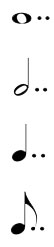
You might have seen these before:

It’s a little bit more complex than a single dotted noted and the general definition would be adding the value of the next faster note and then adding the value of the next faster note after that one or even more confusingly, adding half the value of the note plus a quarter value of the note. This is a needlessly complex way of explaining this and nobody wants to be doing math in their head while trying to play their music. Let’s take a look at the actual values of these double dotted notes and discuss this:

So let’s break down this concept using a whole note. In the case of a whole note you would add the value of a half note and a quarter note onto the whole note.

Whole note = 4 beats
Half note = 2 beats
Quarter note = 1 beat

Double Dotted Whole Note = Whole note + Half Note + Quarter note = 7 beats

All the note values can be broken down this way. At first it might be confusing but breaking it down into note values is so much easier than using fractions.

So while this isn’t a long lesson today it’s certainly an important and somewhat complex one. I hope this helps de-mystify this subject for you. Just for reference, here is a full chart of the note values when adding a dot or two dots to a note.

Thanks again for joining us here at Living Pianos. If you have any questions please contact us directly info@livingpianos.com (949) 244-3729.

What Do Two Dots do to a Note?

Welcome back to our two part series on dots and notes. Last time we covered What a Dot Does to a Note. Today we are going to discuss what two dots do to a note. Last time we talked about how adding a dot to a note adds the value of the next faster no