



Piano and Music Videos

Can't find what you're looking for?

Welcome to LivingPianos.com, I’m Robert Estrin. Today’s subject is about how to play for your piano teacher. I’ve been doing a lot of teaching lately, and I’m enjoying it. I’ve been so busy for the past few years I didn’t have time for much teaching. Now I’ve made the time, and through the wonder of video chat, I have students from all over the world! They are amazing, talented, and dedicated students. It’s a real joy! But I’ve noticed something with my students. If you are a piano student you’ve probably had this experience. You work all week long, then you go to play for your teacher and everything messes up! It’s so frustrating! You want to show your teacher what you’ve done, but you can’t play! Everything’s coming out wrong! Things that you never messed up are going wrong and you feel like an idiot! What can you do about that?

You don’t have to try to impress your teacher.

I want to reflect upon this whole notion of performing for your teacher. You have to understand that your teacher is a confidant. Your teacher is someone who really understands you, if you have the right teacher. You don’t have to try to impress them. They are there to nurture you and to help you get the most out of your practice. It’s not the most important thing for you to play your absolute best when you’re first playing for your teacher. Of course, it’s a great frustration if you don’t play your best when playing for your teacher. But how well you perform a piece for your teacher at the beginning of a lesson is really not the most important thing. A teacher can look beyond those things. The things that they’re going to go over with you have very little to do with the quality of that particular performance. Having said that, I know you want to play better for your teacher so I am going to address that.

You want to show that you can play the music. How can you prepare for such a thing?

It’s amazing how you can play something by yourself at home a bunch of times, and it sounds great! But as soon as you play for someone else, you make mistakes. With in-person lessons the classic statement was, “It went better at home.” Now there’s no excuses. You are at home! So what can you do to prepare so that you can play your best? You must prepare by performing. This is critical. A couple of days before your lesson when you feel really confident, set up the same device that you’re going to have your lesson on and record yourself as if it’s a performance for your teacher. If you go to lessons in person, imagine being in the room you’re going to be in with your teacher. Then make yourself play through your music and see what happens. Psych yourself into the reality that this is the moment you are playing for your teacher. You can actually create that same sense. You’ll always learn something from this. You could even record it. Then if it comes out great, you can send it to your teacher to prove to them that you can play that thing that you never seem to be able to play for them at lessons!

Playing for your teacher can be more relaxed than a performance.

Let’s say you’re working on a new piece. Maybe you don’t have the whole piece learned, so you have to take the end pretty slow. Should you take the whole piece dramatically slower to accommodate the end? Well, not necessarily. In a performance situation, whatever speed you can play the whole piece is the tempo you must play from the beginning. But you might have worked extensively on the exposition of a sonata, yet the development you really haven’t gotten into that much. So you want to play the first part up to tempo to work with your teacher to get it on an even higher level. Then at a certain point you can say, “Okay, this part, I don’t know as well, I’m going to play slower now.”

Changing tempo throughout a piece that you’re learning is not in anybody’s best interest. But playing the first section at a tempo that you’re comfortable with, and then slowing down when you need to, can be appropriate at your lesson. If you have only part of a piece memorized, you can reference the score. You wouldn’t do these things during a performance, but these are all valid ways of playing for your teacher!

Remember, your teacher is there for you!

It’s not about impressing your teacher. It’s about being able to show some kind of representation in the course of the lesson so your teacher can help guide your practice techniques for the following week. So it’s not necessarily about impressing them. However, if you take my advice and practice performing, and record your performance as if it’s your teacher listening to you, you may be able to have more satisfaction in that initial performance at your lesson and subsequent playing during the course of your lesson. Then you won’t feel frustrated that you’re not showing a true representation of your abilities.

I want everyone to know I am not judging you! For my students, I am only here to help you. I hope this helps all you piano students out there feel more confident when playing for your teachers! And teachers, remember to be sensitive to your students so they can feel good about coming into lessons and playing their best, which is what it’s all about. We’re all on the same side here! Thanks so much for joining me, Robert Estrin here at LivingPianos.com, Your Online Piano Resource.

For premium videos and exclusive content, you can join my Living Pianos Patreon channel! www.Patreon.com/RobertEstrin

Contact me if you are interested in private lessons. I have many resources for you! Robert@LivingPianos.com

www.LivingPianos.com
www.Facebook.com/LivingPianos
949-244-3729
How to Play for Your Piano Teacher

Welcome to LivingPianos.com, I’m Robert Estrin. Today’s subject is about how to play for your piano teacher. I’ve been doing a lot of teaching lately, and I’m enjoying it. I’ve been so busy for the past few years I didn&

This is LivingPianos.com. I’m Robert Estrin. Today I will answer a question I received from a viewer. Heinrich asks, “Is it true that you should never trust a person selling pianos?” There are so many implications to this question. I was taken aback by this. What kind of experiences has this man had? And if he’s had these experiences, how many others out there have had similar experiences? To answer this question, I want to talk about something personal.

We recently bought a restored Victorian building in the Waterloo Arts District in Cleveland.

The Waterloo Arts District in Cleveland is the new home of Living Pianos! The building is a magnificent structure that was built during the Civil War. It’s absolutely beautiful! Throughout the building there’s woodwork from old growth forest. You just don’t see that anymore. But nobody ever did anything with the floors. They looked old and tired. We came across a contractor who was recommended by my brother-in-law, who restores floors. It can be a hair-raising experience dealing with contractors. They tell you a bunch of stuff. You don’t know what to believe! They’re usually trying to sell you all kinds of things. You don’t know what you should do. But when you have a great salesperson, like we had, it makes all the difference. Johnny took us through and showed us everything we needed to understand. He educated us. More importantly, he listened to us.

There’s nothing worse than a salesperson who doesn’t listen to you.

We’ve all dealt with bad salespeople. You can talk until you’re blue in the face, but they’re obviously just trying to sell you something. They’re not solving your problem. Ultimately what a great salesperson does is listen to you so they understand your situation and can solve your problem.

Great salespeople are few and far between.

Are you more likely to meet a bad salesperson in the piano industry? I don’t believe there are worse salespeople in the piano industry compared to other industries. But great salespeople are quite rare. For example, years ago I had an opportunity to move to California, managing the tenth largest music store in the country. This was in Universal City. The store catered to the recording industry. I’ve always been very absorbed, some would say obsessed, with music technology. It was a natural fit for me. The reason I bring this up is that people would come in and they would ask for a specific item. They had it in their mind, they wanted this one item. And instead of just ringing it up, I’d ask about their studio. I’d ask about the other gear in their studio and what they were after with the item they came for. Sometimes I could steer them to a less expensive item that would solve their problem.

A great salesperson will listen to somebody to know what they’re trying to achieve and educate them so they can make the right decisions for themselves.

I’d like to think that there are people in the piano industry who are truly helping people. I know many people in the piano industry who have a passion for the piano and really care about the people and the music. But I want to hear from you! I want to know what your experiences have been. Are great salespeople more common in the piano industry? Or do you feel that the piano industry has more of the self-serving type? I hope it’s the former and not the latter! Let’s get a discussion going on this topic, because Heinrich really wants to know, and so do I. He brought up a really good point. I’m looking forward to the comments about this! Thanks so much for joining me, Robert Estrin here at LivingPianos.com, Your Online Piano Resource.

For premium videos and exclusive content, you can join my Living Pianos Patreon channel! www.Patreon.com/RobertEstrin

Contact me if you are interested in private lessons. I have many resources for you! Robert@LivingPianos.com

www.LivingPianos.com
www.Facebook.com/LivingPianos
949-244-3729

Should You Trust A Piano Salesperson?

This is LivingPianos.com. I’m Robert Estrin. Today I will answer a question I received from a viewer. Heinrich asks, “Is it true that you should never trust a person selling pianos?” There are so many implications to this question.

Welcome to LivingPianos.com. I’m Robert Estrin. Is your left hand bigger than your right hand? This is a great question. My left hand is bigger than my right hand. I bet a lot of you pianists out there find the same thing. You might wonder why. I’m really interested in comments from all of you to see if this is true! I’ve talked to many pianists who have found that their left hands are slightly larger than their right hands. It has nothing to do with being right-handed or left-handed either.

My left hand has a bigger reach than my right hand.

I can barely play white key tenths around the front of the keys. That’s my maximum reach. I’m going to talk more later about how you can overcome small hands and why it doesn’t really matter. Some of the greatest pianists of all time had very small hands, even smaller than mine! I can just barely reach white key 10ths. I don’t really depend upon it. I rarely play tenths because it takes so much time for me to grab tiny slivers of keys. It’s not really very useful. On the right hand, if I try to do the same thing, I absolutely can’t do it at all. I just can’t reach tenths with my right hand. You will find that this is true for most pianists. So you might wonder why this is the case. It might have to do with how much you practice and play the piano. And of course, natural physiology enters into it. I’m sure this is not a hundred percent universal. The reason pianists’ left hands are usually a bit larger is that left-hand parts tend to be more outstretched than right-hand parts. The right-hand usually has the melody. The left hand has accompaniments involving all kinds of stretching. So, your left-hand ends up being ever so slightly bigger than your right hand, generally speaking.

What are some ways to overcome the limitations of small hands on the piano?

I promised you some tips about small hands. I have relatively small hands. I always wanted to play music beyond my reach. I will say this: if you don’t have a solid octave you’re going to have a hard time with a lot of repertoire. Fortunately, you don’t really need much of a reach for baroque music or even most classical period music. Octaves are somewhat prevalent, but the reaches in earlier period music are not nearly as great as later period music. So you still might be okay, at least in some repertoire, if you don’t have good solid octaves. If you want to be able to play bigger reaches than an octave, or you can’t quite reach an octave as well as you’d like, perhaps what you want to do is to break the chords. I’ve talked about this before. When you break chords very quickly on the pedal, it’s hard to tell that you aren’t reaching all the notes at once! So, if you want to play big chords that you can’t possibly reach, how can you play them? Using the pedal while breaking chords very quickly will create the illusion of playing big chords beyond your reach.

Can you stretch your hands to expand your reach?

When I was a kid, my father taught me a stretching technique he had heard about. It involved gently pushing your hands against the keyboard to get a little more reach. I didn’t find this technique to be at all helpful. What did help me enormously was developing more strength for rapidly breaking chords. Chords that were beyond my reach became accessible to me! And, you’re going to find the same thing. So don’t fret if you don’t have a big reach! If you develop strength in your playing, you can learn how to break chords successfully and it sounds great! In fact, a lot of pianists with large hands will choose to break chords because of the richness of the sound it creates. So, get your hands nice and strong and learn how to break chords quickly and you’ll be fine. Just from playing music that has bigger reaches you can develop a slightly larger reach. Since the left hand generally has bigger stretches than the right hand, you will tend to find your left hand reach will be a smidgen larger than your right hand.

Have you noticed this? I’d love to get a conversation started! Let me know in the comments how you feel about this! Thanks so much for joining me, Robert Estrin here at LivingPianos.com, Your Online Piano Resource.

For premium videos and exclusive content, you can join my Living Pianos Patreon channel! www.Patreon.com/RobertEstrin

Contact me if you are interested in private lessons. I have many resources for you! Robert@LivingPianos.com

www.LivingPianos.com
www.Facebook.com/LivingPianos
949-244-3729

Why is Your Left Hand Bigger Than Your Right Hand?

Welcome to LivingPianos.com. I’m Robert Estrin. Is your left hand bigger than your right hand? This is a great question. My left hand is bigger than my right hand. I bet a lot of you pianists out there find the same thing. You might wonder why.

Welcome to LivingPianos.com, I’m Robert Estrin. Today’s subject is about lead sheets. Lead sheets are what jazz, rock, country, new age, and many other musicians play from. It’s simply the melody line and chord symbols rather than all the notes on the grand staff to be played by both hands. That’s what most working musicians read from, not the full score. As a matter of fact, other than Classical and perhaps Broadway musicals, the vast majority of music is not all written out note for note. The musicians kind of make up their part based upon the chord symbols and the melody line. So you might wonder: Did Classical musicians ever play from lead sheets? The answer is surprisingly, yes! Perhaps it’s a lost art, but let’s look back to the Baroque Era, with composers like Bach, Handel, Telemann, Corelli, and Vivaldi.

In the Baroque era music was written very differently.

With Baroque music, first of all, there were very few dynamics or phrasing indicated in the score. It was mostly just the notes, and that’s about it. Not only that, but you’ll notice ornamentation symbols throughout the score. These are squiggly lines that scholars, centuries later, are still trying to decipher what the composers meant by them. There are volumes of books written about how to approach mordents, trills and turns, as well as other ornamentation. The fact of the matter is, everybody has different ideas about them now. Back then, it’s likely that performers had the freedom to decide how much to embellish the score based upon these ornaments that were in the score. Perhaps they even added ornamentation in places that didn’t have any of these markings. There was a freedom to improvise on the music. But it goes much deeper than that.

Did you know that the trio sonata, which so many composers from Corelli to Telemann wrote hundreds of, were not actually completely written out?

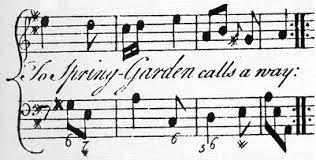
Today, if you buy the sheet music to a trio sonata, it’s all written out. But it wasn’t originally written out. What is a trio sonata? A trio sonata was actually written for a solo instrument. It could be a violin. It could be a flute. It could be any instrument. And a basso continuo, which could be virtually any instrument playing the low part. Perhaps a cello, viola da gamba, something that could play the bass line, which was written out. So you had the melody and the bass written out. Well, what about the keyboard part, the harpsichord, in most cases back then? Was that part written out? No. Now, it wasn’t a lead sheet the way we think of a modern lead sheet. It was what’s called figured bass. Figured bass was a type of lead sheet notation, for lack of a better term.

It did not have the notes. It just had chord symbols (in addition to the melody and bass line). The player had to realize the part based upon those symbols. They were improvising based upon chord changes, just like a jazz musician does today! This is the lost art of improvisation of the Baroque era.

Today when you buy sheet music for a Corelli or Telemann trio sonata it is all written out.

Somebody has gone to the trouble of realizing and writing out a keyboard part from those chord symbols of the figured bass. So almost nobody improvises anymore today. There are some early instrument enthusiasts who actually do this sort of thing. But for the most part, Classical musicians are so used to the sanctity of the score, that they don’t even realize that it wasn’t originally written out! These early works were not written out, except for the melody and the bass. The rest of it was left up to the performer to realize. And even the other parts could be embellished with ornamentation.

This is the truth about Classical music. It was much closer to modern styles of music than most people know. But today we look at it almost like pieces in a museum that you shouldn’t touch. They need to be preserved exactly as they were. But these were living, breathing works of music that evolved depending on who was performing them. So you want to approach Classical music in this way.

Cadenzas were originally improvised, not necessarily written out and learned.

The cadenza was a time for performers to showcase what they could do in the middle of a concerto, taking off on the themes that they had just played. Again, this is all but a lost art. During the Romantic period at salon concerts and informal gatherings, people would make up music going back and forth. They would try to outdo each other. This is what keeps Classical music alive and fresh, that spontaneous element. So while I certainly respect the scores of the great composers and fastidiously learn them, at the same time, you want to understand the lineage where this music comes from. You can add an element of spontaneity and inventiveness to your playing, realizing that these weren’t just static, etched-in-stone works. But they evolved, depending upon who was performing them!

I hope this has been interesting for you! Thanks so much for joining me, Robert Estrin here at LivingPianos.com, Your Online Piano Resource.

For premium videos and exclusive content, you can join my Living Pianos Patreon channel! www.Patreon.com/RobertEstrin

Contact me if you are interested in private lessons. I have many resources for you! Robert@LivingPianos.com

www.LivingPianos.com
www.Facebook.com/LivingPianos
949-244-3729

Did Classical Musicians Ever Play from Lead Sheets?

Welcome to LivingPianos.com, I’m Robert Estrin. Today’s subject is about lead sheets. Lead sheets are what jazz, rock, country, new age, and many other musicians play from. It’s simply the melody line and chord symbols rather than a

Welcome to LivingPianos.com, I’m Robert Estrin. Today’s subject is about what makes a teacher great. Great teachers are so rare. In public school I could count on one hand the truly great teachers I had throughout all my years of schooling. Oftentimes at a certain point in the year, the teacher would assign a paper. It had to be a certain length and you had to have a bibliography of the works you referenced. Everybody in the class would break out into a cold sweat. Why? Because nobody ever actually showed us how to write a paper! They would tell you to make an outline, as if that’s helpful. You wouldn’t even know how to make an outline! Nobody ever showed us how to approach such a thing. They just said, “Do it.” And that was the way it was so much of the time with homework. “Read the book,” they would say. But the people who wrote the books weren’t always great teachers either. I encounter this so much of the time with theory books, by the way. It can be so confusing that it goes right over students’ heads. If you already understand the theory, you can kind of grasp what they’re going for, but in the most convoluted and complex way. It doesn’t help someone to actually learn music theory.

In 11th grade I had a great teacher named Mr. Gray.

Mr. Gray changed my life because he actually showed us how to craft an English composition. To this day I am thankful for what he showed us. I still use the tools he provided in my writing today. It’s the way of organizing. There’s a methodology which I could go into another time, if any of you are interested. It’s a little off topic from music, but not really because in this world, we all have to express ourselves in print. Even if it’s just emails to people, you want to be concise. You want to be digestible and memorable. Organization is a big part of that. This is true for all teaching.

What is the most essential element to teaching?

What is the best way to convey ideas? The best way is to break things down to their component parts in a logical fashion. If you’ve ever had a great math teacher, you know what I’m talking about. Because when you have a math teacher who’s not great, you just feel completely overwhelmed. It can make you feel stupid! Because you think, “Why can’t I get this?” You’re looking at some mathematical equation that you can’t begin to solve because nobody’s given you the tools. But if you have a great math teacher who shows you the methodology, step by step, it’s enlightening. Not only that, it makes doing your homework fun because you understand what you’re doing. You’re not just trying to grope in the dark and hope you stumble upon answers. You know exactly what to do, step by step. That is what you look for in a teacher. This is true with any subject.

Music theory is one of those subjects that is often taught poorly.

I’m not going to mention the school by name, but I went to a school that was guilty of constantly teaching above the students’ comprehension. Part of it was the teachers would write the books that would be used in the class and they wanted to appear smarter than the students. What’s the best way to do that? Have a lot of jargon in the book that’s just not quite digestible. You seem smarter than your students and the students are looking to you for guidance. If you’ve ever felt that way with a teacher, it’s not you. It’s them! They are not giving you the tools you need.

A great teacher empowers you to solve problems.

Whether it’s how to play the piano, how to do math, or how to figure out music theory, a great teacher will completely solidify the basics. It’s the same thing with studying pieces of music. You must have a complete grasp of what you’re doing. It’s so satisfying when you’re anchored that way intellectually. Then you can build from there. Each concept builds on the previous. It’s obvious with a subject like math. But music is no different. In fact, most subjects need to be addressed this way so you can build logically from a solid foundation of understanding and have the tools and the steps needed for your daily work. And that’s how you know you have a great teacher in whatever subject you’re learning. When you have one, you’ll feel so grateful. It opens your mind because it’s not just the little tidbits you get at the lessons. It’s what you get not only throughout the week, but in the months, and yes, the years to follow. Just like the lessons I learned from Mr. Gray in 11th grade!

I hope this is helpful for you. Thanks so much for joining me, Robert Estrin here at LivingPianos.com, Your Online Piano Resource.

For premium videos and exclusive content, you can join my Living Pianos Patreon channel! www.Patreon.com/RobertEstrin

Contact me if you are interested in private lessons. I have many resources for you! Robert@LivingPianos.com

www.LivingPianos.com
www.Facebook.com/LivingPianos
949-244-3729

TEACHER RANT: What Makes a Great Teacher

Welcome to LivingPianos.com, I’m Robert Estrin. Today’s subject is about what makes a teacher great. Great teachers are so rare. In public school I could count on one hand the truly great teachers I had throughout all my years of schoolin

Welcome to LivingPianos.com, I’m Robert Estrin. Today’s subject is about how to keep your review pieces on performance level. I talk to so many people who wonder how they can learn new pieces without forgetting old pieces. People can end up studying the piano for years and still only have one piece they can play, the piece they’re working on that week! So, how do you keep old pieces in shape? How can you possibly have time to learn new pieces when you’re reviewing all your old pieces?

Of course the answer is, you can’t keep every piece you’ve ever played in your hands and in your head all the time. It becomes impossible! Once you amass a repertoire of five or six hours of music, you can’t possibly keep everything in shape. However, it is vitally important that you keep at least the last few pieces you’ve studied in your hands and in your head. Because there’s a pleasure and an ease you gain with music you’ve played for a long time. So, how do you do that without taking up all of your practice time?

The best, easiest, and most fun way of keeping your review pieces in shape is to play them!

Play your pieces all the time! play them every day! Why not? Obviously, if you have pieces like the Hammerklavier Sonata of Beethoven or the Bach Goldberg Variations, they’re going to take a while to play through. So, there are certain limitations depending upon the level you’re on. But certainly you should keep playing the pieces that you’ve studied within the past few weeks.

Let’s say you’re working on a brand new piece, and you have the piece you did at your last lesson. Well, it’s better to have the last few pieces, at least three to five pieces. Otherwise, as I said, you could be playing the piano for years and never have anything really secure. Because there’s nothing like the security of playing a piece that you’ve known for a long time. The ease and security you gain from living with music is tremendous. If you never review those pieces, everything is kind of tentative and you never have that pleasure.

Simply playing through your pieces, is that all you have to do?

Playing through your pieces isn’t all you have to do, but most of the time that’s enough. On a daily basis or at least every other day, play through your review pieces. Play through a bunch of them. It’s fun because they’re pieces you already know. What’s the purpose of all this practicing if you’re not going to have anything you can play? You should enjoy playing the piano, not just practicing. You put in all this tedious work of learning music and working out all the technical details. The reward at the end of the line is being able to play! So of course play them, and play them for people. You’ll get better at performing simply by playing for other people.

Now, if you keep playing your pieces over and over again for weeks on end and that’s all you do, they will deteriorate over time. Because there are slight changes that happen. Which is why you must go back to the score on a periodic basis with your music if it’s something you’ve memorized. Put the score up and play with your foot off the pedal so you can hear the underlying performance without the benefit of the pedal which can obscure things. Sometimes you should use a metronome to make sure you’re playing at a constant tempo. This is a great way to reinforce your playing. Playing with the score slowly to a metronome with no pedal reinforces everything that you’ve learned before. It’s a refresher. I recommend it highly for all of your review pieces. This is particularly helpful with pieces you’ve recently learned that you’re trying to get on that ultimate level. This is a terrific way of doing that. You can actually work at different speeds. Start very slowly with the score, because it’s hard to read something you’ve memorized, particularly if it’s a piece that’s above your reading level. You undoubtedly read through it when you first got it just to see what it was about, and then you got to work and learned it. Going back trying to read it is a tough task, but it’s also vitally important if you want to keep your performance on a high level. Otherwise, it’s like a game of telephone where the message gets so garbled it ends up being a whole new message. If you play your piece over and over enough times and never refer to the score, you can end up with a whole different piece! So, it’s incredibly important to reference the score.

Choose wisely which pieces you keep in your repertoire.

Definitely keep at least the last two or three pieces you’ve learned in your repertoire so you can really solidify them and enjoy the fruits of your labor. You might also select some choice pieces that you’ve learned that you never want to forget. Play them often enough that they don’t get too far gone. If you find that they’ve deteriorated to a great extent, go back to the score. You might have to practice some sections, but don’t let them get so far gone that you have to practically start all over to learn them again. But even if you do, you’ll find if you’ve really learned a piece of music and committed it to memory, relearning it is much faster than initially learning it. So, that’s the good news for any of you out there who haven’t done this. Go ahead and relearn some of those pieces. At first it’ll seem arduous, but then you’ll quickly assimilate the score once again.

There are pieces I’ve learned and relearned multiple times. They become cemented almost as a part of my permanent repertoire. There’s a number of pieces that I just have all the time. Even if I haven’t played them in years, they’re still there. But it takes a long time to get to that point. In the meantime, play through your pieces on a regular basis and have fun with your music! Thanks so much for joining me, Robert Estrin here at LivingPianos.com, Your Online Piano Resource.

For premium videos and exclusive content, you can join my Living Pianos Patreon channel! www.Patreon.com/RobertEstrin

Contact me if you are interested in private lessons. I have many resources for you! Robert@LivingPianos.com

www.LivingPianos.com \
www.Facebook.com/LivingPianos
949-244-3729

How to Keep Your Review Pieces on Performance Level

Welcome to LivingPianos.com, I’m Robert Estrin. Today’s subject is about how to keep your review pieces on performance level. I talk to so many people who wonder how they can learn new pieces without forgetting old pieces. People can end