

All posts by Robert Estrin

What Does Chopin Sound Like Without the Pedal?

Welcome to www.Livingpianos.com. I’m Robert Estrin. The subject today is about what Chopin sounds like without the pedal. When I talk about the pedal I’m talking about the sustain pedal. It’s the one on the right that holds all the notes when you put it down. It’s a glorious thing! It makes everything sound better, doesn’t it? And louder too! It helps you to connect what you can’t connect with your fingers.

What is the job of the pedal in music in general, and in Chopin specifically?

The pedal actually has two distinct functions. One is to connect notes you can’t connect with your hands. For example, you will see music where you have a whole note in the lower register and other things going on in the upper register. You can’t possibly hold that whole note because you’ve got other notes to play. Pedal to the rescue! There is no way to hold those notes with your hands. So sometimes music is written in such a way that you depend upon the pedal to play what’s written in the score. But there’s also the tone enhancement that the pedal affords you in your musical performance.

When you play a note with the pedal, you get a different sound than without the pedal.

If you listen to a note with no pedal compared to the same note played with the pedal down, you will hear that it gets more of a reverberant sound with the pedal down. When you depress the pedal the dampers lift off of all the strings so they are free to vibrate sympathetically, enhancing the tone. And indeed, when you depress the pedal it will have an effect upon the tone, the envelope of the sound. That is the shape of the decay. You can enhance the sustain by judiciously using the pedal just at the point at which the tone might be dying away. But that’s a subject for another day.

What does Chopin sound like without the pedal? Of course it depends upon what piece of Chopin. The famous E-flat Nocturne Opus 9 no. 2, for example, doesn’t really have notes you can’t hold in terms of what’s written in the score, but it’s implied to use the pedal.

When I play without the pedal I strive to connect as much as possible with my fingers.

I can’t connect everything I want to with just my fingers. But I try my best so that the pedal can enhance the sound and not be used as a crutch for things that I can connect with my fingers. You want to strive for your playing to be as legato as possible with your fingers before putting the pedal in. Because if you practice it with the pedal right from the get-go, you might not use the ideal fingering in order to connect as much as possible. So you want to connect with your fingers everything you can. Then it becomes obvious where to pedal. And of course, adding the pedal gives you a much more beautiful sound. Plus you can hold the bass notes to get a richer sound and a more linear quality to bass notes, and indeed the inner voices as well. With the pedal, you get the sense of the line instead of just the chords. The bassline has enough sustain from note to note, instead of just being sporadic.

With the Chopin G Minor Ballade indeed, you not only need the pedal to get the sense of the lines, but there are notes you just can’t possibly hold without it. This is the genius of Chopin! It’s amazing that he could conceive of, and write down music that would work so incredibly well with the pedal. Without the pedal it practically sounds like a whole different piece!

So that’s what the pedal adds to Chopin!

There’s a richness to the quality of the sound you get with the pedal. You get sustained harmonies and a linear aspect of all the lines, from the bass all the way to the treble. Not to mention the enhancement of the tone. Because you can use the pedal to get little gradations of tone in the melody to make one note kind of meld into the next by enriching it with sympathetic vibrations that the other strings allow for when you release the dampers with the sustain pedal.

I hope this has been interesting for you! Thanks so much for joining me, Robert Estrin here at LivingPianos.com, Your Online Piano Resource.

For premium videos and exclusive content, you can join my Living Pianos Patreon channel! www.Patreon.com/RobertEstrin

Contact me if you are interested in private lessons. I have many resources for you! Robert@LivingPianos.com

www.LivingPianos.com
www.Facebook.com/LivingPianos
949-244-3729
Did Classical Musicians Ever Play from Lead Sheets?

Welcome to LivingPianos.com, I’m Robert Estrin. Today’s subject is about lead sheets. Lead sheets are what jazz, rock, country, new age, and many other musicians play from. It’s simply the melody line and chord symbols rather than all the notes on the grand staff to be played by both hands. That’s what most working musicians read from, not the full score. As a matter of fact, other than Classical and perhaps Broadway musicals, the vast majority of music is not all written out note for note. The musicians kind of make up their part based upon the chord symbols and the melody line. So you might wonder: Did Classical musicians ever play from lead sheets? The answer is surprisingly, yes! Perhaps it’s a lost art, but let’s look back to the Baroque Era, with composers like Bach, Handel, Telemann, Corelli, and Vivaldi.

In the Baroque era music was written very differently.

With Baroque music, first of all, there were very few dynamics or phrasing indicated in the score. It was mostly just the notes, and that’s about it. Not only that, but you’ll notice ornamentation symbols throughout the score. These are squiggly lines that scholars, centuries later, are still trying to decipher what the composers meant by them. There are volumes of books written about how to approach mordents, trills and turns, as well as other ornamentation. The fact of the matter is, everybody has different ideas about them now. Back then, it’s likely that performers had the freedom to decide how much to embellish the score based upon these ornaments that were in the score. Perhaps they even added ornamentation in places that didn’t have any of these markings. There was a freedom to improvise on the music. But it goes much deeper than that.

Did you know that the trio sonata, which so many composers from Corelli to Telemann wrote hundreds of, were not actually completely written out?

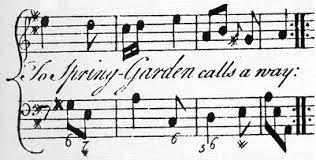
Today, if you buy the sheet music to a trio sonata, it’s all written out. But it wasn’t originally written out. What is a trio sonata? A trio sonata was actually written for a solo instrument. It could be a violin. It could be a flute. It could be any instrument. And a basso continuo, which could be virtually any instrument playing the low part. Perhaps a cello, viola da gamba, something that could play the bass line, which was written out. So you had the melody and the bass written out. Well, what about the keyboard part, the harpsichord, in most cases back then? Was that part written out? No. Now, it wasn’t a lead sheet the way we think of a modern lead sheet. It was what’s called figured bass. Figured bass was a type of lead sheet notation, for lack of a better term.

It did not have the notes. It just had chord symbols (in addition to the melody and bass line). The player had to realize the part based upon those symbols. They were improvising based upon chord changes, just like a jazz musician does today! This is the lost art of improvisation of the Baroque era.

Today when you buy sheet music for a Corelli or Telemann trio sonata it is all written out.

Somebody has gone to the trouble of realizing and writing out a keyboard part from those chord symbols of the figured bass. So almost nobody improvises anymore today. There are some early instrument enthusiasts who actually do this sort of thing. But for the most part, Classical musicians are so used to the sanctity of the score, that they don’t even realize that it wasn’t originally written out! These early works were not written out, except for the melody and the bass. The rest of it was left up to the performer to realize. And even the other parts could be embellished with ornamentation.

This is the truth about Classical music. It was much closer to modern styles of music than most people know. But today we look at it almost like pieces in a museum that you shouldn’t touch. They need to be preserved exactly as they were. But these were living, breathing works of music that evolved depending on who was performing them. So you want to approach Classical music in this way.

Cadenzas were originally improvised, not necessarily written out and learned.

The cadenza was a time for performers to showcase what they could do in the middle of a concerto, taking off on the themes that they had just played. Again, this is all but a lost art. During the Romantic period at salon concerts and informal gatherings, people would make up music going back and forth. They would try to outdo each other. This is what keeps Classical music alive and fresh, that spontaneous element. So while I certainly respect the scores of the great composers and fastidiously learn them, at the same time, you want to understand the lineage where this music comes from. You can add an element of spontaneity and inventiveness to your playing, realizing that these weren’t just static, etched-in-stone works. But they evolved, depending upon who was performing them!

I hope this has been interesting for you! Thanks so much for joining me, Robert Estrin here at LivingPianos.com, Your Online Piano Resource.

For premium videos and exclusive content, you can join my Living Pianos Patreon channel! www.Patreon.com/RobertEstrin

Contact me if you are interested in private lessons. I have many resources for you! Robert@LivingPianos.com

www.LivingPianos.com
www.Facebook.com/LivingPianos
949-244-3729

How to Use the Pedal on the Piano

Welcome to LivingPianos.com, I’m Robert Estrin. The subject today is about how to use the pedal on the piano. This is such a deep subject. I have other videos on the finer points about pedaling, how it imparts changes in tone, when to use it, when not to use it, and how to use the sustain pedal in conjunction with the soft pedal. But today I will cover the fundamentals. If you’ve ever wondered how the pedal works, you’ve come to the right place!

The interesting thing about the pedal is that it does not go down rhythmically.

If you’ve just started using the pedal the hardest thing about it is that it is not used rhythmically, because you want to tap your foot on the beat. It’s the most natural thing in the world! Yet that doesn’t work on the piano. It doesn’t work because if you push the pedal down when a note plays, you will capture the harmonies of the previous notes that were down. It’s a mess. Why is that? The fact of the matter is, when you push the pedal down, whatever notes are held down are going to continue holding down. When you play a note, you’re still holding down the previous notes to some extent, particularly if something is slurred.

How do you create a slur on the piano?

A slur is a glide between notes. A singer or a French horn player does it very naturally and the notes between the slur are all there. On the piano, you can’t do that. So you tend to overlap notes, and that’s the way you create the illusion of a slur. But what happens when you pedal on the beat is the previously played notes are going to be held. If I play middle C and then a C sharp and I pedal at the same moment as I play the C sharp, you’re going to hear the C and the C sharp together. You will hear dissonance. The pedal must go down right after notes plays.

But here’s some good news for you, the pedal comes up exactly on the beat!

The pedal goes up exactly when you play a note. But the pedal goes down right after the note, arrhythmically. It’s important that you understand that, otherwise, you’re going to hear dissonance. It’s the nature of the pedal.

There’s so much more to the pedal. As a matter of fact, I will put links in the description of some other videos I have on pedaling. Decades ago, I made 50 hour-long presentations live on the internet, for a company in Irvine. My show was called Keyboard Kaleidoscope. One episode is an hour long show on the pedal that I will share with you in the notes below, in the description, and on LivingPianos.com! I hope this is helpful for you. Thanks so much for joining me, Robert Estrin here at LivingPianos.com, Your Online Piano Resource.

For premium videos and exclusive content, you can join my Living Pianos Patreon channel! www.Patreon.com/RobertEstrin

Contact me if you are interested in private lessons. I have many resources for you! Robert@LivingPianos.com

HOW TO USE THE PEDAL ON THE PIANO – KEYBOARD KALEIDOSCOPE – ROBERT ESTRIN

www.LivingPianos.com
www.Facebook.com/LivingPianos
949-244-3729

TEACHER RANT: What Makes a Great Teacher

Welcome to LivingPianos.com, I’m Robert Estrin. Today’s subject is about what makes a teacher great. Great teachers are so rare. In public school I could count on one hand the truly great teachers I had throughout all my years of schooling. Oftentimes at a certain point in the year, the teacher would assign a paper. It had to be a certain length and you had to have a bibliography of the works you referenced. Everybody in the class would break out into a cold sweat. Why? Because nobody ever actually showed us how to write a paper! They would tell you to make an outline, as if that’s helpful. You wouldn’t even know how to make an outline! Nobody ever showed us how to approach such a thing. They just said, “Do it.” And that was the way it was so much of the time with homework. “Read the book,” they would say. But the people who wrote the books weren’t always great teachers either. I encounter this so much of the time with theory books, by the way. It can be so confusing that it goes right over students’ heads. If you already understand the theory, you can kind of grasp what they’re going for, but in the most convoluted and complex way. It doesn’t help someone to actually learn music theory.

In 11th grade I had a great teacher named Mr. Gray.

Mr. Gray changed my life because he actually showed us how to craft an English composition. To this day I am thankful for what he showed us. I still use the tools he provided in my writing today. It’s the way of organizing. There’s a methodology which I could go into another time, if any of you are interested. It’s a little off topic from music, but not really because in this world, we all have to express ourselves in print. Even if it’s just emails to people, you want to be concise. You want to be digestible and memorable. Organization is a big part of that. This is true for all teaching.

What is the most essential element to teaching?

What is the best way to convey ideas? The best way is to break things down to their component parts in a logical fashion. If you’ve ever had a great math teacher, you know what I’m talking about. Because when you have a math teacher who’s not great, you just feel completely overwhelmed. It can make you feel stupid! Because you think, “Why can’t I get this?” You’re looking at some mathematical equation that you can’t begin to solve because nobody’s given you the tools. But if you have a great math teacher who shows you the methodology, step by step, it’s enlightening. Not only that, it makes doing your homework fun because you understand what you’re doing. You’re not just trying to grope in the dark and hope you stumble upon answers. You know exactly what to do, step by step. That is what you look for in a teacher. This is true with any subject.

Music theory is one of those subjects that is often taught poorly.

I’m not going to mention the school by name, but I went to a school that was guilty of constantly teaching above the students’ comprehension. Part of it was the teachers would write the books that would be used in the class and they wanted to appear smarter than the students. What’s the best way to do that? Have a lot of jargon in the book that’s just not quite digestible. You seem smarter than your students and the students are looking to you for guidance. If you’ve ever felt that way with a teacher, it’s not you. It’s them! They are not giving you the tools you need.

A great teacher empowers you to solve problems.

Whether it’s how to play the piano, how to do math, or how to figure out music theory, a great teacher will completely solidify the basics. It’s the same thing with studying pieces of music. You must have a complete grasp of what you’re doing. It’s so satisfying when you’re anchored that way intellectually. Then you can build from there. Each concept builds on the previous. It’s obvious with a subject like math. But music is no different. In fact, most subjects need to be addressed this way so you can build logically from a solid foundation of understanding and have the tools and the steps needed for your daily work. And that’s how you know you have a great teacher in whatever subject you’re learning. When you have one, you’ll feel so grateful. It opens your mind because it’s not just the little tidbits you get at the lessons. It’s what you get not only throughout the week, but in the months, and yes, the years to follow. Just like the lessons I learned from Mr. Gray in 11th grade!

I hope this is helpful for you. Thanks so much for joining me, Robert Estrin here at LivingPianos.com, Your Online Piano Resource.

For premium videos and exclusive content, you can join my Living Pianos Patreon channel! www.Patreon.com/RobertEstrin

Contact me if you are interested in private lessons. I have many resources for you! Robert@LivingPianos.com

www.LivingPianos.com
www.Facebook.com/LivingPianos
949-244-3729

Rhythm: The Most Important Element of Music!

Welcome to LivingPianos.com, I’m Robert Estrin. Today’s subject is about the most important element of music: rhythm. Is rhythm really the most important aspect of music? What about the notes? Well, think of it this way: Let’s say there’s a party and you know where the party is. You know it’s a birthday party for your friend. You know whether you’re supposed to bring presents or not, and what the activities are going to be. But if you don’t know when the party is, guess what? No party!

You need to know the when!

Imagine hearing a piece of music with no rhythm, all the notes played equally. Would you even be able to identify the piece? it would sound drastically different without the rhythmic component. But hearing the same exact notes with a rhythmic context sounds completely different. Rhythm is so intrinsically important! Of course there are many elements that are important, but without rhythm, what do you have? You really have nothing unless you put it in some context of time. It’s human nature because our entire experience is based upon the element of time. We go through life in a linear fashion, after all. It’s the way we relate to everything! You could play all the notes of a piece, but it’s meaningless if you don’t have a rhythmic context. That’s why it’s so vitally important in your practice to count out your rhythm.

Composers weren’t haphazard about rhythmic notation.

Things were written precisely for a reason. Because without the rhythm, Beethoven’s Fifth Symphony doesn’t sound like much of anything. This is true of all music. I encourage all of you to count in your practice, to measure your rhythm with a metronome, and double and triple check note values as well as rests. That’s what brings music alive and gives it meaning. This is such an important topic. I’m curious how all of you feel about this! Let me know in the comments. Thanks so much for joining me, Robert Estrin here at LivingPianos.com, Your Online Piano Resource.

For premium videos and exclusive content, you can join my Living Pianos Patreon channel! www.Patreon.com/RobertEstrin

Contact me if you are interested in private lessons. I have many resources for you! Robert@LivingPianos.com

www.LivingPianos.com
www.Facebook.com/LivingPianos
949-244-3729
Can a Dotted Note Get the Beat?

Welcome to LivingPianos.com, I’m Robert Estrin. Today’s question is, “Can a dotted note get the beat?” This is a much more complicated question than you might imagine. The simple answer is no, but with a qualified, yes. Let me explain a bit. First, a primer on time signatures. The top number in a time signature represents how many beats there are in each measure. Each measure of music has a certain number of beats. So if you have a 4 on top, naturally you have 4 beats in each measure. The bottom number represents the kind of note that gets one beat. So if you have a 4 on the bottom, the 4 stands for the quarter note and the quarter note gets one beat. That’s simple enough.

HOW MANY BEATS IN EACH MEASURE

KIND OF NOTE GETTING ONE BEAT

4 – There are 4 beats in each measure

4 – A quarter note gets one beat

Why do you have to have different notes getting one beat? Why would that ever change?

What I’m about to reveal to you will make sense as to why composers choose to have a different note value getting the beat. Why not keep that standard? Well, I’m going to use an example of the second movement of the Clementi D Major Sonatina Opus 36, Number 6. This movement is in 6/8 time. Once again, the top number tells you there are 6 beats in a measure and the bottom number tells you an eighth note gets one beat. So yes, there are 6 beats in each measure. But when you’re playing fast, if you’re tapping along, you’re probably not tapping every single one of those eighth notes. In fact, you end up tapping twice each measure! Those are dotted quarter notes. This is sometimes referred to as a duple division of the measure because you have two groups of 3, two dotted quarter notes, each of which essentially gets the beat. The time signature isn’t written that way though. There’s no way to indicate this in the time signature. So why would a composer choose to write 6/8 since 6 eighth notes is the same as 3 quarter notes. So why wouldn’t it be written in 3/4? Why do composers ever put an 8 or 16 on the bottom? It’s because the subdivisions cause the measure to be divided differently. So you can actually count this piece of 6/8 in two, counting each dotted quarter note as one beat.

In a faster piece, counting in two makes more sense.

Imagine a really fast piece in 6/8. Instead of counting 1, 2, 3, 4, 5, 6 quickly, you count 1, 2 on the first and fourth beat of each measure. That’s basically having dotted quarter notes getting the beat! The time signature doesn’t indicate that precisely, but once you see your music it becomes really obvious. For example, you’ll see notes being grouped in 3’s, 3 eighth notes and 3 eighth notes in a measure, and oftentimes dotted quarter notes. This is how a dotted note will get the beat. The time signature doesn’t tell you that explicitly, but if a piece is rather fast it just makes sense to count it that way.

Notes

With a slow piece in 6/8 it may be different. For example, in the second movement of the Opus 10 Number 3 Beethoven Sonata. You probably wouldn’t count that in two because it’s too slow. So there are times in 6/8 where indeed there are 6 beats in the measure. But when 6/8, 3/8, 9/8, or 12/8 is fast, it’s almost always counted with the dotted quarter note getting one beat and each of those beats being divided into 3 because a dotted quarter note contains 3 eighth notes. So, composers who want a triplet feel and don’t want a whole piece written with triplets all over the place, will instead write the piece with the eighth note getting one beat. The dotted quarter notes essentially become the de facto beat with 3 divisions of each beat being the eighth notes. So that 3/8 time could be in one, 6/8 time could be in two, 9/8 time could be in three, and 12/8 time could be in four. Once again, each one of those beats has groups of 3, which is markedly different from 4/4 time compared to 12/8 time. In 4/4 time, generally, each beat is divided in half or quarters. You have two eighth notes in each beat or four sixteenth notes to each beat.

Composers sometimes will write a piece with triplets throughout the whole thing like in the famous Heller Etudes in A minor. That piece could very well have been written in 6/8 time, but for whatever reason, Heller decided to write it in four and have triplets throughout the whole piece. That is an option. But most often when you have triple divisions of each beat, rather than write with a quarter note getting one beat, composers will write with the eighth note getting one beat. Then the dotted quarter note becomes the de facto beat with 3 eight notes in each dotted quarter note. I hope this has been helpful for you! Thanks so much for joining me, Robert Estrin here at LivingPianos.com, Your Online Piano Resource.

For premium videos and exclusive content, you can join my Living Pianos Patreon channel! www.Patreon.com/RobertEstrin

Contact me if you are interested in private lessons. I have many resources for you! Robert@LivingPianos.com

www.LivingPianos.com
www.Facebook.com/LivingPianos
949-244-3729