Welcome to LivingPianos.com. I’m Robert Estrin. Today I have a really provocative subject for you: Why You Must Learn to Fake at the Piano. Now, if you have ever had a teacher or studied seriously, you have probably been told that faking is the
Welcome to LivingPianos.com. I’m Robert Estrin. If you are completely satisfied with your piano playing and are getting exactly the results you want from your practice, then this article may not be for you. But if you are striving for a higher
Welcome to LivingPianos.com. I’m Robert Estrin. Today I’m going to take you on a day by day journey of mastering a difficult piano piece. Maybe there’s a piece you’ve always wanted to learn, or perhaps you’re struggling with one right n
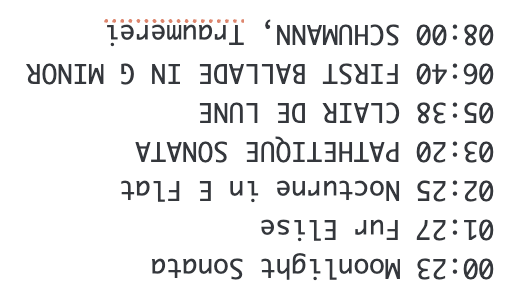
Welcome to LivingPianos.com. I’m Robert Estrin. Today I have something a little different and a lot of fun for you. In this video, I put your ears to the test with a musical guessing game. I play short excerpts from some of the most famous clas
Welcome to LivingPianos.com. I’m Robert Estrin. If you are considering putting a piano into storage, this is something you absolutely need to think through carefully. I have seen this scenario play out time and time again, and it can end in a w
Working My Way Up to Something Special Over the years, I gradually worked my way up through different pianos. At one point I had a Young Chang 6’1″, and from there I upgraded to a Baldwin L. Each instrument was a step forward, both musica
Learn just the first two measures with the right hand. This won’t take long. Play it several times until it’s memorized, checking back and forth with the score. Once it feels comfortable, bring it up to an easy tempo.
Then Learn the Left Hand
Next, learn the left hand. Because it’s built on broken chords, start by learning the chords as solid blocks. This helps you understand the underlying harmony and naturally leads to good fingering. Memorize those chords first, then break them up and play them as written.
You may find that using the pedal creates a beautiful sound. While Mozart’s piano didn’t have a modern sustain pedal, it did have a knee lever that served a similar function. Still, too much pedal can blur the texture. Instead, you can use what I call a phantom pedal by holding the first note of each chord. It’s not essential, but it produces a lovely effect. This enables you to use the pedal to enhance the melody instead of using it to make the chords smooth.
Once the left hand is secure, make sure the right hand is still correct. Check all the details. For example, notice the slur in the second measure and be sure to shape it properly. You never save time by learning something incorrectly, even if it seems minor.
Put the Hands Together
The hardest part of piano playing is putting the hands together. Once each hand is securely memorized, slow the tempo way down and try playing hands together from memory. And check your work. Make sure, for example, that the C in the right hand releases exactly when the E plays at the quarter rest at the end of the second measure. Be fastidious with the details, because you will spend ten times longer fixing anything you didn’t pay attention to initially. If you’ve ever learned something wrong, you know how hard it is to eradicate it. Don’t be in a rush to get it halfway there or even 95 percent there, because that last 5 percent will take far longer than learning the whole thing correctly the first time. Get it right from the start by breaking it down carefully.
Trills Without Stress
In the fourth measure, there is a trill. Trills must be measured, but they don’t have to be fancy. A simple trill using steady 16th notes is perfectly effective. You can always embellish later if you want, but first learn a clean, basic trill so you can move forward confidently.
This same principle applies throughout the movement. Don’t get stuck trying to execute elaborate ornamentation. Learn the movement first. Mozart gives you artistic license with trills, and simplicity can be just as beautiful.
Scale Passages and Technique
Now, in terms of the scale passages that follow, you can practice them just like scales. I’ve got a detailed scale tutorial video that I highly recommend, which shows how to practice these passages with proper technique using the metronome at a slow tempo. Use a slow tempo and focus on raised, rounded fingers. Articulate not only the attack of each note, but also the release, so everything stays clean and even.
Keep your hand position secure so the thumb has room to move. Avoid playing too far out on the keys or flattening the fingers. Rounded fingers make them effectively the same length, allowing for ease and consistency. Start very slowly if necessary and gradually increase the tempo.
You need to use your wrists for staccatos. If you use your arms instead, it will sound like a wet noodle. This way of articulating is especially important at faster tempos. Although Mozart wrote very few dynamics and phrasing markings, that doesn’t mean the music should be played without expression. Logical phrasing is always required.
Understanding Sonata Form
This movement follows sonata form, which consists of an exposition, a development, and a recapitulation. In the exposition, the first theme appears in C major, followed by a second theme in G major, the dominant. The entire exposition is repeated so the themes become firmly established.
In the development section, the music moves through a variety of keys, all derived from the original material. One of the fascinating aspects of this sonata is that the opening theme appears in F major, the subdominant, during the development. This is unexpected and shows how Mozart often bent the rules of form.
In the recapitulation, the second theme returns in C major and closes much like the exposition, but now everything resolves in the home key.
Repeats and Final Thoughts
It’s important to take the first repeat of the exposition, as this helps the themes become fully absorbed by both the player and the listener. In the recapitulation, the ornamentation can be exactly the same as in the exposition. There is no need to add extra notes or play elaborate trills; a simple execution is entirely appropriate and still captures the musical character.
That covers the first movement of this Mozart sonata. With careful practice and attention to detail, it becomes not only manageable, but deeply rewarding to play. In the next part of the series, we move on to the second movement, which is a true gem and a beautiful study in lyrical playing and tonal control. Thanks for joining me here at LivingPianos.com, Your Online Piano Resource.
Welcome to LivingPianos.com. I’m Robert Estrin. How many of you have played that famous C major sonata of Mozart, or always wanted to play it? If that sounds like you, you’re in the right place. We’re going to take a complete deep dive into
How to Play Trills on the Piano – Piano Lessons with Robert Estrin I’ve had quite a few people recently asking me for tips on how to play trills on the piano. It’s no easy task – or is it? This video and article will provide a few tips and te
Keep your hand position secure so the thumb has room to move. Avoid playing too far out on the keys or flattening your fingers. Rounded fingers make them effectively the same length, allowing for ease and consistency. Start very slowly if necessary and gradually increase the tempo.
You need to use your wrists for staccatos. If you use your arms instead, it will sound like a wet noodle. This way of articulating is especially important at faster tempos. Although Mozart wrote very few dynamics and phrasing markings, that doesn’t mean the music should be played without expression. Logical dynamics and phrasing is required to bring the music to life!
Understanding Sonata Form
This movement follows sonata form, which consists of an exposition, a development, and a recapitulation. In the exposition, the first theme appears in C major, followed by a second theme in G major, the dominant. The entire exposition is repeated so the themes become firmly established.
In the development section, the music moves through a variety of keys, all derived from the original material. One of the fascinating aspects of this sonata is that the opening theme appears in F major, the subdominant, during the development. This is unexpected and shows how Mozart often bent the rules of form.
In the recapitulation, the music returns to C major and closes much like the exposition, but now everything resolves in the home key. However, the recapitution never states the first theme in the tonic key which is an interesting break from the typical sonata allegro form.
Repeats and Final Thoughts
It’s important to take the first repeat of the exposition, as this helps the themes become fully absorbed by both the player and the listener. In the recapitulation, the ornamentation can be exactly the same as in the exposition. There is no need to add extra notes or elaborate trills; a simple execution is entirely appropriate and still captures the musical character.
That covers the first movement of this Mozart sonata. With careful practice and attention to detail, it becomes not only manageable, but deeply rewarding to play. In the next part of the series, we move on to the second movement, which is a true gem and a beautiful study in lyrical playing and tonal control. Thanks for joining me here at LivingPianos.com, Your Online Piano Resource.
Welcome to LivingPianos.com. I’m Robert Estrin. How many of you have played that famous C major sonata of Mozart, or always wanted to play it? If that sounds like you, you’re in the right place. We’re going to take a complete deep dive into