

Tag Archives: bach

The Secret of Music: Randomness Vs. Order

Welcome to LivingPianos.com, I’m Robert Estrin. Today’s topic is about the Secret of Music: Order Versus Randomness. This is a weighty topic. The essential truth is that familiarness is comfortable, but if things are too familiar and predictable they can be boring. This is true of everything, not just music. On the other side, randomness is very interesting but it can be difficult to digest. Listening to music that’s all random can sound cacophonous and it’s difficult to make sense of it.

Something that has an element of order but enough randomness to keep you wondering what’s coming next can be very engaging!

Abstract Art

Looking at a painting that contains a bunch of random squiggly lines and different colors might be interesting for a while. But it’s exhausting trying to make sense of it, because as humans, we seek to find order in things in order to gain understanding. Conversely, something that is predictably geometric is equally boring since there is nothing new to surprise you and keep you engaged. Elements of both order and randomness are intrinsically important in art and music.

Here’s an historical perspective on this. The origins of written music goes back to Gregorian chant in the 9th century, which was monophonic plainsong based upon liturgical text. The music grew in complexity somewhat during the Renaissance gaining polyphony and other elements. Music got more and more complex in the later Baroque era. In fact, during Bach’s later years, he was writing some fantastically complex music like Art of the Fugue. He had actually lost favor in the public and many composers writing the new simpler, structured Classical style were more popular than he was, including his own son Carl Philipp Emanuel Bach! Can you imagine such a thing? So music became more and more complex. I wouldn’t describe the late Baroque music as being random, but if you listen to a complex multi-voice fugue it can almost feel random the first time you hear it if you’re not musically astute and comfortable with that level of complexity. This is one of the reasons why music with a structured form became much more popular in the Classical era with Mozart and Haydn. With very clear repetition, development and recapitulation of themes, it was very digestible music. Over the centuries, music became more and more complex once again. Beethoven expanded the form. Then in the Romantic era, music became more overtly emotional.

Harmonies became more and more complicated, until finally composers were writing things that were not based upon tonality.

Alexander Scriabin, at the turn of the 20th century, was writing pieces based upon all different intervals, even ninths! Bartok was also writing music that bordered on atonality. But it was Arnold Schoenberg who came up with the twelve-tone system which systematically avoided repetition of any of the 12 possible notes in what was called a tone row. Music composed with the 12-tone system was extremely difficult to sing. Things went even further with Anton Webern who serialized not just pitches, but rhythms, systematically avoiding rhythmic patterns. Even textures and articulations were serialized in a similar manner. So, there was very little to grab onto. As a work of sheer mathematics, many of these works were brilliant compositions. But this music is extremely challenging to listen to.

This led to a major breakdown of music once again which led to minimalism.

People wanted something that was digestible with repeated patterns. Not to say that minimalism is simple, because the way things are nested and overlapped can be quite fascinating. But compared to what came before, it was much more listenable. So, you see the historical pattern of music becoming more and more complex over time until there’s a breakdown to something simpler, and then the process starts all over again. The intrinsic nature of what makes music tick is that balance between order and randomness.

I hope this is enlightening for you. I’d love to hear your opinions on this subject! It’s really fascinating how our brains perceive things. The comfort of the familiar, and the exploration of the new, and how those two things are balanced is really what it’s all about in music and art, and in life itself! Thanks again for joining me, Robert Estrin here at LivingPianos.com, Your Online Piano Resource.

Please consider joining the Living Pianos Patreon to help support us and get access to extra Living Pianos content! There are some exciting new developments you’re going to hear about soon!

www.patreon.com/robertestrin

Robert@LivingPianos.com
949-244-3729

Do Pianists All Sound the Same?

Welcome to LivingPianos.com, I’m Robert Estrin. Today’s question is about what makes a pianist’s sound unique. This is a really tough question to answer, but I’m going to do my best!
My wife is a flutist. When she was very young, she studied with some great concert flutists. At one point she heard her teacher play her cheap student level flute. Sure enough, it no longer sounded like a cheap flute. It sounded like this great flutist! With wind instruments, it’s obvious. And it’s most obvious with singers. As soon as you hear a voice, you know who it is.

If you hear Frank Sinatra, there’s no doubt about who you’re listening to.

With piano, it’s much further removed from singing, certainly. It isn’t even like the distinctive sounds of wind and string players. But indeed, there are unique sounds different pianists produce. I grew up idolizing Horowitz and Rubinstein. The whole methodology of their pianistic approach was so drastically different from one another. So, this enters into it. Certainly, physiology has something to do with the sound of the piano as well. A massive man might have a bigger sound compared to a very slight man or woman. But not always. It goes much deeper. How you hear things will affect the way you approach the keyboard, and results in very different sound production.

What are some of those differences? Well, I was trained from a very young age by my father, Morton Estrin, to have the weight of the arms supported by the fingers instead of having limp fingers floating in midair and letting the fingers push down. Now, in very fast passages that’s exactly what you want to do, because you can’t support much weight when you’re going very quickly. But in a slow melody, you certainly want to have a sense of line. And the best way to get that is to use the weight of the arm. Using this method you can produce a fluid line on the piano like a singer. Playing just with the fingers, without supporting with the weight of the arm, results in a less fluid performance. Naturally, how the pedal comes into play also affects the tone tremendously.

There are some pianists who produce such unique sounds that you know who they are instantly!

I find this amazing. With the human voice, you’ve got the whole inside of the body and the vocal cords and the intonation of speech. On a wind instrument, you have the lips and you also have the throat and the vibrations within the chest cavity. There is so much more to identify sound. What do you have with the piano? The tone is produced by hammers hitting strings. How the heck do you achieve a distinct sound? Well, just like I have revealed previously, growing up I had very small, weak fingers, and yet I grew up hearing my father and some of his spectacular students. I always would strive to get that big beautiful sound. In fact, I contorted my body trying to make my spaghetti fingers produce anything close to the sound I heard from my father. But I made it happen in slow music particularly. Fast pieces were a little bit tougher for me having weak fingers, and I didn’t practice a great deal as a young child. But on slow music though, even from the youngest age, I was able to produce the sounds that I heard just from making it happen.

The sound of a pianist comes down to what they hear in their head and achieving that sound.

So that’s the lesson for today. It’s all about the connection of the hands to the ears. And that’s what you want to strive for in your playing so you can express your voice on the piano. I’d love to hear from any of you who have ideas about how to produce a beautiful sound on the piano! There’s a lot more to this subject, and I may produce a whole series about this on my Patreon channel. Thanks to all of you who have subscribed! I’ll see you next time. Again, I’m Robert Estrin here at LivingPianos.com, Your Online Piano Resource. Thanks again for joining me.

www.Patreon.com/RobertEstrin
Robert@LivingPIanos.com
949-244-3729

Should You Give Up When Practicing the Piano?

This is LivingPianos.com and I’m Robert Estrin. Today’s subject is about how to know when to move on in your practice. Sometimes it’s hard to know when to stay with things to solve a problem and when to say, “Enough is enough. I will revisit this later on.” The crux of productive practice is knowing the point of diminishing returns. It can be very easy to give up on learning a difficult passage and say, “Oh, this is just too hard. I’m going to try this again tomorrow.” But, there are many things you can do first before coming to that point. If you can’t get something, slow it down. If you still can’t get it, try hands separately, and revisit the score. There are so many options! Try breaking things down into chords. Take smaller sections and piece the sections together. There are a myriad of things you can try.

You don’t have to stop memorizing just because you can’t get everything together.

The method I use and teach for memorizing music is to take small sections at a time memorizing each hand separately first. Then put your hands together and get a small section memorized. Then go back and connect the sections going back to the beginning. But, sometimes you can’t go back to the beginning. Sometimes you can just go back to the previous phrase and piece together every other phrase. So, you have the first four measures, then you connect them to the next four measures. Then when you connect the next four measures, maybe you can’t go all the way back to the beginning, but you at least connect to the previous four measures. That is one thing you can do to plow through. That’s an example of working past the point of diminishing returns. The next day you can get fluid on the longer sections, and get everything put together. So the general rule is: try to simplify and break things down to digestible chunks.

Eventually, you’re going to come to a point where you’re not making progress.

When you get to a point where you’re not making progress on a technical or musical challenge, and you’ve already tried metronome speeds, you’ve tried taking little sections at a time, you’ve tried different articulations, different phrasing, you’ve tried hands playing separately, you’ve tried everything, and you’ve made some improvement. But it’s not nearly where you want it to be. That might be a good time to work on something else. Then tomorrow, when you’re fresh, you start a notch under the tempo you were playing the day before. Sometimes just sleeping on it will foster growth in your music! You’ll be pleasantly surprised to find that the thing you’d been struggling with the day before now comes much more easily to you. Because when you first learn something, it’s never secure immediately.

Music grows naturally with time as you reinforce your memory and refine your playing.

That’s the lesson for today. I hope this is helpful for you. It is absolutely essential to have productive practice so you know when to move on and when to keep plowing through. And generally speaking, when you run into problems, first, try to simplify by either slowing down, sectionalizing, or playing hands separately, so you’re still making progress. But when you’ve built things to a point and you can’t get any further, move on and don’t feel badly about it. Tomorrow’s another practice day!

I’m Robert Estrin here at LivingPianos.com, Your Online Piano Resource.
Please feel free to contact me with any piano related questions for future videos!

Robert@LivingPianos.com
949-244-3729
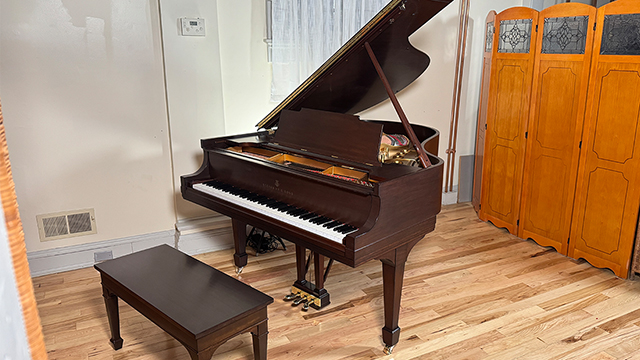
You can Now Buy NEW Seiler Pianos Online: Free U.S. Delivery!

Hi, and welcome to LivingPianos.com. I’m Robert Estrin with a very special announcement:

Now you can buy brand new Seiler pianos from Living Pianos!

Seiler, from Germany, started building pianos in 1849 making concert instruments as well as excellent practice and institutional pianos. Some things never change! Today, Seiler still manufacturers pianos in Germany and around the world, and they’re amazing instruments we’re proud to represent and sell to you anywhere in the country.

What is Seiler about? There are three editions of Seiler pianos. I’m going to get into a lot of that and I’m also going to perform on this beautiful six foot 10 inch SE – 208 model, which is the top of the line series Seiler. There are many things about these pianos that are remarkable. Starting with the GS line which has a wide tail and a wet sand cast plate, double A grade, solid spruce soundboards, and German Abel hammers. It’s an amazing value piano with so many features you don’t find in pianos at this price point. They are beautifully manufactured.

The SE and ED lines are above the GS line and they have some technologies that are not found in any other pianos.

The Membrator Soundboard, is Seiler’s unique technology that provides more sustain to the tone. How is this possible? At the point at which the soundboard is attached to the rim of the piano, the Membrator System transfers sound back to the soundboard, reinforcing the tone. It’s a phenomenal system that’s found in the SE and ED pianos.

The ED line is manufactured in Asia, with exactly the same scale design as the SE line with precision manufacturing. How are they able to achieve this? With German engineering!

With Computer Numerical Control (CNC) a precise duplication of all the specifications are possible in the Asian factory offering you an instrument that is so close to the top of the line, hand-built piano, but in numbers where everybody can enjoy these phenomenal instruments.

On the accompanying video, you can hear a complete performance of Debussy’s Clair De Lune performed on the German made, 6-foot 10-inch, model SE -208.

It’s something to be in the presence of true greatness in pianos. The singing tone, and the clarity, are achieved with a warmth not found in other European pianos. This piano has it all. You’ll be hearing a lot more about Seiler pianos.

Their vertical pianos also have technologies that no other pianos have.

The problem with upright pianos, as you probably know, is there’s a limitation in the speed of repetition because of basic physics. In grand pianos, the hammers go up and down, giving you rapid repetition and control since gravity is at work. On uprights, hammers travel sideways. So, there’s a limit to the speed. Or is there?

With Seiler’s patented, Super Magnet Repetition you can achieve much more rapid repetition than on other upright pianos.

This is available on both the SE and ED lines. The affordable GS line has all kinds of technologies as well! There are pianos with silent systems, and player systems are available as well. We welcome your questions. Once again, I’m Robert Estrin here at LivingPianos.com Your Online Piano Store. Thanks for joining me.

info@LivingPianos.com

Should You Learn to Play The Piano One Hand at a Time?

Welcome to LivingPianos.com, I’m Robert Estrin. The question today is, “Should You Learn to Play The Piano One Hand at a Time?” I have seen elementary piano method books that go on and on with just right hand alone, then the left-hand alone. So the question is, is this a good way to learn the piano?

I would say with very few exceptions this is not a good approach.

What are the exceptions? First of all, very young children. Let’s say you have a four-year-old champing at the bit to learn piano, but they’ve got tiny hands and a short attention span. You don’t want to say, “No, you may not play the piano.” So maybe you show them how to do some simple things with one hand to let them see what it’s like. But anybody who’s really studying the piano, unless they have hand problems which is another issue, must delve into playing hands together from the very beginning of studying the piano.

This isn’t to say that you shouldn’t practice hands separately.

As a matter of fact, it’s an essential technique on the piano. That’s how you learn music, mastering a small section at a time hands separately, then putting the hands together. It’s kind of like if you want to learn how to ride a bicycle and you try with one leg. You miss the whole point of the experience! The most intrinsic difficulty of the piano is being able to play the hands together. Therefore, you must not avoid it. You need to face it! How? By practicing intelligently. Take small chunks, practice each hand separately and put them together slowly until you get the feel for it. If the music is simple enough, you should be able to play hands together. And as you mature, you’ll be able to play more and more complex music hands together, always relying upon hands separate work when necessary. So, that’s a simple answer to this. Hands separate on the piano doesn’t have much relevancy in my opinion beyond being a valuable practice technique in order to put the hands together more easily.

I’m Robert Estrin here at LivingPianos.com, Your Online Piano Store.
Please feel free to contact me with any piano related questions for future videos!

info@LivingPianos.com
949-244-3729