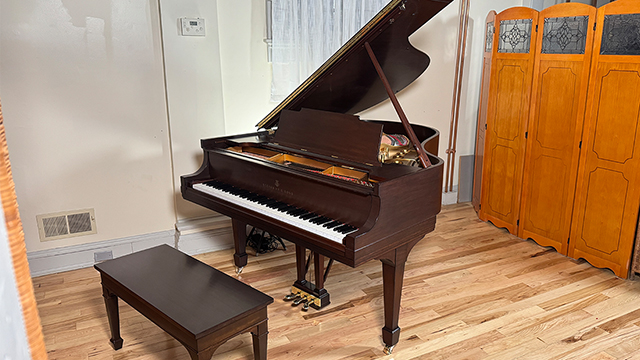
Hi, I’m Robert Estrin, and this is LivingPianos.com! Today’s subject is about how to achieve smoothly connected chords on the piano. This can be extremely difficult, particularly when you’re playing repeated chords. The whole mechanical nature of the piano is such that for a note to replay, the damper comes in contact with the strings. So it’s virtually impossible to completely connect a repeated note on the piano. You can use the pedal, but even then, because of the percussive nature of the piano’s tone, it never really sounds connected.
The more connected you can play with your hands, the smoother the sound will come out of the instrument.
This is true regardless of whether you’re using the pedal or not. Practicing without the pedal while trying to get repeated chords connected is essential. I’ll explain why in a minute. But first, how do you achieve such a thing? The secret is to keep your fingers in contact with the keys the entire time. Keep your fingers right on the keys. And be sure the keys come all the way up before they go back down again. If the key is down even a fraction of an inch before you play it, it may or may not play. A piano is not meant to have keys play when they don’t return all the way to the top. It’s not a technique you can always rely upon. So keep your fingers right on the surface of the keys, but be sure to let the keys fully return.
The first chord of each group has to be captured on the pedal, but you don’t want to capture the previous harmonies.
If you pedal too early, you’ll capture extra notes. You have a very brief amount of time to capture the chord on the pedal. It has to be after it is played, but also after the previous notes are gone. So by playing chords as long as possible, it gives you the maximum amount of time to grab the chord on the pedal. You want to work to have all the chords played while staying very close to the keys.
In places where you have repeated notes, you can change fingers.
When you change fingers on repeated notes, it’s much easier to make them sound smoothly connected. As one finger is going down, another finger is coming up. Whereas if you use the same finger, it doesn’t sound as smooth. It’s really hard to play with one finger and make the notes sound connected. When you change fingers on repeated notes, you get a smooth sound. You don’t have that luxury when you’re playing chords. You only have so many fingers on your hand! If you’re playing three notes, you have to use the same fingers.
So remember the secret to playing repeated chords is to keep your fingers in contact with the keys. But be sure to come up completely before depressing the chords down again. That should help you achieve smoothness in your repeated chords in any music you’re playing! Thanks again for joining me. I’m Robert Estrin here at LivingPianos.com, Your Online Piano Resource.
For premium videos and exclusive content, you can join my Living Pianos Patreon channel! www.Patreon.com/RobertEstrin
Contact me if you are interested in private lessons. I have many resources for you! Robert@LivingPianos.com
Welcome to LivingPianos.com, I’m Robert Estrin. The subject today is about how to figure out rhythms by counting. It’s essential to count rhythms so you know the timing of a piece of music. There’s a lot that we can talk about here. The number one fundamental is understanding time signatures. Time signatures tell you how to count a piece in the first place! What’s counting all about? Well, a carpenter has a tape measure right on their belt. They check their work constantly by measuring. The way we measure in music is by counting.
If you don’t count, you’re just guessing rhythms.
Maybe you have a good sense of rhythm. You can listen to recordings and get an idea of what the rhythm is like. But how do you know the recordings are even right? Suppose it’s a piece that has no recordings? At some point or another, you want to be able to figure out rhythms, and counting is the answer for that.
First, you look at the time signature. The time signature contains two numbers and is found at the beginning of every piece of music. The top number tells you how many beats are in each measure. The bottom number stands for the kind of note getting one beat. So if the bottom number is a four, that stands for the quarter note getting one beat. If the bottom number is a two, the half note gets one beat. If the bottom number is an eight, the eighth note gets one beat. If the bottom number is a one, the whole note gets one beat. So that’s what the bottom number tells you.
So if you have a piece of music in 4/4 time, you would count, one, two, three, four. If you have quarter notes in 4/4 time, there would be one note on each beat. If you have half notes, there will be notes on the first and third beats. But the counting never changes.
Never change the style of counting within a piece of music.
The counting must remain consistent! That’s how it measures accurately. Imagine if you had a tape measure that had inches marked in some places but in other places had multiples of six inches marked without the inches marked anymore. It would be very confusing! So, no matter what types of notes you have, the counting remains consistent. Once you embrace this fundamental concept, figuring out rhythms will become a breeze!
A simple tune like, Mary Had a Little Lamb is in 4/4 time and contains mostly quarter notes and half notes, as well as a whole note at the end. This is a very simple rhythm. But most rhythms are quite a bit more complex.
What do you do if you have eighth notes in 4/4 time or in 3/4 time for that matter?
There are two eighth notes in each quarter note and the quarter note gets one beat. So an eighth note gets half a beat. You count half beats by saying and between the numbers. So for a piece in 3/4 time you would count, one and two and three and one and two and three and, et cetera. So you know exactly where all the notes come in.
What if you have 16th notes in 2/4 time? There are four 16th notes to each beat, so you must divide the beat into four parts. Since you’ve already divided the beats in half, you just need to divide the halves in half. For that you use u.. One u and u two u and u one u and u two u and u. So, if you are in 2/4 time and you have 16th notes, you would have one note for each syllable. Eighth notes still come in where they did before, on the numbers as well as the ands. Likewise, the quarter notes come in where they did before, just on the numbers. Of course you could have half notes, which would get whole measures.
Now you can see that it can be a real mouthful counting like this! As long as your counting remains consistent, you can count just with numbers as well as ands, or even just the numbers. So, in order to figure out exactly what rhythms are, first count with all the subdivisions. But as the music goes faster, you can just think the subdivisions while counting only the numbers. But you must always think the subdivisions, particularly in dotted rhythms. If something is fast, the subdivisions must be precise. Eventually, you can work with a metronome and just count the subdivisions in your head.
Sometimes you have triple divisions of the beat!
Counting this is a little bit different. Something in 6/8 time is, one two three – four five six, one two three – four five six. When going much faster, you may only count the first and fourth beat. You may just count in two. In that case the one represents the first beat, and the two represents the fourth beat.
With polyrhythms, things can get quite different, and you may have really fast notes. Sometimes your best bet is to write-in lines in your music where the beats are which can also help you determine which notes play together with both hands. But those complex rhythmic situations are a subject for another video.
For most rhythms, simply counting them out is the answer for you.
I hope this has clarified things for you, or was at least a good reminder for everybody to remember to count your music. There’s nothing worse than listening to somebody play something where the beats are not consistent. You lose the foundation of the music. Counting is a great way for you to figure out any rhythm! Thanks again for joining me. I’m Robert Estrin here at LivingPianos.com, Your Online Piano Resource.
For premium videos and exclusive content, you can join my Living Pianos Patreon channel! www.Patreon.com/RobertEstrin
Contact me if you are interested in private lessons. I have many resources for you! Robert@LivingPianos.com
I’m Robert Estrin here at LivingPianos.com. It’s hard for me to even contain my excitement for the guest we have today: Madam Ruth Slenczynska! Ruth is regarded as one of the great child prodigies of the 20th century and started performing the piano at that age of 4. She’s also the last living student of Sergei Rachaminoff! She’s performed for presidents and traveled the world over performing the piano. At 97 years old, she is still performing and recording. We are going to talk about her 10 CD set that has been released recently to critical acclaim. It’s in its second run already! I will provide links below here on LivingPianos.com and YouTube. We’re going to talk about this and so much more. So without further ado, here is Madam Ruth Slenczynska.
Robert Estrin:
Ruth, it’s so good to see you today. Thanks so much for joining us.
Ruth Slenczynska:
It’s my pleasure, Bob. I’ve known you since you were a little boy!
Robert Estrin:
That’s right. We go way back together. I’m just trying to remember, you knew my father before you met me? Is that true?
Ruth Slenczynska:
Oh yes. Your father brought you to me as a little tike. And then when you grew older, your father took you to the Midwest to study. And you did quite well for yourself I might add.
Robert Estrin:
Well, thank you. I learned a great deal from you. I share so much of your teachings in my teaching, and my online presence is so influenced by you. That’s why I thought it was great to introduce you to everyone. There’s so much to discuss about your rich history, but the first thing I want to bring up is all the exciting things you’re embarking upon right now! You are doing yet another recording after the smashing success of the re-release of your Decca recordings from decades ago. You have another recording coming up and you’re even playing a concert in a couple of weeks at Lebanon Valley College! Maybe you can talk a little bit about some of these upcoming events.
Ruth Slenczynska: Well, I practice!
Of course practice always helps, and I never stopped really practicing. But of course, as an old lady, I don’t have the strength or the endurance that I used to have. So I practice somewhat less. But I still practice. And practice makes you able to play. So I remain able to play. I might add, I’m a very lucky lady too, because I don’t have the usual ailments that people my age complain of.
Robert Estrin:
I remember studying with you. One thing that I really respected about your teaching that so few teachers will do is, you will practice with students. There’s so many teachers who feel they’re above that. I practiced a good amount when I studied with you, but there was one particular lesson that perhaps I wasn’t as well prepared as I should have been. What you did was, you turned on the metronome and did metronome speeds with me. If anything would motivate me to practice more for the next lesson, that was it! I’ll never forget that. I’m wondering, what music are you playing at your upcoming concert in Pennsylvania at Lebanon Valley College?
Ruth Slenczynska:
Well, I’m playing a Mozart sonata, a prelude by Rachmaninoff, a group of Prokofiev pieces from his ballet Cinderella, and the Sonata of Beethoven that precedes the Moonlight Sonata. It’s a Sonata Quasi una fantasia. So it’s a nice program.
Robert Estrin:
Great program! Fantastic!
You have the distinction on two different ends. You have studied from the time you were a young child. Your first performance was when you were four years old and you still perform. Also, that you are the last living student of Sergei Rachmaninoff. But a lot of people might not realize the legacy of other artists you studied with. You had the opportunity to study with Artur Schnabel, Alfred Cortot, and you studied theory with Nadia Boulanger. You even got the chance to play for Arthur Rubinstein! I can’t even begin to imagine what this must have been like for you and what your takeaway was from the experience of working with these legends.
Ruth Slenczynska:
What you take away from a lesson is the ambience of the whole thing, not just the words, but the feeling of the situation. This is what is important because music is not just something that you hear or even something that you listen to.
Music is a feeling that comes over you. The performer either has the power to make this feeling engulf you and take you into the land of imagination, or the person doesn’t have that power. And that’s what it’s all about.
Robert Estrin:
Absolutely! You said something recently. I don’t know if in regards to what Rachmaninoff told you or something personal that you reflected upon, which is how music is storytelling. And I really relate to that so much. It was so great to hear you share that, because otherwise, what do you have? There are so many people today who can play all the notes, but it’s something beyond that. That feeling that you describe can be so elusive for people. I don’t know if you have any advice to those who practice and practice, and maybe they don’t have that connection. Do you suggest they go to another field? Or is there something they can do to gain the insights into reaching deep within their soul to share their emotions or deep emotions in their music?
Ruth Slenczynska:
Well, I don’t necessarily want other people to share my stories. I want them to find something in the music that reminds them of something in their past and work with that.
Everybody has many, many stories inside them that they just haven’t explored sufficiently.
You have 1000 stories, of course, of your father and your own self. You’ve been around. You’ve had experiences. So you are rich with stories. Everybody should explore their own inside stories and they will find a richness there that they didn’t know they had.
Robert Estrin:
Absolutely. You’ve had so many experiences that you can share. For example, I know that you played for several presidents. You even got a chance to play with one of them. This is a fascinating story. I’d love you to relay these experiences with the various United States presidents, not to mention other world leaders that you can reflect upon. I’m sure people would love to hear about that.
Ruth Slenczynska:
Well, I’ve told the story about president Truman many times, but I had a nice Reagan experience too. I have in my New York apartment a nice letter that starts, “Nancy and I want to congratulate you.” It was from the 50th anniversary of my New York debut. I got this lovely unexpected letter from an American president. But you see, I had known Mr. Reagan and his wife before they were in the White House. This is one reason why I think he sent me the letter.
I don’t think it was just a dictated letter from the president to congratulate an American citizen. I think he remembered me and that is why he wrote the letter.
So I was one of his memories and he was writing to congratulate someone he remembered. When I was included in a luncheon that was given at the White House for various friends of his, ahead of me was a famous actor named James Stewart. I could watch as he climbed the stairs. He was at the top of the stairs. He was receiving his guests – James Stewart arrived. I was close enough to be able to listen. He held out hand and said, “Mr. President…” Reagan took his elbow and poked him. He said, “Don’t you Mr. President me!” They were good friends. He didn’t want to be called Mr. President by his friend. Jimmy and Ron.
Robert Estrin:
I understand you also played for the Kennedy inauguration. Is that right?
Ruth Slenczynska:
Well, I was among many who played at the Kennedy inauguration. It happened through my management. I received a letter that they wanted them to choose 20 artists born in the United States, trained in the United States, to perform at the inauguration. So the management looked at everybody’s schedule who had been born in the United States, and I qualified. I was born in Sacramento, California. I was going to be in the area at the time. So the management informed me, you are among the 20 that we selected.
We were picked up by bus at the airport and brought to this hotel. It wasn’t a famous hotel. It was close to the White House. It was a hotel that was used for special occasions such as this. At the appointed time, the bus came for all of us. Isaac Stern was with us and his wife also. We treated it like a whole little weekend. We were having a good time. And we went to the back of the White House. We were cracking jokes and talking. Nobody heard a note that we played because there were so many people there, all of them talking at the same time. While I was playing, for instance, there were people around me holding drinks, and sandwiches, and talking, not whispering, but actually talking. I couldn’t hear a note I played myself! That was the way it was. What we had to do was submit programs of what we intended to play. I had known Samuel Barber personally, so I submitted a Barber program. I also played some pieces by John La Monte, who was a personal friend of mine. And that’s how it went. Everybody played their own program for 20 minutes, and then we were free to walk around.
While I was playing, I remember that Isaac Stern’s wife went around and she got a whole platter of sandwiches which she was dishing out to us. She said, “Hey, when you get through, there’s a sandwich there I selected for you.” It was a fun weekend.
Robert Estrin:
All right. Now, growing up, of course you wrote the book, Forbidden Childhood. This interview wouldn’t be complete without touching upon the dark side, shall we say of the beginnings of your music. I understand that your father in particular was extremely strict. Yet, what is so fantastic, is how you have one of the most joyful spirits of anyone I know! At your recent 97th birthday celebration on Zoom, there were people on continents around the world. Universally, everyone has been touched by your positive attitude and your giving nature. So I’m wondering how you managed to overcome such adversity. A lot of people sink deep down and never break out of such a thing. Yet you managed to make a career, and a joyful one at that, sharing with the world your love for music.
Ruth Slenczynska:
I got away. I was the butterfly who escaped. Yes, that’s literally what happened. I ran away from home.
Robert Estrin:
How old were you at that point?
Ruth Slenczynska:
19. At the time I thought I was eloping with a fellow student. I did. I married him. But I got away from my father. And from there on, I had control of my life for the first time. I probably did not know what to do. I was very inept. Whatever happened, happened, and it’s happened for the good.
Robert Estrin:
I understand that before teaching at Southern Illinois University in Edwardsville, where we got to work together, there was another college that you taught at. At that college, somebody overheard you in the room below and you managed to get an engagement to go on tour with the Boston Pops! I understand that you had trepidation at first about even performing. You had doubts about your own pianistic abilities at that point. Maybe you can share that experience a bit.
Ruth Slenczynska:
Well, every artist experiences doubts before you walk on stage. Everyone does. This is the most common thing of all. But artists have to keep on operating as artists or they’re not really artists.
And that’s what happened to me too. At that time, I was speaking at a college for young ladies in Palo Alto, College of Our Lady of Mercy was the name of a Catholic school for young ladies. I was teaching these young ladies so that they could play the piano acceptably for what their families required of them. I entered one or two in a competition that was nearby and had good luck some of the time. And in this way I earned my living. I earned my keep.
Robert Estrin:
I had the great pleasure of getting to know James Kerr, your husband for many years. And I want you to talk a little bit about how you met him. He was such a sweet, gentle, intelligent man that I’m sure you miss tremendously. I wonder if you could share a little bit about how you two got together in the first place? Did you two meet at Southern Illinois University?
Ruth Slenczynska:
That was at Southern Illinois University. And that happened because I had been concertizing a very great deal at that time. I had toured South Africa and I came back via Vienna and recorded the Liszt Concerto with the Vienna Orchestra. I then came back to New York, prepared four programs to go to South America, then played all over South America.
When I came home from that I woke up in my New York apartment and I wasn’t sure where I was!
My first thought was, What program tonight? I was in New York. I didn’t have a program that night. I felt strange. And my first thought was, well, I have a doctor friend who lives downstairs, I’ll call him because I don’t like the way I feel. He came up and he said, “Well, I think that what you’re having is a problem with your stomach. I think that what you should do is not play for a year or so.” I thought, a whole year without playing concerts, what will I do?
He said, “You have an ulcer and you need to rest. And you have to go on a strict diet, you can’t have any raw vegetables, you have to eat cottage cheese, and drink a lot of milk.” He put me on a rigid diet. And I started getting phone calls from various colleges who at that time, tried to hire what they called an artist in residence. This one person called up, his name was Lloyd Blakely. He was from Southern Illinois University. He described the situation in such an interesting way that I was interested in it. He said that they were on a new campus, and that they were building new buildings, and they were starting from scratch to build a fine group of people to teach at that university. He said that I would be free to teach and that he was familiar with my books. I wrote Music At Your Fingertips, which was a very much used teaching book at that time. He asked if I would be interested in teaching at that college. So I said, “Well, I’m willing to have a look at you, but I don’t know about living in the Midwest. I’ve never lived in the Midwest of the United States. I’ve never lived in a small town. I don’t know how to drive!” He said, “Well, at least come and look us over.” So he sent me a ticket. I arrived in St. Louis, and the professor who was supposed to meet me there was supposed to hold Music At Your Fingertips so I could identify who it was waiting for me.
I tried it for a year. During that first year, I made friends with certain people and I got invited to their homes. I met this unmarried person in the political science department named James Kerr. I spoke to him and he offered to take me home. My host, Maho said, “He’s a very nice chap.” So I went home with him. He talked about a string quartet concert that was going to take place. And I said, “Oh, yes. I was thinking of going there.” He said, “I have tickets to that. Would you like to go with me?” So I had my first date.
Robert Estrin:
That sounds familiar. How my wife and I first got together was actually one of my father’s concerts. So music brings people together!
Ruth Slenczynska:
That’s right. But the interesting thing is that after that first date, I went home. When I was still teaching, I would have supper. And then I would go to the place where they kept a concert grand. I had the key to that concert grand. I would go there and practice for four hours. I did that every night. That’s how I spent my evenings.
One evening when I was practicing, I had the feeling that there was somebody in that hall. I looked, and there was James Kerr. He greeted me. He said, “Now I know what you do. Every evening of the week I’ve been calling you and now I know what you do with your evenings!” So we got to talking and he invited me to another concert. And that’s how it grew.
Robert Estrin:
Oh, that’s beautiful.
Ruth Slenczynska:
Also he was an amateur cook. He asked me out to dinner. I said, “Fine, what time?” And he said, “Maybe about two o’clock in the afternoon.” I said, “Dinner at two o’clock in the afternoon?” He said, “Yes. First we have to select a recipe, then we have to go and buy the stuff we need for it. And then we go home, we put on a few records. So the two of us will be working in the kitchen to make this dinner, and then we’ll enjoy dinner, and we’ll select some more records and we’ll talk.” And that’s what we did.
Robert Estrin:
Fantastic.
I have one last question I want to ask you. One of the things that I often wondered with such a busy performing career, how did you ever find the time to practice when you were on the road and traveling from continent to continent? How could you possibly keep all this music in shape when you don’t have the time to practice?
Ruth Slenczynska:
You find time. You can find time between things that you never knew were there.
You live on what your fingers can do. You don’t make yourself play something that you cannot play.
So you work and you keep getting a little bit better, and a little bit better, and a little bit better. And then you take one more piece out of the repertoire and you learn that little, by little, by little. And then you learn another piece, little, by little, by little. Pretty soon you have a whole new program that you have learned while you were working. And that’s your repertoire.
Robert Estrin:
Right.
Ruth Slenczynska:
You are always adding to it.
Robert Estrin:
Absolutely. The most important thing is to always be growing as a musician. Always be learning something new. You are truly an inspiration to me and to so many people around the world with your absolutely amazing life. There’s even preliminary talk, I understand, of a film of your life, which would be absolutely thrilling for people. You have one of the most interesting lives of anyone I’ve ever met. It’s really a pleasure getting to talk together here today. Is there anything else you’d like to add before we say goodbye for now?
Ruth Slenczynska:
Well, I don’t know what would interest you, but it’s been an interesting life. The main thing that you have to do is keep adding to your repertoire, keep adding to your friends, keep giving what you can to the music, and never stop looking. When you stop looking I think that’s the beginning of the end.
Robert Estrin:
Those are beautiful words of wisdom. I’ve always said, one of the most important attributes is curiosity. To be interested enough in life, in people, in music, is what keeps us all alive and keeps the spirit alive, isn’t it?
Ruth Slenczynska:
Yes. That’s imagination. Nothing in the world has ever been created without imagination.
Robert Estrin:
That’s beautiful. Thank you so much for sharing your time with all of us. We will be in touch. Once again, this is Ruth Slenczynska. She’s going to be appearing at Lebanon Valley College, Sunday, February 6th, at 3:00 PM. The links to her box set of recordings on Decca are below, here on LivingPianos.com and YouTube. Thanks so much for joining us. We’ll see you next time. I’m Robert Estrin here at LivingPianos.com, Your Online Piano Resource.
For premium videos and exclusive content, you can join my Living Pianos Patreon channel! www.Patreon.com/RobertEstrin
Contact me if you are interested in private lessons. I have many resources for you! Robert@LivingPianos.com
Welcome to LivingPianos.com, I’m Robert Estrin. The subject today is about how to practice with a metronome. The metronome is one of the most valuable tools for your practice. It is perhaps the most valuable tool other than the instrument you’re playing on. The metronome is something that should be on your piano whenever you practice, to check your work, and to work out passages.
How do you use a metronome to work through a section of a piece?
Let’s say you’re working on the famous Alla Turca movement of the famous Mozart Sonata in A major K.331 no. 11. You get to the F-sharp minor section that has some tricky finger work, and it isn’t gelling for you. Some people might think you should go through the whole piece with the metronome. There is value in doing that to check your tempo, and the consistency of speed throughout a movement. It’s important to make sure you’re not speeding up or slowing down. But what I’m going to show you today is how to use the metronome to be able to solidify a passage like this. So let’s say you aren’t happy with your playing in the F-sharp minor section. It’s not as even as you would like. What can you do about that?
Find a speed on your metronome at which you can play the trouble section evenly and beautifully.
Taking too large a section to do progressive metronome speeds can sometimes be counterproductive. If you work on smaller sections, and then string the sections together later, you might have more success. Not only that, but maybe there’s a section you can already play up to tempo, but the next section still needs improvement. It’s unnecessary to work all those metronome speeds on both passages.
There are metronome applications for your phone that allow you to simply tap in the tempo. That’s a real help. If you are using a traditional metronome, you just start tapping or clapping along with your music as you sing or play mentally, so you can match the speed on the metronome. Make sure that it’s a comfortable speed for you. The most important thing is finding a speed at which you can play it perfectly. Once you can play the passage absolutely perfectly, and repeatably, you’re ready to increase the speed. But make sure you find the speed at which you have absolute security first.
The first time you do this, you’re going to find it to be really difficult to play perfectly at any tempo.
Here’s the key: Spend the time on the front end. Play it perfectly even with comfort. If you find you can’t do that, slow the metronome down further until you find a tempo where you can. Make sure you can play without feeling you’re getting off from the metronome at all. Make sure it’s rock solid, steady, and repeatable. You should be able to get it at least three times in a row, perfectly. It should not only sound perfect, it should feel comfortable. Then once you have it at one speed, take the metronome up a notch.
Physical metronomes actually have one benefit that digital metronomes don’t have. On physical metronomes, each notch goes up multiple numbers instead of having every number. For example, 60, 63, 66, 69, 72, 76, 80, et cetera. Notice how the speeds progress from going up by three, to going up by four beats per minute. If you double the speed, 60 to 63, at 120, the next notch on the metronome is 126 which is double the slower speeds. It doesn’t just go up by three throughout the range of speeds on the metronome. So the progression of speeds on a metronome is calculated correctly. You don’t want to go from 69 to 70 to 71 because the increases in speed are infinitesimally small. But one notch on the metronome, or maybe two notches at most, provides just the right amount of challenge to speed up a passage. Once you can play it successfully and repeatably with comfort at one slow speed, go to the next notch on the metronome. So if you’re at 60, play the passage at 63. You may only have to play it once to feel that it’s perfect and keep going notch by notch. But anytime you have any issues where it doesn’t sound right or doesn’t feel comfortable, keep doing it at that metronome speed.
This is one of the greatest practice techniques for developing speed, fluency and evenness in your piano playing!
I recommend doing metronome speeds on a regular basis with anything in your music that isn’t up to a high standard. If you feel that there’s some passage work or any sections of your music that aren’t even, or aren’t reliable, find a speed at which you can play it perfectly, repeatably, and comfortably, and go through metronome speeds notch by notch. You can solve almost any technical problem this way. Try it out! Let me know how it works for you! You can leave comments here at LivingPianos.com or YouTube. Thanks so much for joining me. I’m Robert Estrin here at LivingPianos.com, Your Online Piano Resource.
For premium videos and exclusive content, you can join my Living Pianos Patreon channel! www.Patreon.com/RobertEstrin
Contact me if you are interested in private lessons. I have many resources for you! Robert@LivingPianos.com
Welcome to LivingPianos.com, I’m Robert Estrin. The subject today is about why it is so hard to start in the middle of a piece of music. Have you ever had that situation? Maybe during your practice something fumbles. So, you want to start from where you left off. You try, but it’s too hard, so you just go back to the beginning. Worse yet, you’re in the middle of a performance, and you have a finger slip or a moment of memory insecurity. Then you try to start in the middle, and you just can’t do it. You have to go back to the beginning. It feels so terrible! The audience is fidgeting because they already heard you play that music. This is a real issue. So, first I’ll explain why this happens, then I’m going to offer you some solutions.
It has to do with the way the human mind works.
Learning things sequentially is much easier than random access memory. For example, have you ever seen memory geniuses who can remember thousands of digits? Some of these people are just unbelievable. Or, they can remember countless unrelated items. How do they do it? The secret they use is relating the things they are trying to remember to each other. If you had random objects and you wanted to remember them sequentially, the first visual image that comes into your head can really help. So let’s say you want to remember car, toaster. Imagine a toaster with a car popping out of it. That’s a really weird image that came to my mind. So now I have a car and a toaster. And then you go on. What’s next thing on the list to remember? How about car, toaster,orange. The car is popping out of the toaster and there is an orange on top like the light on a police car. It can be anything. The more outlandish the visual images, the better. You can do a chain of dozens of unrelated things so long as the visual images are so ridiculous that you can’t forget them. The more abstract the better.
There is a sequential nature to memory.
In school growing up, I learned all kinds of music because my father taught me how to memorize. From my first lesson when I was a young child, I had to memorize all my music, and didn’t think anything of it. But in school in social studies, we had to memorize all kinds of dates, wars, generals and battles. I had no idea how to learn that kind of stuff! The sequential nature of learning is so powerful. I wish I had known about this technique back then!
What do you do when you want to start in the middle of a piece?
You get so used to going through a piece all at once, there’s a certain amount of motor or muscle memory. Your fingers themselves remember where to go! Once you get off track, they have no idea where to go anymore. There are a few things you can do to remedy this. Number one: in your practice, whenever there is a problem and you stop to fix it, find your place in the score! I know it can be painstaking to do that sometimes, but by finding the place in the score and making yourself start there, you will gain the ability to start from that place. If you had insecurity one time, you may have insecurity another time. If you know how to start from the point of insecurity, it can be a lifesaver in performance. Anytime you have a problem with something messing up in your practice, that’s an opportunity to learn how to start right at that point. That’s a terrific way of solidifying your music.
There’s more you can do! Practice incessantly with the music even after you’ve memorized something! Look at the score as you play slowly without the pedal. Utilize the metronome where appropriate, and go through to solidify your memory. Let’s say you have a piece you’ve memorized, and it’s pretty secure, but you still have issues with it. What can you do to make it totally solid so you are able to start anywhere?
One of the best techniques is to be able to play a piece without the benefit of playing it on the piano.
First, try just playing it on a tabletop or in your lap. Have the score nearby so when you get to a point of insecurity, you can find your place in the score. Go back a little bit and pass that point until you can play the whole piece away from the piano. Then, the ultimate, is to be able to play without even moving your fingers! Think the piece all the way through. When you can do that, you will gain great security in your playing. That’s why for example, memory problems often happen when you have leaps in music because your fingers have a memory all their own. But when you have to jump from one section of the keyboard to another, you have to be aware of where you’re jumping! Worse yet are pieces that have repeated sections in different keys. When you have a sonata where in one section you modulate from one key to another key, and later the same thing comes back, but it goes to a different key, you have to be very deliberate. Study your score to remember (for example), first time D, second time A, or whatever it may be. Lock it in your brain, and then be present enough in your performance to know, yes, the second time go to A. You have to have that information ready in the back of your brain, looking down on yourself while you’re playing so you’re not all just on automatic pilot! You can’t always trust finger memory. It is a godsend having it. If people didn’t have that to work with, I don’t think pianists could memorize massive amounts of music nearly as easily. But you can’t depend upon it completely.
Conductors have to memorize scores.
Conductors have to know their scores without the benefit of muscle memory. Of course, many conductors are pianists, so they may flesh out a lot of the music on the keyboard first. But for all you pianists out there, take advantage of the music you know by playing mentally. The sound of the music, the feel of the keys as well as the vision of the keyboard. The whole playing experience away from the instrument can be an awesome learning experience. In the meantime, as a first step, make yourself find where you are in the score when you have insecurity in your playing so you can learn to start from there. That’s going to help you if you ever have problems in those particular places during a performance. Thanks so much for joining me. I’m Robert Estrin here at LivingPianos.com, Your Online Piano Resource.
For premium videos and exclusive content, you can join my Living Pianos Patreon channel! www.Patreon.com/RobertEstrin
Contact me if you are interested in private lessons. I have many resources for you! Robert@LivingPianos.com
Welcome to LivingPianos.com, I’m Robert Estrin. Today I’m going to share an important tip with you. More motion equals more volume and less motion equals less volume and more speed. It’s as simple as that. This applies not just to finger work, but to wrist technique as well. I’m going to illustrate both for you today!
The answer is, it really depends upon the context.
Sometimes you want to be able to play delicately and quietly. For example, in the B flat minor Nocturne of Chopin. If you play it with a lot of finger motion, not staying close to the keys, with raised fingers, you will hear a great deal of sound generated from the sheer motion. But if you want to achieve a real pianissimo, you’ll use less motion and stay close to the keys. You don’t even need to use the una corda pedal, the soft pedal! You can get so much control when you’re close to the keys! You get a really soft sound. Now the converse of that, if you want more volume in your playing, simply use more finger motion. Raise your fingers higher. It’s very simple physics really. If you want to bang a nail into the wall, you’re not going to strike from right next to it. You’re going to give some momentum and strike from above. Well the same thing is true with chord technique on the piano.
How does this apply to wrist work?
Let’s say you want to be able to play light and fast chords in the Military Polonaise of Chopin. If you try to use a lot of motion, it’s going to be very loud, but it’s going to be difficult to play fast. You get a lot of volume, but you can’t achieve much speed. Speed is related to how much motion you use in your playing. Staying closer to the keys, using less wrist motion, you have more control, more speed, with less volume.
The amount of motion affects the volume and speed of your playing.
This applies to the wrists as well as finger technique. So remember: when you want to play a true beautiful pianissimo, stay close to the keys. The same is true of anything with staccatos. If you want light action from the wrist, staying close to the keys is going to give you a crisp light sound, whereas more motion is going to give you more power. For fast playing, stay close to the keys and use a minimum of motion in fingerwork or wrist action.
So now you know how to get power and how to get lightness and speed. Staying closer to the keys enables quieter playing and quicker response. To achieve greater power, use more motion. That’s the tip for today! Try it out in your piano playing! Let me know how it works for you in the comments below here on YouTube and LivingPianos.com. Thanks so much for joining me. I’m Robert Estrin here at LivingPianos.com, Your Online Piano Resource.
For premium videos and exclusive content, you can join my Living Pianos Patreon channel! www.Patreon.com/RobertEstrin
Contact me if you are interested in private lessons. I have many resources for you! Robert@LivingPianos.com