

Today we’re going to talk about the importance of reflecting upon your practice by taking strategic breaks.
How is taking a walk in the middle of your practicing beneficial?
When you’re immersed in practicing, after awhile you need to reflect on things. Not only that, you’re doing everything with your upper body. It’s good for you to get out and get some air and get the blood flowing throughout your body. It will also give you an opportunity to assimilate what you have been working on.
Reflecting on your practicing
One way to digest your work is to analyze what you have done in your practice. You can play your music over mentally and work out fingerings while testing how much of the music you have retained. That’s the left brain or Western way of quantifying knowledge – the analytical part of your brain. However, perhaps even more important is to detach yourself from analytical thinking and clearing your mind. This is a more of a Zen approach. If you never get away from the music to enjoy life, what do you have to share with your music anyway?
Why it’s not just about playing the piano or practicing
This principle isn’t just about practicing the piano. It applies to practically any endeavor! You need to get out and smell the flowers to have a chance to simply be – not just try to accomplish things. In the process, you will discover something extraordinary. The analytical part of your mind will help you solidify memory. I’ve talked about practicing away from the piano and that can be incredibly beneficial. But what is equally important is detaching your mind from everything and being in the now!
Maintaining an intense practice regimen.
Those of you who are practicing intensely on a regular basis will be surprised at how getting away periodically will increase your productivity. While intense practice certainly has an essential role in developing your musical skills, getting away from it all is just as important.
I hope this is helpful and thanks for joining me, Robert Estrin here at LivingPianos.comYour Online Piano Store
Welcome to LivingPianos.com. I’m Robert Estrin and today’s question is, “How Do You Find the Serial Number on Your Piano?” There are a number of reasons why you might want to know your piano’s serial number. The piano’s age, along with its condition, and any repair work done to it will affect its value. You need to know this if you’re considering buying or selling your piano, or for an insurance claim or charitable tax deduction. You might also need to know the serial number for a bill of sale, insurance rider, warranty claim or moving or storage receipt. The serial number determines the age of your piano. Once you find it, you can reference the Pierce Piano Atlas, which has all the piano brands with the serial numbers, so you can determine when your Piano was built.
Where can you find the serial number on your piano?
If you look inside your piano at the plate, you may find a date and think your work is done. But it’s not so simple. In fact, the date of manufacture is never stamped on a piano. These dates usually refer to prizes that were won or patents that were awarded, but never the date of manufacture. So you’ve got to dig a little bit deeper. If you’re looking at a grand piano, the first place to look is under the music rack. You can simply slide the music rack out towards you. Underneath, usually on the left hand side on the plate, you’ll see a series of numbers. That can very well be the serial number of your piano. Reference the Pierce Atlas, and you’re done. But sometimes, you’ll see two sets of numbers or even more. It can be very confusing.
There are other numbers you may encounter.
Model numbers generally are letters and sometimes they have numbers in them. So, if you see a letter followed by a bunch of numbers, the first letter might just be the model, followed by the serial number. Over on the right hand side, you might see less digits. This could be an in house numbering system they used when they were manufacturing the piano, or sometimes it’s an artist number for concert grand pianos. Suppose the piano has been regilded, that is, the plate has been painted over. Does that mean you can’t figure out the serial number? Well, the good news is, pianos almost always have the serial number in more than one place. And the serial number isn’t always found on the plate.
There are several other places a serial number can be found.
Sometimes the serial number is stamped into the soundboard, usually towards the front of the piano. Look at the soundboard and you might see numbers. I’ve seen it on the back of the soundboard or even in the rim of the piano, under where the lid lifts up. Like I say, sometimes it takes a lot of detective work to find the serial number on your piano! Now, suppose you look all over the place inside the piano, but you still don’t see it. Well, then you have to go a little bit further.
Something you can do on your own that’s not that hard, is to take the key slip off in front of the keys. Some pianos, it just lifts out. Others might have several screws underneath you take out. Carefully lift up the key slip. You’ll may see the serial number on the key slip itself stamped into the wood. Or it could possibly be on the key frame of the action of the piano. No luck? You still have some possibilities. You can check underneath the piano. Take a flashlight under the piano and look around. Typically, it will be behind the pedal lyre on the piece of wood behind the pedal assembly. But I’ve seen it in other places down there. Sometimes, even on the bottom of the soundboard!
You might want help from a piano technician.
If you haven’t found the serial number yet, you may want to have your piano technician look for it, because you can potentially damage the piano taking it apart yourself. Your piano technician can possibly find the serial number by removing the action and taking out the cheek block screws on the ends of the piano. Once the key slip has been removed, the fallboard can sometimes lift out. But with older pianos, the fallboard is attached to the cheek blocks and this can be tricky to take out because they can fall off. This is why you should use a piano technician. The serial number is oftentimes stamped on the cheek blocks. If you still can’t find the serial number, then you can have your piano technician pull the whole action out a bit. The serial number might be stamped somewhere else on the action. If not, have your piano technician pull the action out completely, put it safely on a piano bench or a table, and hunt inside the piano with a flashlight to find the serial number.
You didn’t think this was going to be so complicated, did you? Well, the good news is, most of the time it’s not. Generally the serial number is on the plate, but now you have some resources just in case it’s not there.
Are there pianos with no serial number at all?
Yes, this can happen when a manufacturer puts the serial number on the plate or another part of the piano that has been replaced. If the plate was regilded or the soundboard was replaced, you might have no way of determining the serial number, or even the manufacturer of a piano! On some stencil pianos, that is OEM pianos that are produced by third party manufactures, it’s all but impossible to figure out not just a serial number, but even the make of a piano!
Where is the serial number found on upright pianos?
Most often the serial number on upright pianos will be right in the front. Open up the top and look inside. If you don’t see it there, you can look around back and sometimes you’ll see the serial number stamped in the back of the piano.
I’m Robert Estrin here at LivingPianos.com, Your Online Piano Store. See you next time.
I’m Robert Estrin with LivingPianos.com. Today’s topic is, “The Two Brains in Music.” I’ve talked before about the part of you that’s playing, almost on autopilot, and the part of you watching over to make sure you don’t take a wrong turn. Today I’m talking about something entirely different.
We have our intellect, but we also have our emotions, the gut. You know this because sometimes you react to something even before you are cognizant of what’s going on. You just get a feeling about something before your brain even understands what is happening. And yet it gives you vital information about your surroundings.
There is an aspect of intelligence in your emotions.
In music, there is a balance between your intellect and your emotions. This transcends just musical performance. But how does this come to be? I studied with Constance Keene at the Manhattan School of Music. She was a spectacular pianist and teacher, and I learned a tremendous amount from her. One of the things that she said was that musical performance is not experiencing the emotion, but recreating memories of the emotions. That’s an interesting thought, and that’s a very cerebral way of playing the piano. Do all pianists play like that? Not necessarily. Particularly, a lot of pianists from the Golden Era early in the 20th century, such as Cortot, Schnabel, or Horowitz. Horowitz never played the same pieces twice the same way, so he offered spontaneous performances every time!
Balance emotions and intelligence in performance.
You can’t play the piano solely with your emotion because you will completely flop. You might play too fast, loud, slow, or quiet. You have to have intelligence balanced with emotion to stay in control of the performance. A performance completely devoid of emotion, no matter how technically proficient it is, is not going to draw you in. You have to have the emotion that lets the music go where it wants to go, even if you haven’t gone there before. It’s a little bit scary. If you’re playing a piece in a public performance, and something occurs to you that you never tried before., you have to make a decision. You can either listen to your brain and play it the way you’ve always played it before. Or, you can think, “Wait a minute, let’s explore this.” going with that emotion. Then you can react to whatever you did, and it becomes a cycle of emotions. That’s when you can really capture your audience!
You have to be incredibly well prepared in order to do this.
I would not recommend you do this in an important public performance unless you are really solid with your repertoire. The secret is being so well prepared in your practice that you try things faster, slower, louder, softer. You practice on different pianos, with the piano open, with the piano closed. You play for small groups, large groups. You record yourself. That way, when you finally get out to an important performance, you can choose a little of this, a little of that, and mold a unique performance based upon what you feel at that moment. That can be one of the most compelling types of performances possible, if you’ve got the inclination for it.
Other performers rely more on refinement.
Ruth Slenczynska is another pianist I had the pleasure of studying with. Her whole thing was refinement to such an extent that her performances were masterfully polished. Much like Josef Lhévinne or Josef Hoffman, with jewel-like perfection. Once, she was teaching a class with all her students, and a student asked her to play the Chopin G Minor Ballade for us. Even though she had performed this piece many times, she said, “Oh no, I haven’t been practicing it. I’d have to play it slower.” Well, he kept begging her and finally she said, “Okay, I’ll play it for you.” And indeed, she played it slower so it could be totally under her control! That’s the kind of pianist she was.
My father, Morton Estrin, on the other hand, if somebody were to ask him to play the G Minor Ballade he would just go for it the best he could. He wouldn’t make any concessions to the music. He would play the emotion and have a satisfying performance, even if it wasn’t perfect. That’s the way his mind worked. It’s not a right or wrong proposition, but it’s how much you depend upon intelligence or refinement vs. how much you depend upon emotion. Every musician needs to find a balance they are comfortable with.
I hope this has been enlightening for you. I would love to get a discussion going about this.
Thanks so much for joining us here at LivingpPianos.com, Your Online Piano Store.
This is Robert Estrin. Welcome to livingpianos.com. Today’s topic is: “Where to Place a Piano in Your Home“. Pianos come in all different lengths from around five feet all the way to over nine feet. Most people don’t have a nine foot concert grand in their home! A piano that size requires a large room that can handle not just the size of the piano, but the sound as well. The bigger the piano, the more volume they create.
How to place upright pianos.
I have a video about WHERE TO PUT AN UPRIGHT PIANO IN A ROOM. Upright pianos are all about five feet wide, because of the 88 keys, and they come a couple feet out from the wall. You also want to allow extra space for when the bench is pulled out. Here’s the key though: if you leave some space between the back of the piano and the wall, you’ll get a much richer sound because most of the sound of an upright comes from the back. If the piano is right against the wall, it soaks up the sound. Now on the flip side, if an upright piano is too loud, put it up against the wall or better yet against some curtains and it will be much quieter.
Placing baby grand and grand pianos.
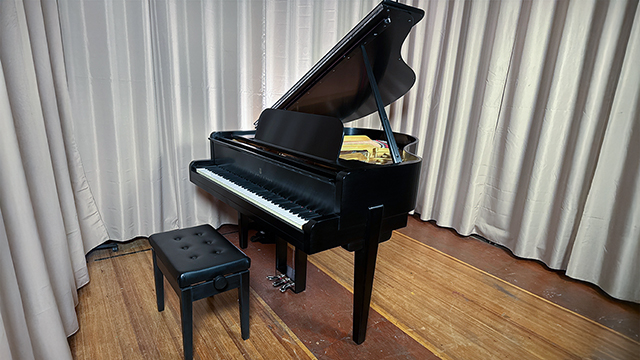
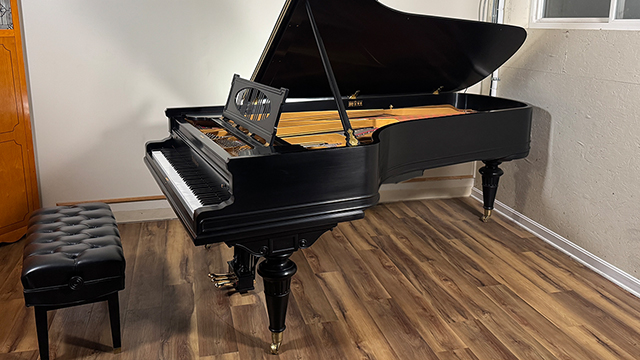
A lot of people think upright pianos are easier to place in a home, but it’s actually easier to place a grand piano than an upright! Ideally, you want to place your grand piano so it opens into the room. It’s nice to have the piano situated in this respect so you can see the keys and the inside of the piano. However, even though this is the typical way that pianos are placed on stage for concerts, in your home it isn’t necessary. It doesn’t matter how you position your piano, you’re going to hear it fine throughout your home. They can tuck into a corner and look quite lovely and sound fine. Or maybe you prefer to sit looking into the room when you’re playing the piano. All of these ways work fine.
Place your piano where you can enjoy it!
If you have an open floor plan, the volume of the piano could be an issue for people in other parts of the house. You want to think about that. You never want to have your piano in a place where you don’t want people to play it because it’s disturbing to you or your neighbors! If a grand piano is too loud, you can put a rug underneath to soak up the sound. With a grand piano, just like the back of an upright, half the sound comes from underneath, or almost all the sound when the lid is closed.
Do what works best for you.
There are many different ways you can place your piano. Baby grands and grands are actually easier to place than upright pianos. They look good any way, and you are going to hear it in your home whether the lid is facing one way or the other. Ultimately where you place a piano in your home comes down to personal preference. So give some thought to where the piano will look and sound best, and will fit in with your lifestyle.
Any of you who have questions about placing a piano in your home, you’re welcome to take pictures and send them to us at info@LivingPianos.com, and we’ll be happy to give you advice about how to place your piano. Thanks for joining us here at livingpianos.com, Your Online Piano Store
I’m Robert Estrin from Livingpianos.com. Today’s topic is, “Reinventing Yourself as a Musician”. You may wonder what I am talking about. In life, not just in music, there’s an illusion that you can have total stability. Of course this is impossible. Everything around you is constantly changing. Even things that appear consistent are in a constant state of flux.
Each performance is unique.
Let’s say for example you perform a piece and it goes exactly the way you want it to. The next time you perform that piece, can you recreate the performance? Even though you’ve done it once before, it’s never going to be the same. You’ll never be able to perfectly recreate that performance, any more than you could recreate a conversation you had with someone. After you have a great performance, you are in a different mental state about that piece. You’ve experienced something new that adds to your repertoire of performances. If you start chasing things you’ve done in the past, you’ll never move forward. You will never reach the same heights as before by trying to imitate something you have done in the past.
How can you reinvent yourself musically?
Studying music that you’ve never played before is a tremendous way to enrich yourself. It can add to your musicianship and help you to see things in a different light. Learning a new piece of music not only offers you the possibility of playing new repertoire, but it can also change your outlook on pieces you’ve previously studied. For example, if you’ve studied several early pieces of Beethoven, and you venture into a later piece of Beethoven, you might have a better understanding of Beethoven and how his mind worked.
You might even delve into a completely new style of music.
Maybe you’ve never played jazz before, and you start learning some jazz! If you go back to your classical pieces, you will find similarities. For example, a cadenza in the G-minor Ballad of Chopin is not dissimilar from a jazz riff of something improvised. We can think of these little cadenza passages as what Chopin might have done while improvising. It’s more spontaneous and can give us a glimpse as to how Chopin played the piano.
Each instrument can show you something new
If you’ve been practicing on the same piano all the time, and then you have an opportunity to play a nicer instrument, it can change your whole outlook on music. The sounds are different, the touch is different. Your connection is different! Having different instruments to play on is unbelievably valuable. For pianists this is especially true because you generally can’t bring your personal piano with you to performances. With Living Pianos, I’ve had the opportunity to play so many great pianos, which has helped me to grow as a musician.
You must reinvent yourself as a musician all the time.
I remember my father, Morton Estrin, would always learn new pieces his entire life. Into his eighties, he was learning mammoth new works, and when he would see colleagues from years ago performing “the same program they played when they were at Julliard 25 years ago” he had no patience for that. Musicians who keep recycling the same music over and over again oftentimes stop growing. It’s important to expand your repertoire and your playing experiences. If you’ve always played recitals, maybe do chamber music. If you’ve rarely performed solo recitals, maybe you’ve done concertos a great deal, then you should try solo performing or something completely different. Always expand your outlook. It’ll keep you fresh. It keeps your music compelling, and it’s the secret to growth, not only as a musician, but in every aspect of life. You must give yourself new experiences all the time in order to keep life fresh and vibrant.
I hope this has been a good lesson for you! I’d love to hear from you, and how you feel about your music and reinventing yourself. Is this something you have done, and how has it worked for you? I’m Robert Estrin at Livingpianos.com, Your Online Piano Store.
This is Robert Estrin from LivingPianos.com, Your Online Piano Store with a great subject today: The fundamental importance of arm weight for producing a good tone on the piano. You might wonder what I’m talking about. Before I get into that, let’s discuss the piano as a unique musical instrument.
What was the first musical instrument ever?
The first musical instrument was obviously the human voice! Every other instrument imitates the human voice to one extent or another. Wind instruments, for example, have a clear connection with breath, flow of the phrase, natural progression from note to note, and the smoothness of the line. This is intrinsic not just to vocal performance, but also all wind instruments. String instruments have the bow to create the sense of line like the breath in singing.
What is the analog for the breath on the piano?
You might think, since phrases naturally ebb and flow like ocean waves, that you can simply calculate playing each note louder and louder towards the middle of the phrase, then gradually softer and softer towards the end of the phrase. However, if you try that, you’ll end up with a calculated performance. No surprise there! The secret of creating a smooth line at the piano is, gradually increasing and decreasing arm weight by transferring smoothly from note to note, growing toward the middle of the phrase, and diminishing toward the end of the phrase.
You can try it for yourself!
Play a phrase once while calculating each note getting progressively louder, then progressively softer. Then try playing the same phrase but using the continuous arm weight that ebbs and flows. You’ll find that no matter how much you try to craft the line based upon your musical inclinations, the first version will sound calculated. That is, after all, exactly what you are doing! When you play the phrase again, remember to use the concept of the breath by utilizing the natural weight of your arm. Instead of pushing down more, just support the weight of your arm with your fingers. Lean into it the keys even after initially playing them. Lean more toward the middle of the phrase and less toward the end. You’ll find that this creates a completely different sound. There is something engaging about imposing upon a phrase the idea of the breath and letting the notes flow naturally with that overarching concept. It creates a singing line that belies the reality of the percussive nature of the piano.
I’m interested in your impressions of how this works for you. If any of you have different ways of achieving the same sound, I’d love to hear from you! Once again, this is Robert Estrin here at LivingPianos.com, Your Online Piano Store.