

Tag Archives: robert estrin

When is it Time for a New Piano?

This is a question I get all the time; almost every day! There are really two factors involved in this question: The condition of the piano and the ability of the player. I’m going to cover both of these topics for you.

If you have a piano that you think might be experiencing some problems, you have to assess the situation carefully and make sure you’re not throwing good money after bad. Problems that arise in pianos differ immensely based on the type of piano you own.

If you have an older (10 or more years) cheaper Asian production piano that is experiencing issues, it might be time to consider buying a new piano. Otherwise, you might end up costing yourself a lot of money in ongoing repairs. These pianos are built with a limited lifespan; they won’t last forever and eventually you will need to upgrade if you are a serious player.

If you have a higher quality piano, many times you can get repairs or work done that will prolong its life for generations. In some cases – specifically when it comes to soundboard issues – you might be stuck having to pay thousands of dollars for a rebuild. If you keep your piano in a nice climate, you close the lid at night (particularly if windows are open) and you generally maintain it well, you probably won’t run into major problems for quite a while depending upon how much you play. If you have an older piano that has been handed down through your family, it will probably require some work at some point.

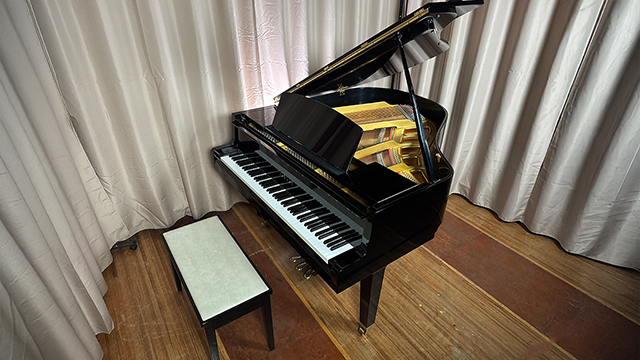
Small repairs with the action or strings require some expense but they are nothing compared to the cost of rebuilding a piano. If you are looking at a bill in the tens of thousands of dollars – or even a few thousand dollars – it might be time to consider buying yourself another piano depending upon the level of the instrument. Many dealers will even let you trade in an existing piano toward the cost of a new one. It’s a great idea to consult a piano technician you trust and ask them honestly if it’s worth putting money into your piano or just buying a new one. For example, in a vertical piano the hammers travel sideways, so they don’t have the benefit of gravity for repetition like grands do. So eventually you will progress to the point where you can play faster than the piano will respond. When you advance even further as a player you will want something larger than a baby grand because the tone develops differently and the keys are longer (behind the fall board) giving a more uniform feel when playing black keys and between black keys close to the fall board.

Thanks again for joining me Robert Estrin Robert@LivingPianos.com (949) 244-3729

What is a Musical Slur? Music Lessons with Robert Estrin

You may find the accompanying video helpful. My wife Florence Estrin demonstrates how to play a slur on the flute as it’s much more complicated to demonstrate on the piano. If you are only able to read the text, I will give you good information about what a slur is.

Slurs are curved lines connecting 2 or more notes:

Note: A curved line that connects 2 notes that are the same is not a slur but a tie which makes the 2 notes into one long note.

Slurs indicate to a wind player when to use the tongue to delineate the beginning of notes and when to connect the notes on the breath. To put this simply, the tonguing will be on the first note and everything else that follows will be on the breath. Florence provides a great example of this in the video above. She also provides some examples of what it sounds like to play the musical line without slurs – tonguing the beginning of each note as well as providing examples of different phrasing.

When it comes to the piano, the difference between a slur and a non-slurred note is much harder to determine. A true slur as in singing is actually a quick glide between notes. Since this isn’t possible on the piano, overlapping notes slightly is the closest approximation of a slur possible. This is technically not a slur but it’s impossible to play a true slur on the piano; like many things when it comes to this instrument, it’s an illusion. If a phrase is not slurred, you can delineate notes by putting a slight space between each of the notes.

There are many different types of phrasing and shadings within slurs and non-slurs we can explore in future videos. I hope this information is useful to you. If you have any more questions please contact me:


Robert Estrin Robert@LivingPianos.com (949) 244-3729

How to Play the Living Pianos Theme Song

I really enjoy your videos on your website and Youtube. Can you please show me how to play the opening jingle for your videos? I’ve noticed it changes frequently but the foundation remains the same.

Thanks,

– Mike

I appreciate your interest in the Living Pianos theme! It’s really quite easy to play. Basically, you play a G octave in the left hand and an F-major arpeggio (broken chord) going all the way up the keyboard in the right hand. Then resolve to a C major chord first playing a D on top going to an E. That’s it!

You can simplify things even further if you have limited piano technique. You can simply play broken F-major chords hand over hand up the keyboard if you aren’t comfortable playing a rapid arpeggio with one hand. I believe watching the video will clarify things for you.

Please let me know how it goes! Robert Estrin Robert@LivingPianos.com 949-244-3729