


Welcome to LivingPianos.com. I’m Robert Estrin. Today I have something a little different and a lot of fun for you. In this video, I put your ears to the test with a musical guessing game. I play short excerpts from some of the most famous classical piano works ever written, and your challenge is to identify each piece as quickly as possible. Some may be instantly recognizable from just a handful of notes, while others might take a few more seconds before everything clicks into place.
This is more than just a trivia game. It is a wonderful way to sharpen your listening skills and discover how deeply these great works are etched into your musical memory. You might surprise yourself by recognizing a piece from its harmony, rhythm, or even just its texture before the main theme appears. See how many you can name within ten seconds, keep score if you like, and share your results in the comments. I would love to hear which ones you knew right away and which ones kept you guessing.
Let us know how you did on this listening test!
Leave comments about pieces you would like full tutorials on.
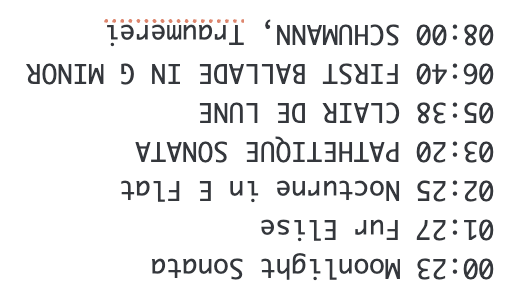
Here are the pieces heard in the recording:
15 thoughts on “How Fast Can You Name These Classical Masterpieces?”
Thanks a lot for your beautiful performances. I’m 58 and a fan of your channel. Since I practice most of them, I could recognized in first seconds exept the last one. It’s a pleasure if you could kindly have a tutorial on Chopin first ballad in g minor. Although it’s a difficult peace but it will helps a lot. Many thanks Robert.
So glad to hear that you like the performances. I have many more in the works. I have been getting a number of comments from people requesting the Chopin G-minor Ballade tutorial. So that is in the works!
Great show, Robert. Thank you. I was able to name each of these classics because I play most of them although not even close to the exquisite way you play. You played each of them so beautifully.! The composers would be very pleased with how you presented their work. Bless you.
Always a pleasure to hear you play on a gorgeous piano! Was it the Bechstein? Yes I got them all and would be very interested in a tutorial of the G Minor Ballade!
The piano is a 1938 Steinway model S. baby grand that my grandfather gave to my father brand new many years ago which we rebuilt!
I have played the 3 Beethoven, so I got those right away. I knew the first by Chopin was by him, but not the second. I didn’t know the name of either Chopin piece. I knew the Schumann. So named 4, named the composer of one, and missed one. Pieces with numbers are hard for me to remember the names. The first Chopin was number and key, but I didn’t even think “Nocturne”. I enjoyed this. Do it again!
recognized all the pieces, but I didn’t have formal musical lessons, I didn’t know the names or composers. : -( But, it was wonderful to hear you play the pieces! Now I know exactly what they should sound like! Thank you!
P.S. I have been practicing the scales faithfully since January and I’m doing really well! My dexterity is getting better. And, just like you said, playing arpeggios in music is getting easier and sounds way better!
I had to search for the HANON The Virtuoso Pianist. I called a couple of ‘music stores’ and they didn’t know what book I was talking about. (Sad! And, I gave them the correct name of the book.) But, one day I made a donation to a thrift store and right there at the door was the HANON book! I was so excited I found it and they were so appreciative of my donation, they gave the book to me to free. What a blessing!
Thank you for all the posts you make!
Got them all in less than 2 secs!
I am a pianist/composer/ piano teacher and was able to name those pieces after 1 or 2 notes were played! I love the idea of this quiz. Maybe next time do a more challenging version for those of us who are very familiar with the “chestnuts!”
I’ve been playing most of these songs for years but can only remember the title of a fraction.
it’s the same retention issue preventing me from memorizing any.
I’m attempting to work up 30 or so new songs, effectively tripling my current repertoire. No easy task for sure at the age of 67.
One of my most favorite and arduous attempts is in fact Chopin’s ballad in G. It would be wonderful if you could produce a tutorial on this piece as I need as much help as I can get.
Thank you, Robert for your ongoing contribution to classical music in the world of pianos. I am your most ardent fan.
I am seriously out of practice, spending more than three decades raising children, and other things keeping me very busy. One of the last pieces I have retained in my fingers is a sprightly little piece, lending itself to many different moods in just one piece. I played it in front of my uncle. He said, “You haven’t lost your touch.” I have wracked my brain trying to remember the name of the piece, and I simply can’t do it! So I can’t look up the music to refresh my memory.
I believe there is software out there that will recognize your audio and come up with a title.
Or you could send out an audio recording to music blogs or even Robert who would most likely recognize the song if it’s classical.
You can simply hit Google Search on your phone and “Search a Song” and it will usually be able to tell you what it is. If it is a commercial recording, it will usually bring up the exact performance!
Thanks to both of you for the suggestion. I don’t have a smartphone, or a recording of my own performance, have to make one. Without knowing what it is, I can’t find a commercial recording.
Although I knew the melody of all the pieces, I could identify only half of them by both name and composer.
Right now I am working on Schumann’s Traumerei. The reason is that recently I listened to a remastered video of Horowitz’s 1978 Moscow concert, and he played this piece as one of his several encores. Here is the link:
https://www.google.com/searchq=Horowitz+in+Moscow&rlz=1CAEVJI_enUS1063US1063&oq=Horowitz+in+Moscow&gs_lcrp=EgZjaHJvbWUyBggAEEUYOdIBCTEwNDM4ajBqN6gCALACAA&sourceid=chrome&ie=UTF8#fpstate=ive&vld=cid:4884659e,vid:w3Thy8wlK8o,st:0
He plays it at the 1:20:23 time marker. I was tearing up toward the end of his playing this piece.