

Tag Archives: living pianos

Why Don’t They Make Pianos Like they Used to?

This is Robert Estrin with LivingPianos.com, Your Online Piano Store with a viewer question. “Why don’t they make pianos like they used to?” So many of the magnificent, American pianos from years ago are just names stenciled on the front of Asian production pianos today. Names you don’t even hear about anymore like AB Chase, Knabe and Chickering were wonderful pianos years ago. There were well over a thousand companies producing pianos in the United States and dozens of companies were making stupendous pianos! You might wonder why they don’t make pianos like they used to.

Have you ever gone downtown and seen a beautiful old car and asked yourself, “Why don’t they make the ‘57 Chevy anymore? It’s such a cool car! I wish they would make Corvettes like they used to!” With cars, it’s pretty obvious. As technologies move on, mileage and safety standards have generally made cars better. But what about pianos?

Have pianos improved?

Not necessarily. However, they do make pianos the way they used to, just in very tiny numbers. Steinway and Mason and Hamlin are both manufacturing a limited number of pianos in the United States very much like they used to. However, Mason & Hamlin is utilizing newer technologies in their actions using synthetic materials in place of traditional wood parts. There are some new rigs and new robotics utilized in manufacturing, but for the most part, American pianos utilize Old World style of wet sand cast plate, hardwood rim, and a tremendous amount of handcrafting. Indeed, many of the great German and other European piano manufacturers from over a hundred years ago are still building pianos like they did centuries ago with the addition of some computer-aided design and manufacturing techniques for more exacting standards of production.

The vast majority of pianos today are made in Asia with a very different methodology from American and European pianos.

You might wonder why. Just look at the difference in the price of a Bechstein or a Steinway compared to a Kawai or a Samick. Asian companies produce pianos that are fully functional and quite good for a fraction of the cost of hand-crafted pianos by utilizing different technologies. Take a company like Pearl River. There aren’t too many companies like them!

Pearl River made over 140,000 pianos last year!

It’s a mind-boggling number. There is no way they could be producing pianos the same way Steinway does. Steinway made a little over a thousand pianos last year. It is just not a scalable manufacturing process.

In order to be able to produce a large number of pianos on a consistent level, it is necessary to be able to utilize newer technologies and newer materials in order to accomplish that. Is this a bad thing? Not necessarily. If you want that Old World style of piano building, they are available if you’ve got the bucks to pay for them. But, vast amounts of resources have been opened up to people who couldn’t afford those pianos. Some of the modernization and new techniques of making pianos in a way they didn’t have before opens up a whole segment of the market to pianos. In China, where they bought 450,000 new pianos last year, obviously those weren’t mostly hand-built instruments. It would be impossible!

That is why they don’t make pianos the way they used to. It opens up markets at different price points. Yet, those Old World style pianos are still available in very small numbers for very high prices. I hope this has been interesting for you. I’m Robert Estrin and this is LivingPianos.com.

info@LivingPianos.com
949-244-3729

Can an Out of Tune Piano Have More Sustain?

Hello, this is Robert Estrin from LivingPianos.com, Your Online Piano Store. The question today is, “Can an out of tune piano have more sustain than a piano that is perfectly tuned?” The simple answer to this question is, believe it or not, yes! Here is an explanation of how and why this is.

If you look inside a piano you know that all the notes have more than one string except on the lowest notes. Most notes have three strings. If you know something about the acoustics of vibrating strings, you understand that if they are vibrating perfectly with one another you’ll get a certain level of sustain. But if one string is just ever-so-slightly out of tune, there will be a slow wave created. If that slow wave is about the same length of time or slightly longer than the sustain of that note, it will actually enhance the sustain of the note more than if it was absolutely dead-on in pitch!

I once talked to a piano tuner who claimed that they purposely de-tuned the piano precisely to get the maximum amount of sustain. I’ve talked to other piano tuners who said that this was total nonsense! My feeling is this: striving to tune a piano is hard enough. Once it is in tune, it is going out of tune little by little. Even if you tried to make the piano perfectly in tune, with every unison phase locked in perfect tune where they didn’t drift at all, in a very short amount of time, some of the notes will still drift slightly sharp or more likely flat. This would cause that slight detuning which could add sustain as long as the tuning doesn’t become so great that the wave cycle is shorter than the length the note sustains naturally.

Indeed, a slightly out of tune piano where the wave cycle is less than the sustain of the notes will sustain longer than a perfectly in tune piano. However, I wouldn’t try to de-tune your piano to get this effect. Believe me, it will de-tune itself soon enough just from playing it! Thanks for all the great questions and keep them coming in to:

info@LivingPianos.com
Your Online Piano Store.
949-244-3729

What is the Farthest a Piano has been Moved?

Robert Estrin here at LivingPianos.com, Your Online Piano Store, with a really interesting question. What is the farthest a piano has ever been moved? Here at Living Pianos, we move pianos all the time. So, this question is very close to my heart.

Going across the country is around 3,000 miles from Maine to California. When you go overseas, of course, it is a much greater distance. We had the opportunity to sell a concert grand to the Royal Theater in London. That is almost five and a half thousand miles away! Interestingly, that move was a piece of cake until the last couple of miles. When you get to the inner city of London, it actually cost more for the last couple of miles than the entire rest of the move including crating the piano! This is their way of limiting traffic in the city.

How Far Have We Delivered Pianos?

We also have had opportunities to sell pianos to China. Shenzen is about 7,200 miles away. So, that is certainly far away. We’ve never moved a piano to Australia – at least not yet. If we have the opportunity, it will be over 8,100 miles away. Is that the farthest a piano can be moved? You’d think it would be since it is on the other side of the planet. Actually, no!

We’ve sold pianos to Singapore which is about 8,800 miles away.

That is the farthest we have moved pianos. But what is the theoretical limit a piano could be possibly be moved? Unless you are just taking a piano for a ride around and around the world, which could be endless, half-way around the world at the equator is the greatest distance at about 12,500 miles. So, that is the theoretical limit. Or is it? Did you know:

There is a piano on the International Space Station!

It is actually a digital keyboard. But, it is a piano nonetheless. For the sake of discussion, let’s talk about that. Once again, orbiting the Earth again and again could be many thousands of miles. But you would be just taking a piano for a ride and not actually moving it from point A to point B. The International Space Station is only about 300 miles away, straight up at the point at which it passes over you. So, the final answer is, if you are going halfway around the world at the equator, that would be the farthest you could move a piano which is 12,500 miles.

It’s interesting to wrap your head around what it takes to move pianos and how far they possibly can go. I hope this has been fun for you. Keep those questions coming in and you’ll see them in future articles and videos! Thanks again, Robert Estrin here at LivingPianos.com, Your Online Piano Store.

info@LivingPianos.com
949-244-3729
How Long Does it Take to Rebuild a Piano?

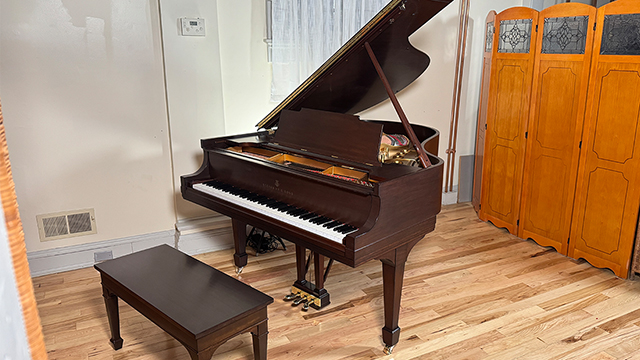
Hi, I’m Robert Estrin. This is LivingPianos.com. The question today is, “How Long Does it Take to Rebuild a Piano?”

There’s a very wide range of time, and there are many aspects to this question. Let’s say you have a piano you want to have rebuilt. Perhaps you have a Steinway, you want to have restored and you decide to send it to Steinway to rebuild. You’re probably going to wait over a year to get your piano back. It can take that long! Now, does that mean they’re taking the entire year to rebuild it? Well, yes and no. They might do parts of different pianos simultaneously. However:

It takes at least months to rebuild a piano.

Now, the other aspect of this question is, what does it mean to rebuild a piano? There are different parts of a piano that can be rebuilt. For example, are you replacing the sound board or repairing the old one? Are you creating a new key set, or are you staying with the original keys? There are different parts of a piano that can be utilized in rebuilding in most instances. Unless you have a piano that’s a complete disaster, you’re going to utilize a lot of the existing parts, so it can take different amounts of time depending upon how much work is required.

Let’s say, for example, you have an unusual piano from the late 1800s with a pre-modern action and it’s an art-case with beautiful scroll work, and some of the scroll work is missing. Perhaps other parts of the piano are destroyed as well, such as the music rack or one of the legs. It could take a very long time to match the woods, to hand-carve the beautiful intricate parts to make the piano match the way it was originally manufactured.

It could take longer than a year.

But I would say that any kind of even the most basic rebuilding that keeps the original action and replaces only some action parts, replaces strings, perhaps pin block, refinish the case, re-guild the plate, has got to take an absolute minimum of two to three months, if that’s all they’re working on. It is a big job. Not only that, you don’t want to rush through it because a piano needs to settle in, and a great part of the work of rebuilding a piano comes after the rebuilding in adjusting everything to play on a high level. On top of that, it’s important to make sure everything is stable.

If a piano has just been rebuilt and hasn’t had fine work performed, it will sound horrendous!

It takes tremendous refinement to get a rebuilt piano to play on a high level. It’s best to let the piano sit, play it, and have technicians work on it, and, of course, even over the next year or two, a rebuilt piano, just like a brand-new piano, is not going to be really settled in and stable for at least a year or two. You must play the piano and have it serviced on a very regular basis until it becomes stable.

So it’s all part of the process. I hope this has been helpful for you. If you have a piano you’re thinking of rebuilding and you want any advice, you’re welcome to contact us here at info@livingpianos.com. Thanks again. I’m Robert Estrin. We’ll see you next time.

949-244-3729

Honest Expression On Demand!


Sitting down at a beautiful semi-concert grand can be inspiring! But the challenge of being able to instantly remove all distractions and focus solely on music can be enormous!

At first, I wasn’t going to release this video since the video quality isn’t the best. But after relistening to the music, I believe it is worth checking out.

Hope you enjoy!
Robert@LivingPianos.com
949-244-3729

Can Playing the Piano Cause Hearing Loss?

This is Robert Estrin at LivingPianos.com with a viewer question. “Can playing the piano cause hearing damage?” You may be concerned about this. You’ve got one pair of ears for your whole life and you don’t want to blow it, right? We all know that rock and roll musicians often suffer from ear damage. You might not know that symphony orchestra players suffer from ear damage as well. It’s a hazard of the trade. Just think what it’s like when you have sixty or so musicians on stage. You might have timpani behind you, or a trumpet section blaring in your ears. It’s a real problem. To mitigate this, there are acoustic baffles made of plexiglass to help with sound while maintaining visibility to the conductor. What about the piano?

Is playing the piano safe for your ears?

Not necessarily. Whenever we help people choosing pianos, one of the first things we ask is where the piano is going. It’s important to match the piano to the room. For example, think of a seven-foot semi-concert grand. It’s glorious to play in a large room with high ceilings. But what if you put a piano like this into a small bedroom? Would it be okay there? Possibly, if you have really thick carpeting, thick drapes, sofas, beds, and other materials that absorb sound. It might sound fine. But with all solid walls, hardwood floors, low ceiling, even a baby grand could be a problem. The voicing of your piano also makes a big difference. Pianos get brighter the more you play them, and some pianos naturally are brighter.

Asian pianos tend to be brighter than American pianos.

If you have a really bright Asian piano in a room where the acoustics are very live, you could indeed inflict ear damage. A lot of it comes down to common sense. One telltale sign that you’ve gone too far is if you ever get ringing in your ears after playing your piano. That is a very strong danger sign. You should back off for a few days because if you experience ringing in your ears repeatedly, you can develop tinnitus. You can have a constant ringing in your ears that never goes away. You also must be careful how you place your piano as well as what room it goes into.

The voicing of your piano by your piano technician can make it louder or softer.

Naturally, whether your piano is open or closed will also make a big difference in volume. Years ago I had the experience of practicing in little tiny cubicles at school. Playing in a room like that makes you feel really powerful because it is easy to generate huge amounts of sound. Then playing in the concert hall even on a nine-foot concert grand piano in such a huge space, you’d feel like you weren’t making much sound at all. It was unnerving because in the practice rooms you could bang out anything. You could overplay the piano because they were played so much they became overly bright on top of playing in a confined space. It was easy to play loud and fast without any trouble articulating everything in that situation. Practicing in a room where things are too loud is not only bad for your ears, but it doesn’t prepare you to play other pianos in better situations.

I hope this is helpful for you and we appreciate the questions coming in! Again, this is Robert Estrin at LivingPianos.com Your Online Piano Store. Thanks for joining me.

info@LivingPianos.com
949-244-3729