

Tag Archives: robert estrin

The Magic Formula for Key Signatures

Welcome to LivingPianos.com, I’m Robert Estrin. Today I’m going to share with you the magic formula for key signatures. Many of you know your key signatures. But maybe you don’t quite understand them or you’re not fluent with them. Do you need to memorize all that stuff? Surprisingly the answer is no. Why not? There are formulas you can use to figure them out!

You never have to memorize your key signatures.

Believe it or not, I have never memorized my key signatures, but I can name them. F, C, G, D, A, E, B. How did I do that so fast? I’m actually thinking through the intervals that fast. I’m going to show you how to do exactly the same thing so that you don’t have to memorize them. You can understand them and figure them out. You might not be able to figure them out as quickly as I just did, but you will be able to figure them out. You will get faster with it over time.

The interval of a fifth is critical in key signatures.

What is a fifth? The fifth, simply put, is the fifth note of a scale. So in C major, G is the fifth note of the scale. This interval is what’s called a perfect fifth. It’s a perfect fifth because G is the fifth note of the C major scale. You can invert this and put the C on top. It’s still a perfect interval, but now it becomes a fourth. So fourths and fifths are essentially the same. That’s one of the reasons they’re perfect intervals. Inverted, they remain perfect. Incidentally, octaves are also perfect intervals, as well as primes or unisons. If two people are playing the same note on different instruments, that’s called a prime. Once you understand fifths and fourths, the rest is easy!

If you have a key signature with sharps, the first sharp is always F-sharp.

You have to memorize that F-sharp is the first sharp. Once you memorize that and a couple other small details, the rest is seamless. So you have F-sharp. From there it goes up by fifths. You can either count with your fingers or you can do it on the piano. Count out five notes, F, G, A, B, C. C is the second sharp. From here you count out the next one, C, D, E, F, G. G is the next sharp. You can keep counting this way. D is the next sharp, then A, then E, and the last sharp is B. So these are all the sharps, F, C, G, D, A, E, B. You don’t have to memorize them. You just have to be able to figure them out.

How do you know what key you’re in?

If you go up a half step from the last sharp to the right, that’s the major key. So if you have one sharp, an F-sharp, go up a half step to see you’re in the key of G major. If you have two sharps, F-sharp and C-sharp, you’re in the key of D major. If you have three sharps, F-sharp, C-sharp, G-sharp, you’re in the key of A major. If you have four sharps, F-sharp, C-sharp, G-sharp, D-sharp, you’re in E major. If you have five sharps, F-sharp, C-sharp, G-sharp, D-sharp, A-sharp, you’re in B major. With six sharps you end on E-sharp, which means you’re in the key of F-sharp major. And finally, all seven sharps mean you’re in the key of C-sharp major.

That’s just half the story, because now we go to flats!

The first flat, if you only have one, is going to be B-flat. From here it goes down by fifths. I mentioned earlier that fifths and fourths are the same thing reversed. So you might as well go up by fourths because it’s easier to count up than down. So B-flat, E flat, A-flat, D-flat, G-flat, C-flat, F-flat. That’s the order of the flats. This is exactly backwards from the order of the sharps. The patterns are unbelievable!

Finding what key you’re in is even easier with flats.

There is one that you must memorize. The key with one flat is F major. It has the B-flat in it. You just have to know that. From there, the second to last flat is the key you are in. Because all flat scales, with the exception of F major, begin on a flat. So if you have two flats, B-flat and E-flat, you’re in the key of B-flat major. If you have three flats, B-flat, E-flat, A-flat, you’re in the key of E-flat major. If you have four flats, B-flat, E-flat, A-flat, D-flat, you’re in the key of A-flat major. And it goes on and on that way.

So all you have to look for is the last sharp on the right and go up a half step to find your major key. Or look for the second to last flat to the right to find the major key. I hope you enjoy these theory primers! Let me know in the comments here at LivingPianos.com and on YouTube. Thanks again for joining me, Robert Estrin here at LivingPianos.com, Your Online Piano Resource.

For premium videos and exclusive content, you can join my Living Pianos Patreon channel! www.Patreon.com/RobertEstrin
Contact me if you are interested in private lessons. I have many resources for you! Robert@LivingPianos.com

Is it Okay to Re-Divide the Hands in Piano Playing?

Welcome to LivingPianos.com, I’m Robert Estrin. Is it okay to re-divide the hands in piano playing? That’s the question today. There are many schools of thought on this subject. With Beethoven in particular, there are many people who feel that it’s very important to play the music exactly as it is written and not to redistribute the notes between the hands in a way that Beethoven didn’t write. Other people think as long as it sounds good, what’s the difference? Is there a difference? Should you divide the hands or not?

It really depends upon how you execute the music.

The question is, can you make it sound the way it is written while re-dividing the hands, or is it going to sound different? If it sounds choppy then that’s no good. If you know the sound that the composer intended and you divide the hands in a way that sounds the same, but it’s easier to negotiate, in my opinion there is absolutely nothing wrong with doing that. As long as the integrity of the sound is maintained based upon how the composer wrote the music, there’s nothing wrong with re-dividing the hands to be able to negotiate passages more cleanly and faithfully.

If somebody can hear the difference in the way it sounds, you should avoid dividing the hands.

Re-dividing the hands can be a lifesaver in a lot of instances. It can make the music sound better. It can help you play more cleanly. Just always keep in mind the intent that the composer had in the way they wrote the score. That’s my opinion. Let me know in the comments how you feel about this! Thanks again for joining me, Robert Estrin here at LivingPianos.com, Your Online Piano Resource.

Steinway VS Baldwin: Listening Test!

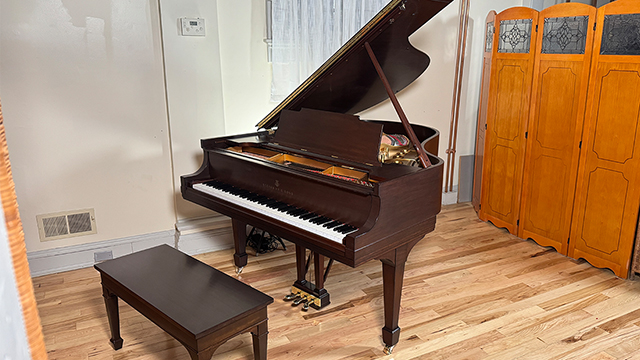
Welcome to LivingPianos.com, I’m Robert Estrin. Today I’ll be doing a piano test drive! I have two of the great American semi-concert grand pianos, Steinway and Baldwin. In the past, concert artists had a choice. Baldwin supported concert pianists around the world with their concert instruments. Of course, Steinway won the marketing war. They became the only de facto choice for touring artists, because putting concert grands in every major city in the world is a very daunting task.

In their heyday, Baldwin was making amazing pianos!

I’m going to play a brief excerpt of the Chopin G Minor Ballade. First I will play it on the Steinway Model B from 1981. Then I will play the same excerpt on the Baldwin SF seven foot semi-concert grand from 1967. I’m really interested in your opinions! Leave your comments here at LivingPianos.com and YouTube. I want to know your impressions of these two magnificent American semi-concert grand pianos!

For premium videos and exclusive content, you can join my Living Pianos Patreon channel! www.Patreon.com/RobertEstrin

What is a Major Scale?

Welcome to LivingPianos.com, I’m Robert Estrin. Today’s subject is about major scales. What is a major scale? I’m sure most of you probably already kind of know what it is. But for those of you who know what a major scale is, you might want to stop right now and see if you can put it into words. You might find that you’ll be stumbling a bit if you’ve never asked yourself this question. You kind of intuitively know what it is, but how do you define it succinctly?

A major scale is a series of whole-steps and half-steps.

I want to define whole-steps and half-steps for any of you who are searching for this because you don’t know anything about what a major scale is at all. A half-step is any two keys next to each other with no keys between. That’s black or white keys. It can be two white keys, or it can be a black and white key. Two keys together with one key between is a whole-step. A major scale is a series of whole steps and half
steps.

Major scales contain eight notes.

The first and eighth notes are the same. They are spelled diatonically. What does that mean? It means it has all the letters in order without skipping or repeating any. For example, an A major scale would contain some form of A, B, C, D, E, F, G, A. It has to have all the letters in order without skipping or repeating. Spelling counts, and there’s a good reason for it. When you look at the music, you see the notes on consecutive lines and spaces. All major scales will go from line to space to line to space, or from space to line to space to line. That’s essentially what a major scale is.

Where are the half-steps?

As I mentioned, there are eight notes. They are all whole-steps except between the 3rd & 4th and the 7th & 8th notes. That’s why on the piano, because you have some white keys that are a half-step apart, the C major scale contains all white keys. All other major scales contain either sharps or flats, but never both.

How can you figure out scales?

You can take any note on the piano, and remember that the notes are going to be in the order of the alphabet. So if you have a D major scale, it’s going to have some form of D, E, F, G, A, B, C, D. It must be spelled diatonically with all the letters in order. But those notes don’t form a major scale because the half-steps are not in the right place. So you use accidentals, either sharps or flats, never both. It just happens to work out that way! You can count the numbers of the notes. Remember to move by whole-steps except between the 3rd & 4th and the 7th & 8th notes. Of course you can hear when a major scale is correct, because you know what it’s supposed to sound like. So that is how you can figure out all your major scales, simply by spelling them diatonically and arranging them with all whole steps, except between the 3rd & 4th and the 7th & 8th notes. You can start on any key on the piano and you can spell a major scale.

It’s not always quite so simple.

I’m going to do a G-flat major scale. We start with G-flat. Then we move up by whole-steps to A-flat, then B-flat. Now we move up by a half-step. You may be tempted to say “B”, but I already said it can’t be B, because you have to have all the letters in order without skipping or repeating any. So the fourth note has to be called C-flat! You might think that’s crazy, but if you saw it in the music it would be much more logical to have all the letters on consecutive lines and spaces. So indeed the spelling makes it more logical visually because a scale will always go alternating between lines and spaces. This is why a C-flat makes much more sense than a B-natural in this case. Having that C-flat keeps it diatonic, makes it easier to read, and it’s more logical. If you enjoy this little tutorial, I can offer you more! If any of you wonder about key signatures, let me know in the comments below here on LivingPianos.com and YouTube.

With music theory the fundamentals must be solid for you to be able to understand more advanced concepts.

This is akin to mathematics. Imagine trying to do algebra if you were rusty on your multiplication tables. Everything builds on everything else. It’s the same with music theory. If you have the fundamentals down, you can get to really advanced harmonic analysis and structural analysis of compositions. It will be as easy as reading notes became for you early on. Everything builds on everything else with such beautiful logic. It also makes your music easier to learn, to digest and to read. Thanks again for joining me, Robert Estrin here at LivingPianos.com, Your Online Piano Resource.

For premium videos and exclusive content, you can join my Living Pianos Patreon channel! www.Patreon.com/RobertEstrin

For premium videos and exclusive content, you can join my Living Pianos Patreon channel! www.Patreon.com/RobertEstrinContact me if you are interested in private lessons. I have many resources for you! Robert@LivingPianos.com

Czerny Concerto for Piano Duet

This performance is by the Double Digit Piano duo: Coren Estrin Mino and Ron Palka. Coren is my sister!
The performance was with the Cleveland Philharmonic.

Advanced Pedal Techniques

Welcome to LivingPianos.com, I’m Robert Estrin. Today’s subject is about advanced pedal techniques. It’s absolutely not what you would expect at all. I guarantee it! I could talk about half pedaling, which sometimes you do to get a certain sonority. I could talk about combining the una corda pedal, the soft pedal, with the sustain pedal. I could talk about engaging the sostenuto pedal, the middle pedal, to hold some notes when maybe you don’t want to blur everything together. Then you can combine that with the sustain pedal. I could talk about using little dashes of pedal to bring out certain notes. There’s a wealth of pedal techniques that you couldn’t possibly even write in, and even if you could, it wouldn’t be that helpful. Because the piano you’re playing on, the acoustics of the room, not to mention the music you’re playing, all enter into these advanced pedal techniques.

What I’m talking about today are next level pedal techniques.

I will use the slow movement from the Mozart K 545 C Major Sonata as an example. I’m talking about the second movement. I know many of you purists out there might say, “Why use pedal in Mozart at all? Mozart’s piano didn’t have a pedal.” This is true. However, there are two reasons why you might consider using at least some pedal in Mozart. Number one, although Mozart’s piano did not have a sustain pedal, it did have a lever operated with your knee that did exactly the same thing as a sustain pedal. So there was a certain amount of sustain that could be achieved, much like with the pedal. Secondly, when you’re playing on a modern piano, it’s so drastically different from a Mozart era piano that it essentially becomes a transcription for modern piano. The sound, the sustain, and the whole quality of the instrument is so different from what Mozart heard out of his piano. Arguably, you’re playing on a whole different instrument! You might as well take advantage of what the modern piano offers you.

What kind of techniques am I talking about?

I’m not talking about any of the pedal techniques I brought up before. So what am I talking about? In pedaling this, you might be tempted to pedal so that the chords in the left hand get blurred together. Why not simply change the pedal whenever the harmonies change? It’s a very simple technique. The problem with that is when you add the right hand, the right hand notes become blurry. You don’t want the right hand to be blurry. But you want the left hand to be sustained, giving that bed that the melody can float on. Well, here’s the technique. It doesn’t involve the pedal. Not at first.

Use your hands to simulate the sound of the pedal!

In the left hand, you want to hold the bass notes longer. When you do this, the left hand is sustained without having to depend upon the pedal for it. Why is this so helpful? Because then you can use little touches of the pedal to articulate certain notes in the melody, to make the melody more sustained. These touches of pedal on the melody are really subjective. They’re not going to be the same for everyone. It depends upon the room, the acoustics, and the piano. By using little dashes of pedal on the melody while playing the accompaniment with this phantom pedal technique, you can capture the long notes on the melody to make them sing longer.

Simply pedal the long notes in the melody so they sustain longer.

With your left hand, use the phantom pedal technique holding the notes that fall on the beat so that you can use the pedal to enhance the melody instead of trying to pedal the chords to make them sound more lush and sustained. This opens up dramatic possibilities for using the pedal in a more subtle fashion to enhance the melody rather than connecting the accompaniment. This isn’t just in Mozart. This goes for a vast array of musical styles. Try it in your playing. You’ll be richly rewarded with a far more musical performance! You will get a sound that’s cleaner because you’re doing more with your hands. You won’t have to depend upon the pedal to connect what you can connect with your left hand. This opens up great expressive possibilities with the pedal in your piano playing. Thanks again for joining me, Robert Estrin here at LivingPianos.com, Your Online Piano Resource.

For premium videos and exclusive content, you can join my Living Pianos Patreon channel! www.Patreon.com/RobertEstrin

Contact me if you are interested in private lessons. I have many resources for you! Robert@LivingPianos.com