


Tag Archives: robert estrin

How to Develop More Speed in Your Piano Playing

Welcome to LivingPianos.com, I’m Robert Estrin. We now have over 1,300 videos here on Living Pianos and YouTube! After 1,300+ videos, what more is there to say? Well, quite a bit, really! Today’s subject is about how to develop more speed in your piano playing. I did a video about this years ago. It’s worth watching. You can see that video here. But today I’m going to share one particular secret which is the whole basis for developing speed at the piano. Before I get to that, I’m going to talk about the simple physics of the piano.

More motion equals greater volume – Less motion equals faster speed.

I’m going to break it down into finger technique and wrist technique. I’ll show you how both of them work. To demonstrate, I’m going to use the Ballade by Burgmuller. This is a great little piece to demonstrate both techniques. The right hand has chords which utilize wrist technique. While the left hand has fast 16th note finger work. So let’s first talk about the wrist technique first in the right hand. When you’re first learning this piece, you should articulate everything clearly by differentiating each finger and each wrist motion to achieve precision in your playing.

Wrist technique:

It’s just like if you want a lot of power doing anything. For example, let’s say you are hammering in some nails. You would naturally lift the hammer up high enough to gain momentum of the hammer. which provides more motion. You’re obviously going to get far greater power from the extra motion of your arm. Well, in piano, you don’t use your arms for this type of technique. But you do use your wrists. So in slow practice you want to articulate the chords with your wrist. Later, you can use less motion to achieve faster speed. When going slowly, you can play chords with quite a bit of power if desired. Now in this particular piece, it is written at a low dynamic level. But if you want to play them loud, more wrist motion will accomplish that. As you go faster, you use less motion and stay closer to the keys.

Finger technique:

It isn’t just your wrists! It also is true of finger work. As you begin to learn a piece, use raised fingers and sink your fingers into the keys, much like you do when practicing exercises or scales and arpeggios at a slow speed, because it helps to delineate the release of notes. It’s actually far harder to lift up previously played fingers than to play new notes. What do I mean by this? Well, you can demonstrate this for yourself. Put your hand on a flat surface, and lift your fingers one at a time. You will notice the fourth and fifth fingers are particularly hard to lift up when your other fingers are down. However, pushing your fingers down is not so hard.

One of the most important finger techniques to develop on the piano is the release of previously played notes.

If you don’t practice releasing notes, you can get a blurry sound. Worse yet, imagine if your thumb didn’t release and couldn’t play again! The first three notes of this piece are C, B natural, and then C again. If the C doesn’t come up in time, it won’t replay after the B plays because it would still be down. That’s why in slow practice, practicing with an exaggerated motion of the fingers can really help your hand learn which fingers are down and which fingers are up. Try this and you’ll see the power you can get by using strong, raised fingers. Typically you don’t play this way in performance, but in practice it can be extremely valuable when you’re first learning a piece. You want to really articulate the notes to figure out your hand position, and to feel your fingers really dig into the keys. You want to start very slowly with a lot of motion and raised fingers. As the tempo increases, you’ll notice that the fingers stay closer and closer to the keys. Again, less motion equals more speed.

It’s simple physics really. When you need power, you use more motion. And when you need speed, you use less motion.

That’s the lesson for today! Try this in your playing. If you come to a passage you’re working on, and you can’t get fast enough speed, try lightening up. Stay closer to the keys, and you’ll be astounded at how much faster you can play by simply using less motion! I hope this lesson is helpful for you. I’m producing a lot more videos and it’s all for you! You can email me and let me know what you’d like to see in future videos. Tell me what topics you are interested in. Thanks again for joining me, Robert Estrin here at LivingPianos.com, Your Online Piano Resource.

For premium videos and exclusive content, you can join my Living Pianos Patreon channel! www.Patreon.com/RobertEstrin

Contact me if you are interested in private lessons. I have many resources for you! Robert@LivingPianos.com

Piano Test-Drive: Steinway Concert Grand

Welcome to LivingPianos.com. I’m Robert Estrin, and this is Piano Test-Drive! I have a gorgeous instrument to present to you! The first thing I did on this piano is the first thing I do on almost every piano I encounter, which is to improvise. I let the sounds take me where they will. Truth be known, I did record the Chopin G minor Ballade on this instrument. You can find that performance here. But what’s really fascinating is sitting down on an instrument with no preconceived notions and just letting the sound take you.

An instrument like this Steinway Concert Grand from 1952, which has been masterfully rebuilt, is almost like driving a sports car.

Any maneuver you want to undertake, the instrument can handle it. You can go anywhere you like, and it can take you there at lightning speed! For example, the opening chords of the improvisation you’re about to hear, which I recorded last night. They’re massive chords. They blend from one to the next and it’s a glorious big sound. Yet in the middle, I come down and play with delicacy, just like if you’re in that sports car and you decide to take a scenic drive by the ocean to enjoy a little bit of the scenery. There are repeated notes, there’s everything I could throw at this piano! I’m wondering how you’ll like this. Listen for the end, because you’ll hear the massively strong, lowest B-flat octave on the piano at the end of this improvisation. I hope you like it!

The Steinway model D is the Concert Grand you see on stages throughout the world!

If you go to the symphony to see a concerto, 97% of the time it’s a Steinway model D Concert Grand on stage. It’s the de facto standard. To have a glorious instrument like this is such a treat. I just want to record as much as I can on this piano for the time I have it.

I hope you’ve enjoyed this! I would love to hear your impressions of this instrument in the comments here at LivingPianos.com and YouTube. Thanks again for joining me, Robert Estrin here LivingPianos.com, Your Online Piano Resource.

For premium videos and exclusive content, you can join my Living Pianos Patreon channel! www.Patreon.com/RobertEstrin

Contact me if you are interested in private lessons. I have many resources for you! Robert@LivingPianos.com

Stealing Moments to Practice: Advice from Ruth Slenczynska

It is a great challenge to find enough time to practice! Even piano performance majors in conservatories have to deal with course loads to satisfy degree requirements. In my recent interview with Madame Ruth Slencyznska, I asked her how she managed to find time to practice, particularly when she was traveling from continent to continent playing concerts. Her answer was to steal moments!

My father had the same philosophy. Whenever a student couldn’t make a lesson, he would take advantage of the time by practicing. It’s amazing how much you can get done when you take advantage of every spare moment!

Dinner isn’t quite ready, practice! Waiting for a return phone call, practice!

In the accompanying video, I took advantage of a 15 minute slot I had available before teaching a student. I showed how you can learn at least a couple of phrases in a short practice session. These little bursts of productivity can really add up over time. You must take advantage of any time you have to squeeze in more practice time!

You will see in the video how I concentrate on learning very small chunks of music at a time. This has many benefits. First, if you only have a small amount of time, you are guaranteed to be able to learn something. Also, when you have more extended practice time, you can sustain a longer period of productivity by never exceeding what you can absorb at any one time.

Try this out for yourselves. You will find that even when you think there isn’t enough time to do anything productive, you could end up with more time than you imagine. Instead of just scrolling on your phone waiting impatiently, you can instead forge ahead with learning your music! Let me know how this works out for you.

I’m Robert Estrin here at LivingPianos.com, Your Online Piano Resource.

For premium videos and exclusive content, you can join my Living Pianos Patreon channel! www.Patreon.com/RobertEstrin Contact me if you are interested in private lessons. I have many resources for you! Robert@LivingPianos.com
How Do You Achieve Smoothly Connected Chords on the Piano?

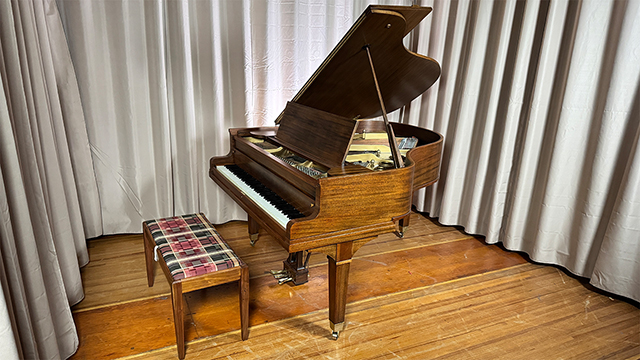
Hi, I’m Robert Estrin, and this is LivingPianos.com! Today’s subject is about how to achieve smoothly connected chords on the piano. This can be extremely difficult, particularly when you’re playing repeated chords. The whole mechanical nature of the piano is such that for a note to replay, the damper comes in contact with the strings. So it’s virtually impossible to completely connect a repeated note on the piano. You can use the pedal, but even then, because of the percussive nature of the piano’s tone, it never really sounds connected.

The more connected you can play with your hands, the smoother the sound will come out of the instrument.

This is true regardless of whether you’re using the pedal or not. Practicing without the pedal while trying to get repeated chords connected is essential. I’ll explain why in a minute. But first, how do you achieve such a thing? The secret is to keep your fingers in contact with the keys the entire time. Keep your fingers right on the keys. And be sure the keys come all the way up before they go back down again. If the key is down even a fraction of an inch before you play it, it may or may not play. A piano is not meant to have keys play when they don’t return all the way to the top. It’s not a technique you can always rely upon. So keep your fingers right on the surface of the keys, but be sure to let the keys fully return.

The first chord of each group has to be captured on the pedal, but you don’t want to capture the previous harmonies.

If you pedal too early, you’ll capture extra notes. You have a very brief amount of time to capture the chord on the pedal. It has to be after it is played, but also after the previous notes are gone. So by playing chords as long as possible, it gives you the maximum amount of time to grab the chord on the pedal. You want to work to have all the chords played while staying very close to the keys.

In places where you have repeated notes, you can change fingers.

When you change fingers on repeated notes, it’s much easier to make them sound smoothly connected. As one finger is going down, another finger is coming up. Whereas if you use the same finger, it doesn’t sound as smooth. It’s really hard to play with one finger and make the notes sound connected. When you change fingers on repeated notes, you get a smooth sound. You don’t have that luxury when you’re playing chords. You only have so many fingers on your hand! If you’re playing three notes, you have to use the same fingers.

So remember the secret to playing repeated chords is to keep your fingers in contact with the keys. But be sure to come up completely before depressing the chords down again. That should help you achieve smoothness in your repeated chords in any music you’re playing! Thanks again for joining me. I’m Robert Estrin here at LivingPianos.com, Your Online Piano Resource.

For premium videos and exclusive content, you can join my Living Pianos Patreon channel! www.Patreon.com/RobertEstrin

Contact me if you are interested in private lessons. I have many resources for you! Robert@LivingPianos.com
Should You Buy a Steinway?

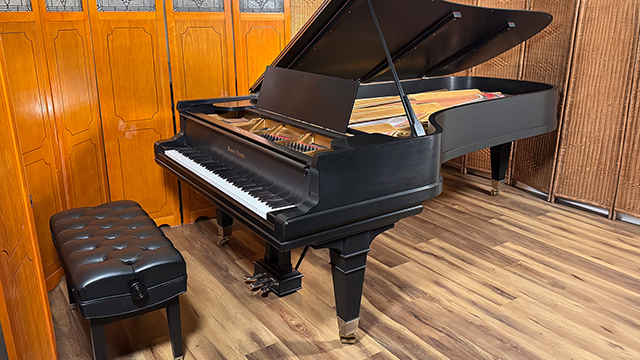
This is LivingPianos.com. I’m Robert Estrin. Today’s question is: Should you buy a Steinway or other fine piano? It’s tough when you’re going to buy a piano. You will see digital pianos for a few hundred dollars. Then there are pianos for hundreds of thousands of dollars! So what should you get? Obviously not everybody has the resources to buy pianos that cost a hundred thousand dollars or more. But there is definitely a choice of how far to go.

How much should you spend on a piano?

Let’s say you have the option of buying a Steinway, Bechstein, Mason and Hamlin, or some other top-tier, hand-built piano. But you could buy a perfectly good Chinese or Indonesian piano, brand new, for less money than a used Steinway or Bechstein, or something of that nature. Which one would be better for you? Is one going to hold up better? Is one going to be more satisfying to play? Is it really worth spending tens of thousands of dollars, or over a hundred thousand dollars on a piano?

There’s a lot to consider. From an investment standpoint, it actually makes more sense to buy a fine piano than to buy a cheap piano. For example, let’s say you buy a no-name stencil piano, a piano that comes from some unknown factory in Asia with a familiar name on the front of some piano company that went out of business years ago. And it’s from a reputable company and from a good store. Nobody’s trying to pull wool over your eyes. They’re telling you like it is, “This piano is made in China and imported.” It looks just as nice as the $80,000 piano sitting next to it. Why should you even consider getting an $80,000 piano, or even a used, top-tier grand piano for $30,000? Is there any reason for this? Well, think about this: a $30,000 fine used piano or $80,000 fine new piano are instruments that, because of their intrinsic value, are worth rebuilding when the time comes. That’s why you see a lot of rebuilt Steinways, Mason and Hamlins, Blüthners, and other really fine pianos. Because the cost of new ones is so great, they are worth rebuilding.

What if you buy a brand new baby grand for $10,000. (I believe there are some in that price range, although things have gotten a little bit more expensive lately.) Well guess what? When that piano wears out, it’s not worth rebuilding! The cost of restoration exceeds what the piano could eventually be worth after being rebuilt.

So I hate to say it, but they’re essentially disposable pianos!

Sometimes it’s hard to know when to pull the plug. Do you put new hammers on a piano you bought for $10,000? Should you spend $3,000 on action work? Or do you just get another piano at that point? Do you restring a piano you only spent $10,000 on? Do you spend thousands to restring it? You don’t have to ask that question if you have a Blüthner or a Steinway, do you? Of course it’s worth it, because new ones cost $80,000 – $100,000!

Of course, you’re not buying a piano as an investment, you’re buying a piano as an instrument to play.

So, what is the difference then? It depends upon how important piano is to you. If you’re an advanced player, obviously you want a piano that’s on a high level, with proper preparation. Any piano requires maintenance, but a higher quality piano will be more stable over time. It can maintain a higher level of regulation and voicing and even tuning, so you can enjoy a higher level of playing. And it won’t nickel and dime you trying to keep it that way. A lesser piano could involve more work to keep it playing okay. This isn’t always the case. There are some relatively inexpensive pianos that offer moderately good performance that can remain somewhat stable for you. So, I’m not saying every cheap piano is going to cost more to maintain. But many of them will. That’s one thing to consider. The other thing is what it will do for your playing experience. If every time you sit down at a piano you get a beautiful tone, you’re going to want to play more. Not only that, but you can do more with the music.

One of the benefits of having a really high-quality piano is the expressive potential of the instrument.

There are more gradations of loud and soft as well as colors of tone that are possible on a high level piano. On lesser pianos, the notes will start dropping out when playing very softly because the action isn’t refined enough to achieve a true pianissimo compared to a well regulated, hand-built instrument. On the other level, on a fine piano, you can play louder and louder without it ever getting harsh. With a piano like a Baldwin SF10, which is one of the great American pianos of all time, you can put tremendous energy without ever over driving the sound into distortion. It’s like a really high-quality sound system where you can turn the volume up, and it doesn’t hurt your ears. It just fills the room with sound. You can even feel the sound. On a lesser system, you wouldn’t want to turn it up that loud because the audio gets harsh and distorted. When you are playing a really fine piano, it will never get harsh, no matter how much energy you put into it. You never introduce distortion into the sound. It just opens up with beautiful, rich sonorities.

So, what level piano should you buy?

The right piano for you to buy depends upon your resources. You certainly don’t want to stress yourself by getting a piano and then not being able to pay your bills! However, if you look at the long term, you only buy a piano once if you buy a piano like a Steinway, Bosendorfer, or something of that nature. Whereas when you buy a lesser quality instrument, it’s very possible at some point in the future, you’re going to get something else. So, you might buy two or three pianos over time. If you get a fine instrument, you buy it once. And that piano, if it’s well-cared for, can get passed down from generation to generation. So, from a monetary standpoint, it’s an investment rather than an expense. And you get to enjoy the sound and the beauty of a fine instrument. So, is it worth it to get a Steinway or other top-tier piano? It absolutely can be.

Is there any benefit to buying a fine piano for a beginner?

Sometimes parents want to buy a piano for their children. They say, “Well, I don’t want to get anything too expensive. I don’t know if they’re going to stay with it.” And some parents just buy keyboards for their children to take piano lessons. What they’re doing is setting up their kids for failure. Because the keyboard is not going to be satisfying to play. And if it’s not a weighted action, their kids will have difficulty at lessons playing on a real piano. So you have to get a good enough instrument that is going to be rewarding and worthwhile to play. The piano you practice on should prepare you to play other pianos, which is the other big point. If you get serious at all, you will get to play in recitals. Or maybe you get to play at your school, or church. You’re probably going to be playing fine pianos at some point along the way. If you’ve never driven a sports car, you might not have any idea how to drive one. But if you know how to drive a fine automobile, you’re going to be able to drive anything that runs okay. The same is true with fine pianos. You gain experience getting the most of any piano when you are accustomed to playing on a fine piano on a regular basis.

There are many good reasons to get a fine piano.

The most important thing is that you’re going to enjoy it more! And it’s a good investment, so you can justify it for yourself. So yes, go out and get a Steinway. You’ll never regret it! Thanks again for joining me. I’m Robert Estrin here at LivingPianos.com, Your Online Piano Resource.

For premium videos and exclusive content, you can join my Living Pianos Patreon channel! www.Patreon.com/RobertEstrin

Contact me if you are interested in private lessons. I have many resources for you! Robert@LivingPianos.com

How Can You Determine What Level Pianist You Are?

I get questions from piano students all the time asking, “How can I determine what level player I am?” Students from India have specific designations from organizations like ABRSM that have regimented repertoire putting students in specific categories of levels. Many music organizations like Music Teachers’ Association of California also categorize students by numeric levels. I laugh sometimes when I see repertoire with designations of, Easy, Intermediate and Advanced, and such, with pieces of the standard literature sometimes being called, ”Easy”. But there are no ways to categorize levels of playing since people have drastically different aptitudes. Someone may have a great affinity for Baroque music, but a weak sense of rhythm. Or someone may be a phenomenal sight-reader, but they can’t play anything from memory, or play anything on a really refined level. I would say that someone playing Beethoven Sonatas and large works of Chopin (like his Ballades and Scherzi) for example, may be considered advanced, but only if they are playing these pieces honestly.

There is a huge range of levels within intermediate and advanced music on the piano.

Ultimately, it isn’t important to categorize yourself into any particular piano level. You are growing as a musician as long as you are practicing, and most importantly, expanding your repertoire. Every new piece you learn adds to your skill as a pianist, and increases the depth of your musicianship. There will always be new pieces to learn, new styles to assimilate, and new techniques to explore. No matter how much music you learn, or how accomplished you become at the piano, there are always vast new areas of music for you on the piano. There also will always be people who can do things on the piano you can’t do no matter how accomplished you become.

It’s about the journey, not the destination.

So, enjoy your practice! And don’t worry about what level you are on. That’s my advice to you. If you spend productive time at the piano on a regular basis, you will continue to grow as a pianist.

Thanks for subscribing, and telling people about Living Pianos. There are more piano videos coming your way on LivingPianos.comYour Online Piano Resource!

For premium videos and exclusive content, you can join my Living Pianos Patreon channel! www.Patreon.com/RobertEstrin Contact me if you are interested in private lessons. I have many resources for you! Robert@LivingPianos.com