


All posts by Robert Estrin

How to Get A Unique Sound on the Piano

Welcome to LivingPianos.com. I’m Robert Estrin. The subject today is about how to get a unique sound out of the piano. It seems like all that’s involved in getting a sound out of the piano is just the speed at which the hammers hit the strings. So how could you possibly get a unique sound? Obviously, singers each have distinctive sounds because the physiology of everyone’s body and vocal chords are unique. With wind instruments, it’s the same thing because the whole vibrating chamber within you is essentially part of the instrument. But the piano is a mechanical contraption. How could you possibly get a unique sound? Yet, if you listen to different pianists, you hear drastically different sounds! You might wonder how this is possible. Well, there’s a lot to this subject.

First let’s talk a little bit about the mechanics of a piano.

I just happen to have an instrument with the action of a nine-foot concert grand piano I use on many of my videos. It’s my second prototype, modular piano system. You see that you push a key and the hammer goes up. Key goes down, hammer goes up. Really the only thing affecting the key once it’s pushed is its speed. It’s the only thing being measured. You might wonder how you can possibly get a unique sound. Is it really possible, the physics of it? The answer is yes! I’m going to explain how this is possible.

First of all, of course the speed has a lot to do with the tone and the loudness. Before we get into the subtleties of pedaling, what about just playing with your hands? Can you really get different qualities of sound just with your hands? For example, if I were to play Bach’s Sarabande Movement from his G Major French Suite no. 5, to see if it’s possible to achieve a different sound playing it with two completely different types of touches, I wonder if you can hear any difference.

See the accompanying video to hear for yourself!

You might have noticed some different shadings of expression. It is possible to play with completely different techniques in order to create different qualities of sound. The first time I just let my fingers be totally relaxed and floppy. I just let them play the attack of the note without any regard to the sustain of the note. You might be thinking it doesn’t make any difference on a piano, but it does! Why it does and how it does is partly due to the fluidities from note to note. You have the analog of the breath by the weight of the arm being transferred smoothly from note to note. That’s one aspect of sound. And secondly, the precise balance between the hands. It can be achieved by having different weights in the two hands and even different weights on the different sides of the hands. So right there, already, you can hear some difference.

The sustain pedal allows for even more expression.

When you add the complexities of what the pedals do on the piano, there are dramatic differences! Of course, if you put the pedal down before you play a note, it’s going to have an echoey sound. In fact, it almost has a little plume right after the initial attack. But if you want to achieve a truly sustained tone, you wouldn’t want to necessarily have that large swell on the attack. You probably would want to increase the sustain of the tone by pedaling just after the initial attack. You do this to capture more sustain, to make the note hold longer so you can create a smooth line instead of a percussive quality of each note. By pushing the pedal down about half a second after playing each note, you can achieve much more sustain. There’s a subtle difference in the tone. The sustain is more full when you put the pedal down after the initial attack. Unlike putting it down before you play the note, which just makes the beginning of it very loud and doesn’t really achieve that continuous quality you want, to mimic the sound of a human voice or a bowed instrument.

Many modern digital pianos will do some of the same things I’m talking about by using physical models of acoustic pianos. But naturally doing this on an acoustic piano is the ideal situation for you. I’m using Pianoteq physical modeling piano software which is not sample based. So you can really get a feel for the sound of the pedals and all the complexities of piano tone.

The una corda pedal can also help to create a sustained tone.

The una corda pedal, or soft pedal, is the one on the left. On a grand piano it shifts the whole action over so the hammers are not striking directly on all three strings. They strike more directly on two of them. You get a warmer tone, because the initial attack is less intense, yet the sympathetic vibration of the three strings is relatively more prevalent. You get a more sustained tone just by using the una corda pedal. It’s not just softer, but the envelope of the sound is different. The initial attack is less and the sustain relative to the attack is greater.

Combining the una corda pedal with the technique I showed you earlier of depressing the sustain pedal just after the initial attack, you can get a very sustained, continuous tone. And that’s just scraping the surface, because you can utilize the pedal in innumerable ways. You can try half-pedaling techniques, where the dampers are just coming a little bit in contact with the strings, just to be able to dampen the tone a little bit to get different tonal colors. There are even ways of fluttering the pedal or just using little bits of pedal here and there to bring out certain notes within a line. So yes, there are ways in which you can get different sounds out of the piano with the pedals as well!

Support the weight of your arms when playing massive chords instead of hitting the keyboard.

When you hit the keyboard, it’s a rather harsh sound. Whereas if you keep your fingers on the surface of the keys, you can precisely depress all of the notes with the same energy. It’s a more musically pleasing sound. You do this to avoid some of the notes being overplayed and harsh while others are underplayed. You don’t have the same control when you are hitting the keyboard from above. Try that on a fine grand piano and you’ll really hear a difference!

Pianists have dramatically different sounds! Ultimately one of the most important components of getting a unique sound out of the piano is how you balance the notes within a chord or the lines within counterpoint. You can achieve a tremendous variety of sound on the very same pieces of music. I often love to listen to a great number of performances of the same piece with great pianists. It’s so enlightening! I encourage you to do the same thing. YouTube is a tremendous resource for that. Look up almost any piece of music and you’ll usually have dozens of different performances from professionals, up and coming pianists, and even students. You’ll hear a great variety of sounds on the piano.

So yes, you can get a unique sound out of the piano! I’ve just shown you many techniques, and there’s even more for you to discover. I’d love to hear your ideas for getting a unique sound out of the piano! Let me know in the comments! Thanks so much for joining me, Robert Estrin here at LivingPianos.com, Your Online Piano Resource.

For premium videos and exclusive content, you can join my Living Pianos Patreon channel! www.Patreon.com/RobertEstrin

Contact me if you are interested in private lessons. I have many resources for you! Robert@LivingPianos.com

www.LivingPianos.com
www.Facebook.com/LivingPianos
949-244-3729

What’s the Difference Between Sforzando and Forte?

This is LivingPianos.com. I’m Robert Estrin. The subject today is about the difference between sforzando and forte. On the piano, it’s really tough. You don’t have much control over the shape of the tone once a note is played, other than the pedals. I’ll get into that in a moment. You must be able to delineate what a sforzando is compared to a forte or fortepiano. Sometimes you’ll see a forte and right after that a piano (FP)! What is it!? Is it forte or is it piano? Well, that’s what we’re going to talk about today!

Forte means loud.

Forte indicates everything is played at a high volume. On the piano when you play a note, it’s immediately fading away. So you get a strong attack. In fact, when you play the piano without the pedal, everything is somewhat sforzando, because a sforzando is basically just a strong attack. So forte is loud throughout, sforzando is a strong attack that fades away, whereas a fortepiano is like a sforzando, but with a longer time before the sound diminishes in volume. I also play French horn. All of those distinctions can be achieved with much more precision on the horn. So how do you achieve these things on the piano?

One sforzando technique is to let go of the pedal after the initial attack to make the chord fade away.

You can fake a sforzando-like sound by utilizing the pedal. It’s a very subtle difference in tone. Little touches of the pedal sometimes can create a sforzando effect. On the piano we don’t have as much to work with on the tone of a note once it’s struck. All you have are the pedals! You can do half pedals, you can incorporate the soft as well pedal. But to understand the tone you’re after is key for achieving the desired results. If you listen to the beginning of Vladimir Horowitz’s performance of the Pathetique Sonata of Beethoven, it is very stark in the way he pedals it to get that fortepiano effect. Other pianists play a little bit smoother, without so much angularity in their fortepiano or sforzandi. So there are a lot of different ways of approaching this.

On the piano, you just have to do your best with what you have to work with.

On the piano, you can use the pedal to try to achieve some sense of the beginning of the note compared to the end of the note. But on wind instruments and string instruments, there are infinite possibilities for the shape of every note! That’s why you see all these different markings of accents in the score: fortepiano, sforzando, accents, fortissimo piano, et cetera. You have to understand what the sound would be if it was played by a symphony orchestra, or a string quartet, or a brass choir, to get a sense of the sound you are after. As a pianist, you just have to do the best you can with your hands and your pedaling to achieve the sound the composer intended.

I hope this is helpful for you! Thanks so much for joining me, Robert Estrin here at LivingPianos.com, Your Online Piano Resource.

For premium videos and exclusive content, you can join my Living Pianos Patreon channel! www.Patreon.com/RobertEstrin

Contact me if you are interested in private lessons. I have many resources for you! Robert@LivingPianos.com

www.LivingPianos.com
www.Facebook.com/LivingPianos
949-244-3729
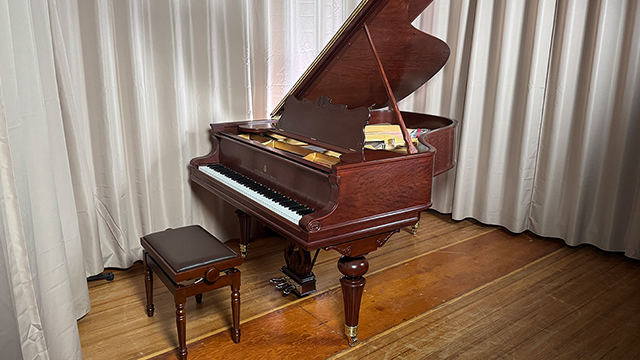
Should You Trust A Piano Salesperson?

This is LivingPianos.com. I’m Robert Estrin. Today I will answer a question I received from a viewer. Heinrich asks, “Is it true that you should never trust a person selling pianos?” There are so many implications to this question. I was taken aback by this. What kind of experiences has this man had? And if he’s had these experiences, how many others out there have had similar experiences? To answer this question, I want to talk about something personal.

We recently bought a restored Victorian building in the Waterloo Arts District in Cleveland.

The Waterloo Arts District in Cleveland is the new home of Living Pianos! The building is a magnificent structure that was built during the Civil War. It’s absolutely beautiful! Throughout the building there’s woodwork from old growth forest. You just don’t see that anymore. But nobody ever did anything with the floors. They looked old and tired. We came across a contractor who was recommended by my brother-in-law, who restores floors. It can be a hair-raising experience dealing with contractors. They tell you a bunch of stuff. You don’t know what to believe! They’re usually trying to sell you all kinds of things. You don’t know what you should do. But when you have a great salesperson, like we had, it makes all the difference. Johnny took us through and showed us everything we needed to understand. He educated us. More importantly, he listened to us.

There’s nothing worse than a salesperson who doesn’t listen to you.

We’ve all dealt with bad salespeople. You can talk until you’re blue in the face, but they’re obviously just trying to sell you something. They’re not solving your problem. Ultimately what a great salesperson does is listen to you so they understand your situation and can solve your problem.

Great salespeople are few and far between.

Are you more likely to meet a bad salesperson in the piano industry? I don’t believe there are worse salespeople in the piano industry compared to other industries. But great salespeople are quite rare. For example, years ago I had an opportunity to move to California, managing the tenth largest music store in the country. This was in Universal City. The store catered to the recording industry. I’ve always been very absorbed, some would say obsessed, with music technology. It was a natural fit for me. The reason I bring this up is that people would come in and they would ask for a specific item. They had it in their mind, they wanted this one item. And instead of just ringing it up, I’d ask about their studio. I’d ask about the other gear in their studio and what they were after with the item they came for. Sometimes I could steer them to a less expensive item that would solve their problem.

A great salesperson will listen to somebody to know what they’re trying to achieve and educate them so they can make the right decisions for themselves.

I’d like to think that there are people in the piano industry who are truly helping people. I know many people in the piano industry who have a passion for the piano and really care about the people and the music. But I want to hear from you! I want to know what your experiences have been. Are great salespeople more common in the piano industry? Or do you feel that the piano industry has more of the self-serving type? I hope it’s the former and not the latter! Let’s get a discussion going on this topic, because Heinrich really wants to know, and so do I. He brought up a really good point. I’m looking forward to the comments about this! Thanks so much for joining me, Robert Estrin here at LivingPianos.com, Your Online Piano Resource.

For premium videos and exclusive content, you can join my Living Pianos Patreon channel! www.Patreon.com/RobertEstrin

Contact me if you are interested in private lessons. I have many resources for you! Robert@LivingPianos.com

www.LivingPianos.com
www.Facebook.com/LivingPianos
949-244-3729

5 Classical Music Myths

Welcome to LivingPianos.com. I’m Robert Estrin. Today I’m going to tell you about 5 classical music myths. I’m going to finally put these myths to rest! I hear these things all the time. But usually from people who don’t have much exposure to classical music. They just think these things are true, but they’re really not. Are they 100% categorically false? Not all of them. But generally, these things are not necessarily true:

Myth #1 – Classical music is relaxing.

People will say they like classical music because it’s relaxing. And it’s true that some classical music is relaxing. There’s some beautiful music on the piano as well as other instruments. But classical music isn’t just relaxing. It can elicit a wide variety of emotions. It can be angry. It can be scary. It can be exciting! It can be relaxing. It can be contemplative. It can be humorous. There’s a whole range of emotions. It’s not just relaxing. So if you want relaxing music, there are some pieces that are relaxing. For example, Mozart and Brahms offer relaxing music, however. a lot of their music is not relaxing at all! There’s a lot more to classical music than just being relaxing

Myth #2 – Classical music is serious.

I just mentioned that classical music can be humorous. There are many places where Beethoven and other composers have elements of humor in their music. It’s not all serious! Like I said before, classical music has a whole range of emotions.

Myth #3 You have to have training to appreciate classical music

If you have training, it may help you to appreciate classical music. But simply listening to classical music is all you need to appreciate it. If you listen enough you will develop an understanding and appreciation for the music. Listen to the same piece more than once, because you may capture more the second, third or fourth time listening to a piece as you become more familiar with it. So you do not need training to enjoy classical music.

Myth #4 – Classical music is boring.

Once again, if you take the time to become familiar with a piece of classical music, you may find that it’s incredibly enriching! There’s so much there that you might not capture in one listening. It might just go right over your head the first time you listen to it. So you think it’s boring because you didn’t get it. It’s like learning a concept that is a little bit hard to grasp. You might just decide it is too boring and give up. But if you just stay with it a little longer, you may come to understand the concept you didn’t get the first time you are exposed to it. But once you spend the time to become familiar with it, it can be really exciting and enriching once you understand it. The same thing is true with classical music. Once you become familiar with a piece of classical music, it’s not boring, far from it.

Myth #5 – Classical music is for snobs.

This one is tough. Unfortunately, since classical music is not supported by the government, at least in the United States, the only way that it can exist is by donors. So if you do go to the symphony or to the opera, there’s the exclusive section with the gold plaques honoring the donors. And then during intermission. they’re sipping champagne behind velvet ropes. You might say these people are snobs. But thank goodness for these snobs! If they didn’t support the symphony and the opera, as well as chamber music and concert halls, we wouldn’t even have classical music! So you might think of them as snobs. And when you’re on the other side of the velvet ropes, it might feel that way. But in reality, they have a passion for music and they have the means to bring music to people. That is a great service to the community. Are some of them snobs? Absolutely. Some people do it for the wrong reasons. They want to get dressed up and be looked up to. There’s some of that. But the classical music world is so underfunded. They’ll take any support they can get!

Generally speaking, classical music is not just for snobs. It’s for everyone! Once you become familiar with a few key pieces, you’ll fall in love with them. Maybe at first you’ll think those are the only pieces that are worth listening to. But when you open up your horizons and listen to other music, you’ll realize there’s a world of great music for you to enjoy!

Thanks so much for joining me, Robert Estrin here at LivingPianos.com, Your Online Piano Resource.

For premium videos and exclusive content, you can join my Living Pianos Patreon channel! www.Patreon.com/RobertEstrin

Contact me if you are interested in private lessons. I have many resources for you! Robert@LivingPianos.com

www.LivingPianos.com
www.Facebook.com/LivingPianos
949-244-3729
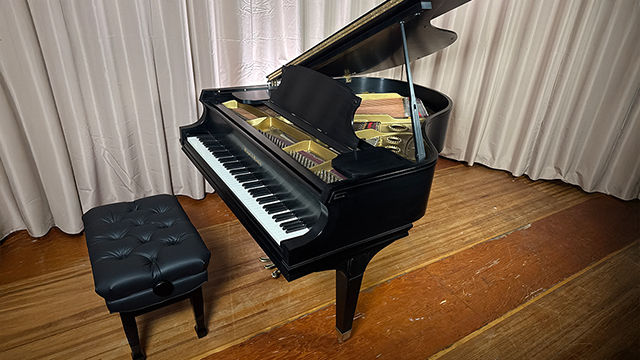
How to Project Your Piano Playing in a Hall

Welcome to LivingPianos.com. I’m Robert Estrin. The subject today is about how to project your piano playing in a hall. This isn’t just for when you’re playing in a concert hall. This is actually appropriate for anyone playing in any room. And it’s drastically different from what you might think! I’ll give you an analogy. Let’s say you go to a museum and look at some gorgeous paintings. You see a magnificent impressionist landscape painting from across the room by one of the great French impressionists. And as you get closer, you see the beauty, the colors and the wonderful imagery. But if you get close enough, at a certain point, you just see little jabs of paint all over the canvas. It doesn’t even look like an image anymore! It almost has a grotesque quality to it when you get too close. But when you back up, the beauty of the artwork is revealed.

When you are playing the piano, you are closer to that instrument than anyone who’s listening to you.

You get a skewed idea of the sound you’re creating, because you don’t hear what it sounds like for anybody else. Just like in the museum, being too close to a painting looks angular. If you want your playing to project, particularly in a hall or a church where there’s reverberation, you have to delineate things much more clearly than you ever would imagine. This goes for articulations, phrasings and dynamics. They all have to be exaggerated.

I’ve played in many orchestras as a French hornist. Sometimes a solo is written to be played piano. But a solo that’s written piano for horn, clarinet, oboe, or flute has a much bigger sound when you’re in the orchestra. Because to project even a quiet solo out into the hall requires a tremendous amount of energy. If you play the beginning of a slow movement of a Mozart Sonata in a lackluster fashion, without projecting, as if you just want to hear it for yourself, it may sound fine to you sitting right at the piano. But from even a short distance away someone listening to you probably won’t get a sense of the performance. It’s just out there somewhere and it doesn’t really draw you in. But if you play with much more intensity and articulate all the notes, and more importantly, the line and dynamic changes, then you’ll get something that may sound exaggerated for you. But for someone listening to you, it sounds more distinct. You have to put much more energy into the phrasing. There are bigger rises and falls of dynamics. The articulation, the slurs, and all the little markings are exaggerated and delineated so that it comes through throughout the room. This technique is not just for quiet music. It’s equally important in more heroic music.

This is a really important lesson about how to play for other people.

This is not just for playing in concert halls. Even in your own living room, for people across the room, the sound is dramatically different from sitting right in front of the piano. In order to project your ideas, your interpretation, your musicianship and your concept of the music, you must delineate and exaggerate! It may even have a slightly grotesque quality when you’re playing it, much like looking at an impressionist painting up close. This is because you’re really stretching everything so that it comes across, whether somebody is ten feet away or one hundred feet away. I hope this is a valuable lesson for you!

If you ever have the opportunity to go to a concert hall with a fellow pianist and play for one another, you could try this out for yourself! Or you could even take a recording device. Record it two different ways and see which one you like better! Thanks so much for joining me, Robert Estrin here at LivingPianos.com, Your Online Piano Resource.

For premium videos and exclusive content, you can join my Living Pianos Patreon channel! www.Patreon.com/RobertEstrin

Contact me if you are interested in private lessons. I have many resources for you! Robert@LivingPianos.com

www.LivingPianos.com
www.Facebook.com/LivingPianos
949-244-3729
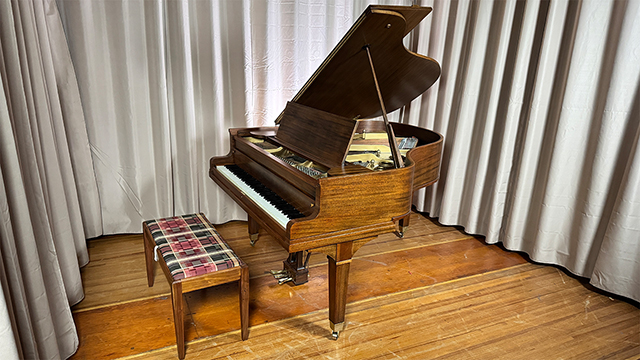
Why is Your Left Hand Bigger Than Your Right Hand?

Welcome to LivingPianos.com. I’m Robert Estrin. Is your left hand bigger than your right hand? This is a great question. My left hand is bigger than my right hand. I bet a lot of you pianists out there find the same thing. You might wonder why. I’m really interested in comments from all of you to see if this is true! I’ve talked to many pianists who have found that their left hands are slightly larger than their right hands. It has nothing to do with being right-handed or left-handed either.

My left hand has a bigger reach than my right hand.

I can barely play white key tenths around the front of the keys. That’s my maximum reach. I’m going to talk more later about how you can overcome small hands and why it doesn’t really matter. Some of the greatest pianists of all time had very small hands, even smaller than mine! I can just barely reach white key 10ths. I don’t really depend upon it. I rarely play tenths because it takes so much time for me to grab tiny slivers of keys. It’s not really very useful. On the right hand, if I try to do the same thing, I absolutely can’t do it at all. I just can’t reach tenths with my right hand. You will find that this is true for most pianists. So you might wonder why this is the case. It might have to do with how much you practice and play the piano. And of course, natural physiology enters into it. I’m sure this is not a hundred percent universal. The reason pianists’ left hands are usually a bit larger is that left-hand parts tend to be more outstretched than right-hand parts. The right-hand usually has the melody. The left hand has accompaniments involving all kinds of stretching. So, your left-hand ends up being ever so slightly bigger than your right hand, generally speaking.

What are some ways to overcome the limitations of small hands on the piano?

I promised you some tips about small hands. I have relatively small hands. I always wanted to play music beyond my reach. I will say this: if you don’t have a solid octave you’re going to have a hard time with a lot of repertoire. Fortunately, you don’t really need much of a reach for baroque music or even most classical period music. Octaves are somewhat prevalent, but the reaches in earlier period music are not nearly as great as later period music. So you still might be okay, at least in some repertoire, if you don’t have good solid octaves. If you want to be able to play bigger reaches than an octave, or you can’t quite reach an octave as well as you’d like, perhaps what you want to do is to break the chords. I’ve talked about this before. When you break chords very quickly on the pedal, it’s hard to tell that you aren’t reaching all the notes at once! So, if you want to play big chords that you can’t possibly reach, how can you play them? Using the pedal while breaking chords very quickly will create the illusion of playing big chords beyond your reach.

Can you stretch your hands to expand your reach?

When I was a kid, my father taught me a stretching technique he had heard about. It involved gently pushing your hands against the keyboard to get a little more reach. I didn’t find this technique to be at all helpful. What did help me enormously was developing more strength for rapidly breaking chords. Chords that were beyond my reach became accessible to me! And, you’re going to find the same thing. So don’t fret if you don’t have a big reach! If you develop strength in your playing, you can learn how to break chords successfully and it sounds great! In fact, a lot of pianists with large hands will choose to break chords because of the richness of the sound it creates. So, get your hands nice and strong and learn how to break chords quickly and you’ll be fine. Just from playing music that has bigger reaches you can develop a slightly larger reach. Since the left hand generally has bigger stretches than the right hand, you will tend to find your left hand reach will be a smidgen larger than your right hand.

Have you noticed this? I’d love to get a conversation started! Let me know in the comments how you feel about this! Thanks so much for joining me, Robert Estrin here at LivingPianos.com, Your Online Piano Resource.

For premium videos and exclusive content, you can join my Living Pianos Patreon channel! www.Patreon.com/RobertEstrin

Contact me if you are interested in private lessons. I have many resources for you! Robert@LivingPianos.com

www.LivingPianos.com
www.Facebook.com/LivingPianos
949-244-3729