



Piano and Music Videos

Can't find what you're looking for?

Welcome to our first in a multiple part series on how to approach the Chopin G Minor Ballade. This is an amazing piece of music that exemplifies the manic emotions of Frédéric Chopin swinging from points of incredibly low despair to the heights of ecstasy. Today we are going to discuss some of the middle section because there are a number of techniques that come one after another very quickly.

You are probably familiar with the big heroic middle section that restates the theme and ends with a flurry of octaves.

Let’s start on the descending diminished chord:
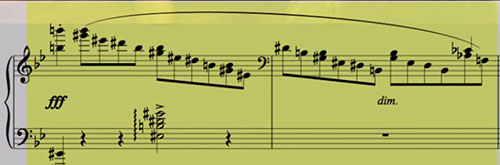
The best way to practice this section is to play it slowly and practice getting your fingers in the right place instantly. So, I suggest playing just a few notes at a time and stopping when the hand changes position. For example here:
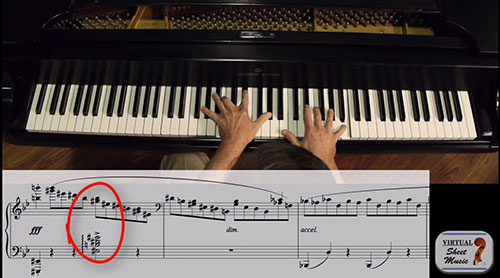
Play the first few notes and practice getting your hand in the right position above the chord, but don’t play it. Keep playing the passage over and over and stopping until you can get your hand in the right position over the chord in a relaxed manner. You will want to continue doing this for each subsequent group.
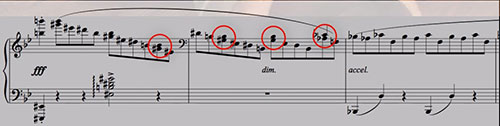
If you practice this way you learn to play this passage with much more fluidity and you’ll be ready for each subsequent hand position before you need to play. You need to be able to play each section with ease and this technique is a great way to achieve this.

The next section we are going to discuss will provide a great example of how to be over note groups, in this case, 2 note groups following the bottom notes going up the scale.
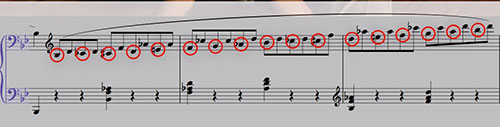
You can also practice these 2 notes groups in different rhythms. By practicing in two-note groups, it will force you to come up with a fingering that will accommodate the passage enabling a smooth execution of the passage. After playing this section in two-note groups and getting 100% comfortable with it, breaking it up as it’s written will be almost effortless.


In the next section you can use another technique:
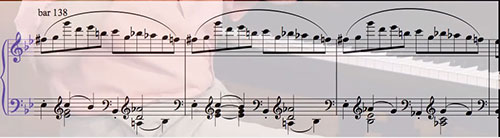


This section is difficult because you have two completely different techniques in each hand. In the right hand, you will want to play fast and light and in the left hand, you will want to delineate the phrasing clearly.


In the right hand, it’s best to practice with the metronome and gradually get your playing up to speed. Start at a slower tempo and continue to play the section until you are absolutely comfortable. When you feel confident in your playing, put the metronome up one notch and practice it again until you are absolutely comfortable. Keep doing this until you are able to play the passage up to speed without issues. As you get faster, concentrate on lightening up your fingers and keep them very close to the keys.


For the left hand, you will want to use a similar technique that we discussed in the first section of this lesson and that is getting your hands over the next set of notes instantly. Keep practicing and stopping before the next group of notes. Practice getting your hands and fingers in the correct position before you play the notes. Keep practicing over and over until your hands and fingers go to the correct notes almost instantly and effortlessly.


Combine the hands once you feel confident with each individually. Remember to keep your right-hand fingers very close to the keys. This section is very tricky because you have two different techniques in each hand. That is why practicing hands separately first is so effective in solving the technical issues.


Stay tuned because next time we will cover the next section of this piece and discuss a new set of techniques. Thanks again for joining me Robert Estrin Robert@LivingPianos.com (949) 244-3729

How to Play Chopin’s G minor Ballade – Part 1

Welcome to our first in a multiple part series on how to approach the Chopin G Minor Ballade. This is an amazing piece of music that exemplifies the manic emotions of Frédéric Chopin swinging from points of incredibly low despair to the heights of

Welcome to our ongoing series covering Bach’s French Suites. Last time we covered the Allemande section of the 5th French Suite in G major. Today we will be covering the 2nd movement, the Courante, which is a very difficult movement.

The biggest thing I recommend is playing the eighth notes staccato and the sixteenth notes legato. Not only does this add more energy to the piece but it actually allows you to play the notes a bit slower – when you play the staccato short it gives the impression of a faster tempo than what you are actually playing!

This is actually a trick I learned from listening to Vladimir Horowitz many years ago. He would play notes so cleanly and detached that it sounded faster than everyone else. If you put a metronome to his music though you would realize that this wasn’t always the case.

So why is this technique so effective. One of the reasons is because it brings out the difference between the lines. With the sixteenth notes being legato they are distinctly different from the staccato eighth notes.

The biggest thing to mastering this piece – like any other – is effective practice. When it comes to this piece in particular you will want to practice it very slowly. During your slow practice you will want to exaggerate the difference between legato and staccato; so when you speed up the piece the difference will still be there.

You should really go through the whole piece like this and have the patience to practice it with the metronome. You should gradually bring the piece up to speed but only after you can absolutely master it at a certain speed before increasing it. It’s important to play it cleanly and relaxed. Do not make the mistake of increasing the speed before you are ready.

When it comes to ornamentation I like to use it to enhance certain sections of the piece. In the fourth measure, there is an f sharp and I like to add a trill to it. You will notice if you listen that I always measure the trill; your trill must always be measured. While it might seem like free expression, you will always want it to fit properly within the music and the tempo and it must be measured.

Piano Lessons: How to Play Bach’s French Suites – Part 2

Welcome to our ongoing series covering Bach’s French Suites. Last time we covered the Allemande section of the 5th French Suite in G major. Today we will be covering the 2nd movement, the Courante, which is a very difficult movement. The biggest th

This question comes from a viewer and while this is a very specific example, the solution is something that will help you with a wide range of music. The problem with negotiating this example is that from measure 21 to measure 40, there are a lot of fast notes in the left hand that needs to be played quietly. This can be a huge challenge because it’s extremely difficult playing fast and light on the piano. So how do you overcome this challenge?

Utilizing the weight of the arms and the position of your fingers right above the keys is the way to play this section with fluidity. For this specific piece, there are a lot of broken chords in the left hand and I have a suggestion for you on how to practice this effectively. Start with the first two notes of the section and play them together. They are written separately but for now, play them together. You want to achieve the same level of volume with your pinky and your thumb. This is a great challenge because the thumb is so much stronger than your pinky, but you must achieve a balance in the sound between the two notes. Once you have them equal in volume go ahead and break those notes ever so slightly like playing the bottom note as a grace note. Once you feel comfortable with this, add another note and continue adding notes in this manner.

Every time you start a new group of notes you should approach it as a separate passage. Prepare yourself mentally for each section and practice each section individually. Don’t consider this one long passage of notes. Instead, break it down into digestible chunks you can play in a relaxed manner. Then work on connecting these groups of notes.

This lesson really boils down to keeping your body and arms at the proper position to achieve power with the correct hand positions and finger patterns. These are all lessons I’ve taught in the past that are relevant to so many pieces of music.

If you have any more questions please contact me directly: Robert@LivingPianos.com (949) 244-3729

Piano Lessons for the 3rd Movement of Beethoven’s Moonlight Sonata

This question comes from a viewer and while this is a very specific example, the solution is something that will help you with a wide range of music. The problem with negotiating this example is that from measure 21 to measure 40, there are a lot of

The soft pedal is something that every pianist must learn to utilize effectively. While it’s commonly referred to as the “soft pedal” its actual name is the una corda pedal. Today we are going to discuss when and how to use the soft pedal effectively in your music.

Una Corda actually translates to “one string”. On older pianos, there used to be two strings for each of the notes. By pressing the una corda pedal you would move the hammers over so they would only strike one of the strings. New pianos are a bit different as they have three strings for each note for most notes of the piano. So, when you press the soft pedal it will move the hammers over and they won’t strike the strings in the middle of the hammers, so it produces a mellower tone.

True una corda or soft-pedals only exist on grand pianos. An upright – even with a third pedal on the left – does not truly simulate the effect of an una corda pedal. You can see this because when you depress a true una corda pedal, the keys of the piano will shift slightly to the right. On upright pianos, the soft pedal does different things, but typically it brings the hammers closer to the strings changing the touch, not the tone.

In the video above I demonstrate the effect of the una corda pedal by playing the Chopin movement from Schumann’s Carnival. I provide an example with and without the una corda pedal. You will notice that not only is the music softer but the tone is a different color.

When used properly, the soft pedal is an extraordinarily expressive device that can add new color and depth to your music. So when do you use it?

In the example I play from the video, the same theme is played twice in a row. When I repeat the theme and use the soft pedal it creates a new and different sound. It’s a really beautiful way to highlight certain sections of your music.

But using the soft pedal really is not that simple. While the example above is a good spot to utilize the soft pedal, its effect won’t be the same on every piano. This is because not all soft-pedals are the same. Every piano will have a different response when using the soft pedal. Some pianos might not produce much of an effect at all while others will produce a very dramatic change in tone. It’s very important to get to know the effects of your soft pedal whether you are playing your piano at home or performing on another piano. Room acoustics, audience noise, and many other factors can determine whether or not the soft pedal is appropriate. Many times I have performed on pianos that were a bit too bright and border on having a harsh tone. When faced with this problem I might use the soft pedal a great deal to sweeten the tone and produce a better sound out of the instrument. Sometimes you might encounter a piano that is too mellow and you might want to use the soft pedal very sparingly.

It’s important to remember that the soft pedal is not something you can simply write into your music and play at the same point on every piano. This pedal is something you should employ at times when a tonal change is suitable. As you grow and progress as a pianist you will find yourself using the soft pedal when it’s appropriate and being able to make these judgment calls for yourself.

Thanks again for joining me Robert Estrin Robert@LivingPianos.com (949) 244-3729

When to Use the Soft Pedal on the Piano

The soft pedal is something that every pianist must learn to utilize effectively. While it’s commonly referred to as the “soft pedal” its actual name is the una corda pedal. Today we are going to discuss when and how to use the soft pedal effec

You’ve probably seen this in a lot of Chopin and Liszt compositions. Instead of having measured notes, there are a ton of very tiny notes that on the surface might not make much sense at first. You’ll have ridiculous combinations like 11 notes against 6 – which simply can’t be divisible in any precise way. So how do you play these passages and what do they mean?

In the video example above I use the beginning of the B-flat minor Nocturne of Chopin. Right at the start of the piece (the second statement of the theme) has a section just like I’ve described above. There are a whole bunch of notes (11 against 6) that are not divisible. So how do you play these passages?

The best way to practice these sections is to try to find the closest measured way you can play it. The first thing you should do is divide it out as close as it mathematically can work. If you play it as measured as possible – trying to find places where you can put in the extra notes – you will start to get a better feel for the passage. You might notice that playing these passages measured will result in a passable sound but it’s not exactly accurate and it may not sound very fluid. When played correctly, these unmeasured cadenzas are almost like improvisations and that’s the feel and sound you want to achieve.

The next step after you’ve broken these passages into a measured approach is to loosen it up a bit. Get used to playing these cadenzas measured and from there you can start to break them up and make the sound a bit more fluid. The final product doesn’t have to be mathematically perfect; the goal is to create a musical feel. The left hand should maintain the pulse and the right hand should be able to play with freedom – like an improvisation. Keep working on this until you get a result that sounds natural.

If you have any more questions about this topic or any topic at all, please contact me directly. Thanks again for joining me Robert Estrin Robert@LivingPianos.com (949) 244-3729.

How to Play Unmeasured Cadenzas on The Piano (Chopin, Liszt)

You’ve probably seen this in a lot of Chopin and Liszt compositions. Instead of having measured notes, there are a ton of very tiny notes that on the surface might not make much sense at first. You’ll have ridiculous combinations like 11 notes ag

Welcome back to the third part in our series on The Art of Pedaling on the Piano. In our first lessons we discussed the essential techniques of pedaling and in our second lessons we talked about using the pedal to color your music. This week we will be discussing specialty uses of the pedal.

For our video example we used a selection in the 1st movement of the Pathetique Sonata of Beethoven. The movement starts off with forte pianos for certain chords. I’ve seen pianists approach these chords in a number of different ways. One I recommend is to push the pedal down before you play the notes – creating a booming sound before you let go of the pedal and let the chord sound forte. Another technique involves quickly letting go of the pedal on the point of attack and then quickly putting it back down. Either one of these techniques will work just fine but you don’t have to limit yourself to only these two.

You can feel free to experiment with your pedaling in situations like this to see what type of sounds you can create. If you listen to a number of different artist recordings of the same piece you will notice striking differences between them. Each pianist has their own unique style and take on their music; as you should have one of your own. Keep experimenting and having fun with your music.

Thanks again, I’m Robert Estrin Robert@LivingPianos.com (949) 244-3729

The Art of Pedaling Part 3 – Special Uses for the Pedal

Welcome back to the third part in our series on The Art of Pedaling on the Piano. In our first lessons we discussed the essential techniques of pedaling and in our second lessons we talked about using the pedal to color your music. This week we will