


Tag Archives: online piano store

How to Get Good Tone on the Piano

This is Robert Estrin from LivingPianos.com, Your Online Piano Store with a great subject today: The fundamental importance of arm weight for producing a good tone on the piano. You might wonder what I’m talking about. Before I get into that, let’s discuss the piano as a unique musical instrument.

What was the first musical instrument ever?

The first musical instrument was obviously the human voice! Every other instrument imitates the human voice to one extent or another. Wind instruments, for example, have a clear connection with breath, flow of the phrase, natural progression from note to note, and the smoothness of the line. This is intrinsic not just to vocal performance, but also all wind instruments. String instruments have the bow to create the sense of line like the breath in singing.

What is the analog for the breath on the piano?

You might think, since phrases naturally ebb and flow like ocean waves, that you can simply calculate playing each note louder and louder towards the middle of the phrase, then gradually softer and softer towards the end of the phrase. However, if you try that, you’ll end up with a calculated performance. No surprise there! The secret of creating a smooth line at the piano is, gradually increasing and decreasing arm weight by transferring smoothly from note to note, growing toward the middle of the phrase, and diminishing toward the end of the phrase.

You can try it for yourself!

Play a phrase once while calculating each note getting progressively louder, then progressively softer. Then try playing the same phrase but using the continuous arm weight that ebbs and flows. You’ll find that no matter how much you try to craft the line based upon your musical inclinations, the first version will sound calculated. That is, after all, exactly what you are doing! When you play the phrase again, remember to use the concept of the breath by utilizing the natural weight of your arm. Instead of pushing down more, just support the weight of your arm with your fingers. Lean into it the keys even after initially playing them. Lean more toward the middle of the phrase and less toward the end. You’ll find that this creates a completely different sound. There is something engaging about imposing upon a phrase the idea of the breath and letting the notes flow naturally with that overarching concept. It creates a singing line that belies the reality of the percussive nature of the piano.

I’m interested in your impressions of how this works for you. If any of you have different ways of achieving the same sound, I’d love to hear from you! Once again, this is Robert Estrin here at LivingPianos.com, Your Online Piano Store.

info@LivingPianos.com
949-244-3729

What is the Farthest a Piano has been Moved?

Robert Estrin here at LivingPianos.com, Your Online Piano Store, with a really interesting question. What is the farthest a piano has ever been moved? Here at Living Pianos, we move pianos all the time. So, this question is very close to my heart.

Going across the country is around 3,000 miles from Maine to California. When you go overseas, of course, it is a much greater distance. We had the opportunity to sell a concert grand to the Royal Theater in London. That is almost five and a half thousand miles away! Interestingly, that move was a piece of cake until the last couple of miles. When you get to the inner city of London, it actually cost more for the last couple of miles than the entire rest of the move including crating the piano! This is their way of limiting traffic in the city.

How Far Have We Delivered Pianos?

We also have had opportunities to sell pianos to China. Shenzen is about 7,200 miles away. So, that is certainly far away. We’ve never moved a piano to Australia – at least not yet. If we have the opportunity, it will be over 8,100 miles away. Is that the farthest a piano can be moved? You’d think it would be since it is on the other side of the planet. Actually, no!

We’ve sold pianos to Singapore which is about 8,800 miles away.

That is the farthest we have moved pianos. But what is the theoretical limit a piano could be possibly be moved? Unless you are just taking a piano for a ride around and around the world, which could be endless, half-way around the world at the equator is the greatest distance at about 12,500 miles. So, that is the theoretical limit. Or is it? Did you know:

There is a piano on the International Space Station!

It is actually a digital keyboard. But, it is a piano nonetheless. For the sake of discussion, let’s talk about that. Once again, orbiting the Earth again and again could be many thousands of miles. But you would be just taking a piano for a ride and not actually moving it from point A to point B. The International Space Station is only about 300 miles away, straight up at the point at which it passes over you. So, the final answer is, if you are going halfway around the world at the equator, that would be the farthest you could move a piano which is 12,500 miles.

It’s interesting to wrap your head around what it takes to move pianos and how far they possibly can go. I hope this has been fun for you. Keep those questions coming in and you’ll see them in future articles and videos! Thanks again, Robert Estrin here at LivingPianos.com, Your Online Piano Store.

info@LivingPianos.com
949-244-3729
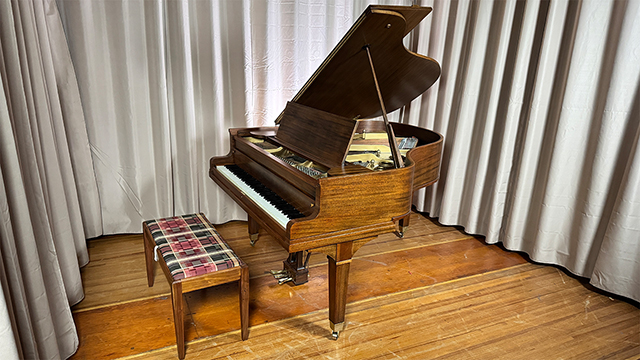
What is a Tone Poem?

What is a Tone Poem?

Tone poems are programmatic pieces which are based upon stories.

They are typically large orchestral works, sometimes approaching an hour or more in length. Richard Strauss, Ein Heldenleben (A Hero’s Life) is one such epic work for symphony orchestra. Richard Wagner also composed tone poems as did Debussy. However, it was actually Franz Liszt who first developed the tone poem earlier in the 19th century even though he is known mostly as the quintessential virtuoso pianist and composer of brilliant piano works.

Since early childhood, throughout conservatory and beyond, I played both piano and French horn.

So, I have always been enamored with tone poems. The great tone poems of the late Romantic era are in my blood! I hope you enjoy the tone poem I have created for you. info@LivingPianos.com 949-244-3729

The Power of Interlocking Phrases

THE POWER OF INTERLOCKING PHRASES

This is Robert Estrin at LivingPianos.com, Your Online Piano Store with a fantastic tip for your memorization, which is the power of interlocking phrases.

Now, what am I talking about here? Well, if you’ve spent time memorizing music, you know that the most efficient way to do it is to take a small section at a time, because after all, there’s a limit to how much you can learn at once. What can really help you is by watching this video and reading the article on how to memorize:

HOW TO PRACTICE THE PIANO PART 1 – MEMORIZING MUSIC

You take each hand separately a small section at a time, mastering each hand and then putting them together and getting that memorized.

But How Do You Get the Phrases Together?

You learn this section, that section, and you’re going to have a whole bunch of random phrases. That’s where the interlocking phrases come in. For example, in the above video, if you are learning a Mozart sonata like the K545, the famous C-major sonata of Mozart, you start with the first phrase to learn. But instead of doing that, go one note further as demonstrated in the accompanying video. That extra note is where you start learning your next phrase. That way, after you learn the first phrase and get that solid, you have a common note between the two phrases. When you finally get the second phrase learned, you go back to the beginning, and you’ll be able to be on the first note of the second phrase.

Interlocking Phrases Is So Helpful!

Beyond that, when you get into more advanced stages of learning your music, you might find that you have all the phrases learned but you can’t get through everything in a fluid manner. Then you can try interlocking at different points. For example, you do the first four measures, and then you try the second measure to the sixth measure. Then you practice off-setting the points at which the phrases connect because one of the biggest challenges with memorizing music is getting everything smoothly put together.

So, that is the power of interlocking phrases in learning music. I hope this tip if helpful for you. Again, I’m Robert Estrin here at LivingPianos.com, Your Online Piano Store. If you haven’t already subscribed to my YouTube channel, go for it, because you’ll get all the fresh videos. Thanks for joining me. Robert@LivingPianos.com 949-244-3729