

Tag Archives: piano lessons

Why Do They Write E Sharps and C Flats?


This is a really interesting question. Sometimes you will see E sharps or C flats written in music and you might wonder why they just don’t write F or B instead – after all, an E sharp is an F and a C flat is a B on a piano. So why add this level of complexity?


Let’s start by exploring the foundations of Western Music. For most of us the music we are familiar with is founded upon the principles in Western Music. Everything from Rock to Pop to Symphonies utilizes the same aspects of being built upon scales.


What are scales exactly? Musical Scales are a series of whole steps and half steps that have all the notes (letter names) in order. For example, here is a C major scale:


When you see these string of notes together you should recognize that they are Diatonic, which means they are all built on the interval of a second. In other words, one letter to the next letter, line to space, space to line consecutively.


For more information on scales we have a series of in-depth videos on this topic:


What is a Major Scale?


How Many Musical Scales Are There?


What is a Relative Minor Scale?


What is a Chromatic Scale?


What are Pentatonic Scales?


What are Whole Tone Scales?


So let’s get back to the topic at hand. Why is it a good idea to sometimes have E sharp instead of F or C flat instead of B written in your music?


Let’s say for example you had a piece in C-sharp major:


As you can see, it has all the same letters as a C major scale and we happen to have an E# in there as well instead of F. It would look pretty weird on paper if the notes were C# D# F F# G# A# B# C# wouldn’t it? In cases like the one above it is much easier to decipher the notes if they are written diatonically.


Let’s examine this same topic when it comes to chords. Chords are built on the interval of 3rds (for more information you can see our video: What is a Chord?). To put it in simple terms, chords are built upon the interval of a 3rd which are two letters apart – all lines or all spaces. So for example, here is a C major chord:


So if you had a C# major chord it would look like this:


And the same principle applies as the one above. It’s much easier to comprehend the chord written with an E# rather than an F. It makes more sense and is more digestible on the page. It is instantly recognizable as a chord.


Hopefully this clarifies the concept of why E sharps and C flats are (and other accidentals which are white keys) are easier to read than their enharmonic equivalent spellings.


Thanks again for joining us here at Living Pianos, if you have any questions or comments please feel free to contact us directly: info@LivingPianos.com or (949) 244-3729.

How to Practice the Piano Part 1 – Memorizing Music

How To Practice the Piano

3 Part Series

There are 3 separate skills in learning to play the piano:

• Memorizing

• Sight Reading

• Improvising

You can become quite proficient in one or two of these skills and be completely deficient in others. It is necessary to take a unique approach to develop each of these skills. The biggest mistake you can make is to not be clear as to which skill you are working on!

5 Steps To Memorizing Music

Sight-read through the piece once or twice. (First Day Only)

Begin To Practice: TAKE A SMALL SECTION AT A TIME.

A. Right Hand Alone Figure out:

1. Notes

2. Rhythm-Count out loud

3. Fingering

4. Phrasing

5. Expression

Play many times until memorized.

B. Left Hand Alone Figure out:

1. Notes

2. Rhythm-Count out loud

3. Fingering

4. Phrasing

5. Expression

Play many times until memorized.

C. Hands Together Slowly at First:

Play many times until memorized.

D. Go on to the next small section and learn it the same way.

E. As each section is mastered, connect from the beginning

How to Play Chopin’s G minor Ballade – Part 1

Welcome to our first in a multiple part series on how to approach the Chopin G Minor Ballade. This is an amazing piece of music that exemplifies the manic emotions of Frédéric Chopin swinging from points of incredibly low despair to the heights of ecstasy. Today we are going to discuss some of the middle section because there are a number of techniques that come one after another very quickly.

You are probably familiar with the big heroic middle section that restates the theme and ends with a flurry of octaves.

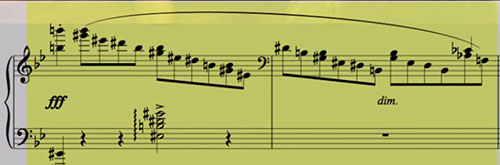
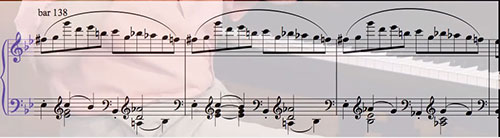
Let’s start on the descending diminished chord:

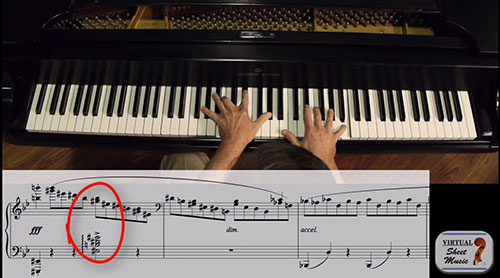
The best way to practice this section is to play it slowly and practice getting your fingers in the right place instantly. So, I suggest playing just a few notes at a time and stopping when the hand changes position. For example here:

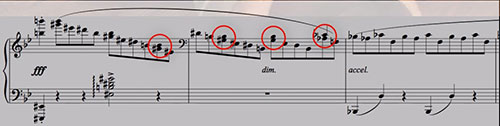
Play the first few notes and practice getting your hand in the right position above the chord, but don’t play it. Keep playing the passage over and over and stopping until you can get your hand in the right position over the chord in a relaxed manner. You will want to continue doing this for each subsequent group.

If you practice this way you learn to play this passage with much more fluidity and you’ll be ready for each subsequent hand position before you need to play. You need to be able to play each section with ease and this technique is a great way to achieve this.

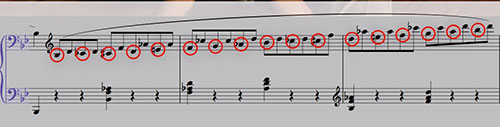
The next section we are going to discuss will provide a great example of how to be over note groups, in this case, 2 note groups following the bottom notes going up the scale.

You can also practice these 2 notes groups in different rhythms. By practicing in two-note groups, it will force you to come up with a fingering that will accommodate the passage enabling a smooth execution of the passage. After playing this section in two-note groups and getting 100% comfortable with it, breaking it up as it’s written will be almost effortless.


In the next section you can use another technique:


This section is difficult because you have two completely different techniques in each hand. In the right hand, you will want to play fast and light and in the left hand, you will want to delineate the phrasing clearly.


In the right hand, it’s best to practice with the metronome and gradually get your playing up to speed. Start at a slower tempo and continue to play the section until you are absolutely comfortable. When you feel confident in your playing, put the metronome up one notch and practice it again until you are absolutely comfortable. Keep doing this until you are able to play the passage up to speed without issues. As you get faster, concentrate on lightening up your fingers and keep them very close to the keys.


For the left hand, you will want to use a similar technique that we discussed in the first section of this lesson and that is getting your hands over the next set of notes instantly. Keep practicing and stopping before the next group of notes. Practice getting your hands and fingers in the correct position before you play the notes. Keep practicing over and over until your hands and fingers go to the correct notes almost instantly and effortlessly.


Combine the hands once you feel confident with each individually. Remember to keep your right-hand fingers very close to the keys. This section is very tricky because you have two different techniques in each hand. That is why practicing hands separately first is so effective in solving the technical issues.


Stay tuned because next time we will cover the next section of this piece and discuss a new set of techniques. Thanks again for joining me Robert Estrin Robert@LivingPianos.com (949) 244-3729

What is Atonality? Atonality Part 1

You have undoubtedly heard atonality in spooky movies and other places where notes clash and you hear strange dissonances. Unlike most melodic music which you can sing along, atonal music can be much more challenging to comprehend.

Western music is based upon major and minor scales that form tonal music which is relatively easy to comprehend. Atonal music is based upon tone rows, where all twelve chromatic notes available are arranged in a random pattern, and the entire piece is built upon that.

If you explore this, you will discover all sorts of unusual sounds and clashing harmonies. We will go into more depth on atonality in future videos and I certainly welcome your comments and suggestions on this subject.

Thanks again for joining me Robert Estrin Robert@LivingPianos.com

How to Use the Pedal in Debussy’s “The Little Shepherd”

Debussy’s “The Little Shepherd” from his Children’s Corner Suite is one of my favorite pieces. It is simple but very poetic. This question comes from a viewer who wants to know the best way to use the pedal in this piece.

The challenge of the piano is that it doesn’t have the expressiveness on a single note that other instruments have. Or does it? Achieving expressiveness on single notes on the piano is certainly possible if you use the pedals correctly. In this article I’m going to share some secrets on how to achieve this.

The way that a pedal effects the note all depends on when you depress it.

If you depress the pedal before you play the note you will get an echoey sound with a boominess after the initial attack.

If you are striving for a more sustained tone you will want to depress the pedal after the initial attack. This will create a more linear sound which is rounder than pedaling before playing the note as described above.

You can complement this effect with the use of the una corda pedal (soft pedal) which offers a more sustained sound since only 2 of 3 strings are initially hit directly making the attach quieter.

The effects really are subtle and might be hard to hear over your computer unless you have good speakers or headphones. But it truly makes the difference in bringing expressiveness to the music. Try these techniques on your piano and let us know the differences you notice.

Thanks again for joining me Robert Estrin Robert@LivingPianos.com (949) 244-3729

3 Reasons You Should Use a Metronome When You Practice Music

The metronome is much maligned by many musicians for its incessant ticking which can be like a form of Chinese water torture! Many teachers are insistent upon using the metronome and students have questioned whether or not they need this ticking box.

The metronome really is one of the two most important tools at your disposal (the other being an audio recorder) and you should be practicing with it regularly – whatever your skill level. Today we are going to discuss three reasons why the metronome is so important as well as some great applications on how to use it.

The first reason why you need the metronome is that nobody has a perfect clock in their brain. When you start to learn a piece of music and you encounter tough sections, you will naturally slow down a bit to compensate for the difficulty. You might think that once you work them out and get things up to speed, there should be no problem. But you may overcompensate and actually play these sections even faster! The only way to be sure is to play with the metronome.

Don’t make the mistake my mother used to make by putting the metronome too fast and trying to keep up with it. She would drive herself crazy with frustration trying to match an impossibly fast speed of the metronome. Find a speed you are comfortable with and work your way up to an appropriate tempo.

The second reason you want to use a metronome is that it provides an essential practice tool for difficult sections of music. Start by playing at a slow speed accurately with comfort. Then, incrementally increase the speed notch by notch gaining confidence at each new tempo until you get the passage mastered up to tempo. This is an indispensable tool for developing a refined technique on your instrument.

The key is to use this technique by zeroing in on specific sections of your music – not the whole piece. It will not take as much time as you think and you will master tough sections of your music much more quickly.

The third reason you want to use a metronome is because it will help you improve as a musician. The pulse is one of the most important aspects of music and developing a consistent beat will make you a better musician. This aids in playing with other musicians with a tight ensemble.

These are three great reasons to use the metronome and I’m sure many of you have more suggestions as well. Please leave us some comments or email me directly Robert@LivingPianos.com