

All posts by Robert Estrin

When Was the Golden Era of Pianos?

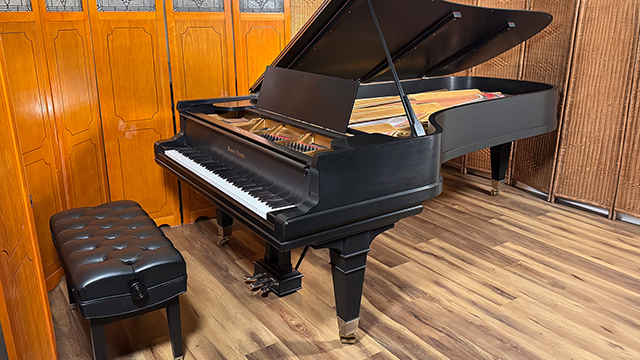
Today we are going to discuss what and when was the Golden Era of pianos. You may have heard this term before and it may not be a precise time, but most people agree it was before World War II and even before the Great Depression. By the late 1920s, piano sales in the United States suddenly dropped by 80-90%.

Advent of the Player Piano

You have to go back a bit to gain perspective. The piano developed hundreds of years ago. But the player piano came about in the early 20th century. (It even had its foray in the late 19th century!) They became as common in American homes as televisions did later on. Before the phonograph or radio, the piano was the primary way you could have music in your home. Many people played the piano as a means of entertainment because there was nothing else available. The player piano changed this because it allowed people who didn’t play, to have music in their homes. If you’ve ever looked at player piano rolls, they sometimes have the words of the songs on the side of the roll so you could sing along with the music. Some more sophisticated player pianos had levers that would allow you to transpose the key. You could also adjust the tempo and volume of the instrument. There were even buttons that could adjust the dynamic range of the bass and treble sections of the piano making for an interactive playing experience.

The Expressive Player Piano

The intent of the reproducing piano was to play back an almost exact replica of a performance by a particular pianist from the classics played by Rubinstein and Horowitz, to composers such as Gershwin and Rachmaninoff. These pianos were very sophisticated for their time and still are today. They didn’t just play mechanically like standard player pianos, but would reproduce the dynamic expression of the pianos through the player system. There were people who learned to play the piano by watching the keys move; so you can get a grasp as to why they were so popular.

The Demise of the Piano Industry in the United States

You may have guessed already what killed the piano and player piano industry. Technologies were a big part of it because when radio came in, it was much less expensive than acquiring a piano and took up less room. The great depression finally hit and the U.S. went from hundreds of companies making pianos, to a small handful with many piano companies filing for bankruptcy. There were large corporations like Aeolian that bought many of the troubled piano companies. But it was never the same after that and the piano industry has never recovered to what it was in the Golden Era of pianos.

This is Robert Estrin at LivingPianos.com Your Online Piano Store! 949-244-3729 Info@LivingPianos.com

The Lost Art of Classical Improvisation

So many of the great composers of all time from Mozart to Chopin dazzled audiences with improvised music. Because of the reverence for the legacy of scores the great composers left us, it creates the incorrect impression that everything they did was written down. It’s actually quite the contrary!

Most of the music of the great composers was played spontaneously!

We only have the written scores they thankfully took the time to write out since audio recording hadn’t been developed yet. We can only imagine what masterpieces came out on the spot from the great composers and pianists of the past!

Naturally these informal performances planted seeds for works they would craft later on. Imagine being in a salon hearing Liszt take off with flights of fancy with no predetermined musical destination!

Today, jazz artists carry on improvised music improvised music.

While most jazz is based upon previously composed music, there are some artists who delve into freeform improvisation which can be quite fascinating.

I have always enjoyed making up music spontaneously. What’s funny is that going in, often times I have no predetermined game plan whatsoever as in the accompanying video. The sound of the piano as well as my deep, inner mood (which I may be unaware of at the time!) guides the music.

It’s a little bit like being naked – being open to revealing the most intimate feelings with disregard for what they may be.

The challenge is to not judge what is being played – keeping the expression honest. Every piano inspires different music. Each day brings fresh melodies. I hope you enjoy these videos. Robert@LivingPianos.com 949-244-3729

Why Class Piano Doesn’t Work

Today we’re going to explore a potentially controversial subject which is the shortcomings of class piano. First, there is some value to class piano which should be acknowledged. It’s a way to get people acquainted with the piano which can motivate people to undertake more serious study.

What else is good about class piano?

You get camaraderie with other people which mitigates the isolation of piano studies. There is an aspect of enjoyment to a class setting. One excellent possibility for class piano involving intermediate or advanced students is exploring collaborative 4-hand and 2-piano music. There is also the potential of delving into improvisation becoming comfortable with a wide range of piano styles.

However, class piano provides a poor substitute for private instruction for formative study.

Here is what I discovered years ago when I was engaged to develop a class piano program for an arts school. While I would begin each class with subjects of relevancy for all students, it would devolve into giving a bunch of mini private lessons. You may wonder why this is the case. The reason is very simple.

Piano involves so many independent skills where everybody has unique strengths and weaknesses to such a drastic extent that individual attention is essential in piano studies.

Each piano lesson one to the next, is a completely different experience. Other fields of study can be taught successfully in a class setting. For example, a biology teacher can develop a lesson plan which is refined over the years. The subject can be taught essentially the same way to different classes year after year.

Learning the piano doesn’t work this way.

For example, there are some people who easily pick up note reading while others slave over trying to recognize notes for weeks or months in order to become fluent at note reading. Rhythm requires other skills that vary from student to student. I’ve seen people struggle with clapping even the simplest rhythms. There is also the coordination of the two hands. Combining the hands is one of the most difficult aspects of playing the piano which comes more naturally to some students than others.

Memorizing music is also as skill that varies tremendously from student to student. While everyone can learn to read music as long as it is taught in a systematic way, teaching in a class setting can reduce the progression of studies to the lowest common denominator avoiding leaving people behind yet impeding the progress of other students.

So it’s not that class piano can’t work at all, but it’s not an efficient way of learning the piano.

Class piano can be fun and can provide a way to get your feet wet with the piano, but ultimately having private instruction provides an invaluable resource in order to maximize the progress of your piano studies. Ideally, you have the combination of private instruction and master classes where the you get together with fellow students on a periodic basis playing for each other, discussing theory and analysis of your music, as well as possibly playing piano duets and improvising. Combining classes with private instruction offers the benefits of both. I would love to hear your comments and experiences. Thanks for joining me, Robert Estrin here at LivingPianos.com. Please feel free to contact us at info@LivingPianos.com 949-244-3729

Anyone Can Improvise on the Piano

This is another freeform improvisation in which I let this gorgeous Steinway concert grand guide the exploration of tonal colors. It turned out to be based on the pentatonic scale which is a fancy way of saying, “black keys”. You can learn more about pentatonic scales here.

You can explore the sound of a piano by playing the keys like a percussion instrument creating abstract sounds if you haven’t developed any kind of harmonic language yet. This is how I started my exploration into improvisation as a young child. Over time, you will find chords and patterns you can utilize in future improvisations making them less abstract. That’s how my improvisations have evolved over the years. However, I still love to play atonal improvisations!

How Fast Can a Piano Play?

In this video, I’m going to demonstrate why every pianist will eventually outgrow any upright piano. If you are serious about playing the piano, you will eventually need a grand piano or at least a baby grand. How can this be?

There are many differences between upright and grand pianos but there is one issue that limits upright pianos;

Speed of Repetition

In the video provided with this article, I play a selection of a Scarlatti Sonata that requires fast repetition on both a Yamaha U3 – a 52” tall upright piano – and a Steinway concert grand. You will see how the repetition capable on the upright is not nearly as fast as what is possible on a fine grand piano. You might be wondering,

What if you can’t play that fast anyway?

Does repetition really matter? Here’s a fun exercise for you to try. If you have an upright piano in your home, try playing the same chord twice in quick succession. You will notice that no matter how much force you apply to the keys, the second chord will never have the same amount of energy as the first one played.

The second chord will be quieter than the first chord on an upright piano.

It doesn’t matter how high the build quality is of the upright. It’s a case of physics. The vertical action on upright pianos have hammers which travel sideways rather than up and down as in grand piano actions,

Upright action design doesn’t take advantage of gravity the way grand piano actions do in allowing hammers to fall back into place as quickly.

Let’s take a look at a grand piano action:

As you can see, actions on grand pianos are laid out horizontally. The hammers fall down vertically when the keys are depressed. This design allows the hammers to fall back to their original position much quicker than any upright piano could ever allow. This is why, no matter how hard you try:

Upright pianos can never have the same speed of repetition as grand pianos.

Thanks for joining me, I hope this has been helpful for you. Please let me know if you have any suggestions for future topics or any questions about this one! Robert Estrin Info@LivingPianos.com (949) 244-3729.

Why Don’t They Make More Pianos in the USA?

Why can’t more pianos be made in the United States? At first, you may think it’s because they are too expensive. Of course, Steinway, Mason & Hamlin and Charles Walter are top-tier pianos with premium prices. But couldn’t a mid-range piano be made in the United States which doesn’t have such a high price? You’d think that would be possible. Charles Walter may be the closest thing to that at this point, but with incredibly limited production. There are some simple answers as to why more pianos cannot be made in the United States at a lower cost.

To give you a parallel, I’m going to bring up Tesla. Tesla is in the news all the time because they’re trying to change the whole model of the automobile industry with electric cars and newer technologies. It’s been a huge challenge for the company and it’s kind of like a catch-22 because companies like General Motors and Toyota have a scale of production that enables them to offer each car at a much lower price instead of having to spend seventy or a hundred thousand dollars to get a Tesla. As great as they are, few people can afford that price point. Of course, Elon Musk has been working hard ramping up production so he can get a $35,000 car out there. He’s facing the challenge of the scale of production.

It’s exactly the same problem when it comes to starting a piano company in the United States and enabling a mid-range price point. That’s a huge stumbling block right there. The second part of this equation is, unless you created an export company; it’s tough in the United States where piano sales went from over 90,000 new pianos sold a little over ten years ago to a little over 30,000 in 2016. So, exporting could really help sales. Yet, there are a lot of hurdles to overcome with that these days. If you’re a new company, how do you get the brand recognition to do that? There are a lot of challenges and I applaud anyone who gives it a go because the piano industry could benefit from innovation. People like Elon Musk prove that if you do things in a new way, there’s a possibility that you can grow market share. So, perhaps there is a way for a new piano company to produce pianos in the United States utilizing innovative technologies and business strategies. Hope you have enjoyed this. You can contact us anytime at info@LivingPianos.com 949-244-3729.